



Prototype Parade No. 77 | Model Maker October 1956 | Drawn & Described by Richard Collett
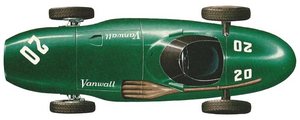
Vanwall 1956
ALTHOUGH Britain has produced a number of very successful racing drivers, she has not, until recent years, produced an equally successful racing car capable of carrying these drivers to all British victories in any Grand Prix, despite the numerous attempts which have been made at intervals to do this.

Probably the best known pre-war British racing car was the E.R.A., and the excellence of its design is testified by the large number which still run magnificently in club meetings up and down the country. Unfortunately, even this sturdy little car was incapable of effectively challenging the might of the State-backed German and Italian companies.
Since the war further efforts have been made to produce a British Grand Prix car, and during the last few months three types, Connaught, Vanwall and B.R.M. have shown considerable promise. One of these, the Vanwall, subject of this article, gave a great display at the Daily Express International Trophy Meeting at Silverstone in May, when in the hands of Stirling Moss it won the Formula One event at an average speed greater than the original lap record, and also equalled fourteen times the new lap record set up earlier in the race by the B.R.M. of Mike Hawthorn.

The Vanwall is the "brain child" of A. G. Vandervell, Head of the firm of that name, which produces the majority of the thin-wall bearings used by European motor manufac-turers. Mr. Vandervell entered motor racing after the war with a 41 litre V-12 Ferrari, which had been "breathed upon" by his staff and was therefore known as the Thinwall Special. This was probably the most potent privately owned Ferrari and at one time held both the Silverstone and Goodwood lap records. 1954 saw the introduction of the present Formula One which called for cars with supercharged engines of up to 750 c.c. capacity or normally aspirated engines of up to 22 litres, and consequently of a new Vandervell car, this time of completely British origin. The new car had a 2&rac12; litre engine fitted with fuel injection and the name was shortened to Vanwall Special. The most unusual feature of the car was the external radiator which was mounted on the curved nose. This model was replaced in 1955 by one with a normal internal radiator fed by an air intake in the nose and the name was again shortened, this time to Vanwall.

For 1956, further alterations were made; the new chassis which had been designed in co-operation with Colin Chapman, whose firm produces the Lotus sports cars, was fitted with an equally new, very smooth and high-tailed body, with a distinctive shape which makes it easily recognisable on the track. The driver is fully enclosed in the cockpit and protected by a deep, well-raked windscreen. The cars are all painted British Racing. Green while the black racing number is painted on white discs on the nose and both sides of the tail.
The engine, like those of most contemporary Grand Prix cars, is of conventional design with twin overhead camshafts and four cylinders. Since its inception the Vanwall has been fitted with fuel injection, which in this case is effected by pumping the fuel at high pressure into the bodies of four Amal carburetters with a Bosch fuel pump; this system is similar to that used by Maserati on their new models, but differs from the Mercedes-Benz method where fuel is injected directly into the cylinders. The suspension is equally conventional, unequal length wishbones and coil springs being used at the front and stiffened with an anti-roll bar; whilst at the rear a de Dion rear axle is used with a high-level transverse leaf spring. Hydraulic dampers are used on all springs. All four wire-spoked wheels are fitted with disc brakes; those at the rear being mounted inboard whilst those at the front are drilled radially; in both cases the unsprung weight is thereby reduced.
The principal dimensions are: Length, 13 ft. 8 in.; Width, 4 ft. 1 lin.; Height (to top of wind-screen), 3 ft. 7 in.; Track front, 4 ft. 54 in.; rear, 4 ft. 34 in.; Wheel base, 7 ft. 64 in.
Despite its apparently orthodox design the new Vanwall appears to have the potentialities of a world beater, and it was proclaimed as such after its sensational debut at the previously mentioned Trophy Meeting, especially in view of the retirement of both Lancia Ferraris. Sad to say the position was reversed at the British Grand Prix on July 14th which was won by the Ferraris, all three Vanwalls retiring with mechanical troubles of various sorts. If it is possible to build increased reliability into these cars, we may yet see an end-of-season sensation, or failing that, at least we can look forward to some fierce battles for World Championship in 1957, after the various Marques have spent the winter in preparation and redevelopment. It seems probable that Moss, who has always expressed a desire to race a British Grand Prix car, will be persuaded by his experience of these cars to sign a contract to drive Vanwalls in 1957, thus providing an apparently invincible combination and a worthy complement to our sports racing achievements.


