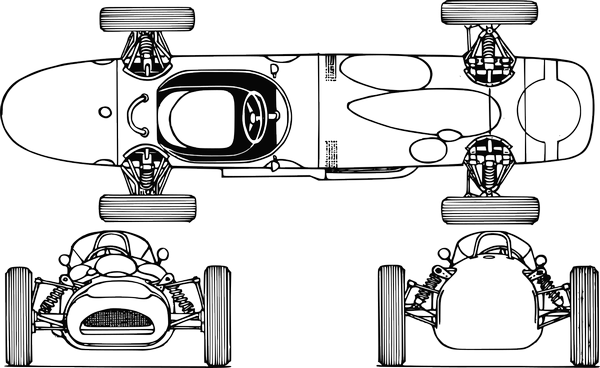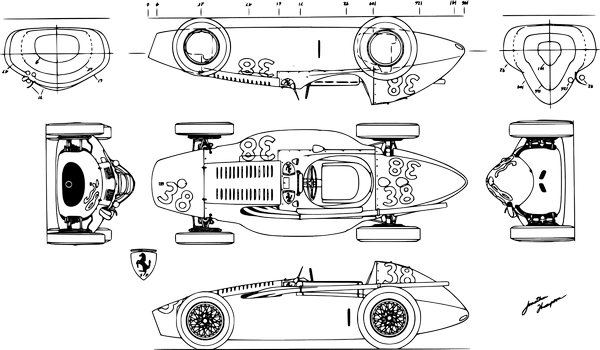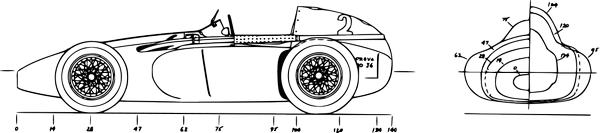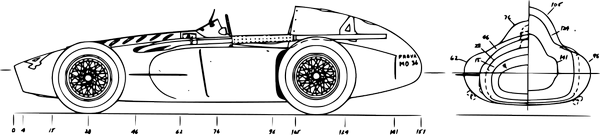


Scale Plans Series No. 10 | Model Car & Track June 1965 | By Julian Thompson
Ferguson P99
ONE of the most interesting cars to emerge during the 1½ litre Formula 1 period was undoubtedly the 4 wheel drive Ferguson. This machine is outstanding, not only for its highly ingenious drive system, but also because at a time when all Grand Prix contestants were building rear engined cars the Ferguson's 4 cylinder Coventry Climax unit was mounted in front of the driver.

With 4 wheel drive it was more advantageous to have equal weight distribution on all wheels, rather than the bias to the rear, which is desirable with a 2 wheel drive car. Modernists may therefore regard the P.99 as old fashioned in appearance, but it is in fact a new conception of a racing car in possibly everything but the engine. The project can be considered as having been commenced way back in 1939 when Engine location and the necessary, complex drive train dictated an offset cockpit. Note shift lever mounted on firewall to left of steering wheel.
A.P.R.Rolt and the late Freddy Dixon — one of Britain's foremost racing drivers and tuning experts of pre World War II days — combined to do research on 4 wheel drive. After the war this was expanded and financed by Harry Ferguson, the tractor "king" head of Harry Ferguson Research, Ltd. Investigations and experiments over the years gradually amassed sufficient information and ability to enable the building of a Grand Prix car to become a possibility. This was undertaken during the winter of 1960/61, and in less than twelve months from the first drawings, the Ferguson 4 wheel drive racing car won its first race, only the third in which it had competed. In itself this was a considerable achievement, because although there have been many 4 wheel drive cars before the Ferguson it was the first with this form of transmission to win a race on a road circuit. On July 8th, 1961, the car made its first public appearance at Silverstone in the British Empire Trophy race, but unfortunately was eliminated by a mechanical fault in the early, stages so that a true assessment of its potential could not be made on that occasion. Incidentally, a 2½ litre Coventry Climax engine was fitted for this event to comply with the Intercontinental Formula under which the British Empire Trophy was run. A week later, on July 15th, the car was rolled out from the paddock at Aintree to compete in the 14th R.A.C. British Grand Prix, and on this occasion it was fitted with a 1½ litre formula 1 engine.
The many thousands of spectators who watched the event did so under astrocious weather conditions that prevailed that day — the Aintree circuit being lashed by driving rain throughout the greater part of the race. Although the Ferguson, driven by Jack Fairman, could not approach the performances of the victorious Ferraris, the conditions on the streaming track served to provide a surface upon which the car was able to conclusively demonstrate its remarkable steadiness and roadholding qualities. At Tatts Corner these were very evident. The machine negotiated this notorious turn lap after lap at speed without any apparent tendency of the tail to break away on the greasy, treacherous right hander. The use of an ingenious form of "limited slip" differential between the front and rear wheels enabled the Ferguson to achieve fantastic acceleration out of the corners, and this combined with its previously mentioned steadiness certainly denoted the considerable possibilities contained in its design.
Later in the season it proved itself by comfortably winning the Oulton Park Gold Cup race, during which event it was impecably driven by Stirling Moss. It was designed primarily as a research vehicle to enable Ferguson to carry out tests on stability, braking and so on, at high speeds. Consequently the P.99 was only raced where suitable to justify the claims of 4 wheel drive and prove the results of many years of experimental work. Many enthusiasts were disappointed that the car did not have a longer racing career, but it was never meant for a full Grand Prix programme — it was a technical exercise to prove its point.
Unique features of the Ferguson lie in the transmission and the inboard disc brakes fitted with a centrally located Dunlop Maxaret anti locking device. For braking, a tandem master cylinder was used that, in the event of failure in either the front or rear systems, the brakes on one axle continue to operate. The limited action differential allowed for effective braking on either the front or rear pair of discs on all four wheels, should such a failure occur, although the pedal effort would necessarily have to be increased for the same retarding effect. The ingenious anti locking system is worked by hydraulic pressure from a pump and accumulator. Pressure being utilised to apply the pads, and anti lock units, which include a small flywheel, are used to prevent locking. The flywheels, normally driven by the wheels, are so arranged that any undue check on their speed, which would occur when a wheel begins to lock, immediately relieves the hydraulic pressure and permits fluid to escape and return to the supply tank. Maxaret, established in aircraft practice, was a practical impossibility for racing cars so long as a unit had to be fitted to each wheel, but in the Ferguson, because of the presence of the limited-action differential in the transmission, a single unit only is needed for the whole system, as no one wheel can lock indpendently.
The controlled differential is one of the key features of the P.99. To the back of the engine the casing for the multi-dryplate clutch and offset gearbox is bolted. The drive is stepped down vertically to the gearbox through the Ferguson limited differential within the latter to all four wheels via open propeller shafts — final drive units being mounted in the multi-tube space frame. The all-around independent suspension incorporated on the car employs inclined coil springs and Armstrong dampers; the wheels being located by tubular wishbones of unequal length. Main driving and braking thrusts are taken on the lower wishbones and these are on the same centre line and of the same length as the universally jointed drive shafts so that sliding joints are not required.
Light-alloy Dunlop wheels with centre lock hub caps are fitted and designed for quick removal with a ring spanner; the hubs are fully rotating so that breakage of a half-shaft will not result in the loss of a wheel.
A light-alloy fuel tank with a capacity of fourteen gallons is positioned in the bulbous tail of the car, and a second of twelve gallon capacity is a Marston-Excelsior flexible plastic tank situated between the body shell and the frame, alongside the driver who sits slightly to the right of centre.
Following the P.99's appearances in various races it has competed successfully in hillclimbs, and in 1964 won the British R.A.C. championship in the hands of Peter Westbury. Also during '64 the same driver demonstrated its amazing acceleration at various meetings staged in different parts of England for the First British International Drag Festival.
It is possible that 4 wheel drive, more than any development during the past decade, could change the face of Grand Prix racing. BRM have, for some months, been carrying out experiments using the Ferguson principle and have produced a 4 wheel drive prototype — not as a prospective challenger in the 1½ litre formula, but as a mobile test bed for the purpose of trying out ideas for the forthcoming 3-litre, or 1½ litre supercharged formula that is due to commence in 1966.
For the 1964 Indianapolis 500 Mile Race the Ferguson principle was also utilised in a car known as the Studebaker S.T.P. Special — the whole project being completed in under four months. This Indy Novi-Ferguson, as it was alternatively known, showed considerable promise and qualified for the event at a speed of 154.504 m.p.h. driven by R. Unser. Unfortunately the disastrous accident that occurred in the opening laps of the race eliminated the car and the possible advantages of 4-wheel-drive at the world famous Speedway still remain to be proved.
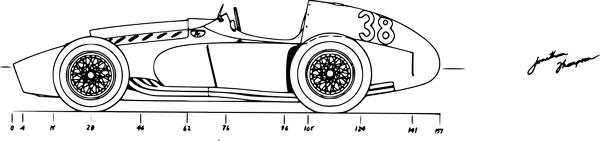
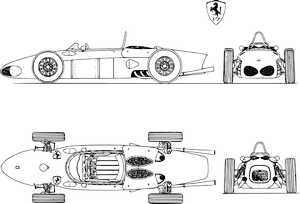
The Ferguson P.99, depicted in the accompanying photographs as it appeared at Aintree and Oulton Park in 1961, was finished in an attractive shade of dark blue, with a white band round the nose. These are the well known Scottish racing colours adopted by Mr. R. R. C. Walker, head of the racing team which bears his name, and who co-operated with Harry Ferguson Research Ltd., in the team management of the car in its early days.
It cannot be regarded as a handsome vehicle. The various bonnet bulges housing camshaft covers and carburetors are essential, but detract from an otherwise smooth outline. However, the car does possess an individual, definite character, and with its considerably exposed suspension detail provides intriguing constructional problems in the smaller scales.
ESSENTIAL PROTOTYPE DIMENSIONS: Wheelbase: 7 ft. 6 in. Track: front 4 ft. 4 in. rear 4 ft. 2 in. Overall length: 12 ft. 6 in. Height to scuttle: 2 ft. 6 in. Ground Clearance: 4½ in. Wheels and tyres: 5.00 x 16 front and rear.