Prototype Parade No. 30 | Model Maker May 1951 | Drawn by Maurice J. Brett
4.5L Bentley Le Mans
H AVING recently dealt with a number of sleek moderns, it was felt that another vintage type deserved a turn. When the choice had narrowed to a Bentley the temptation to pick the immortal "Blower 4 ½" was well nigh irresistible, but this urge was firmly suppressed on the grounds that, glamorous though the ex-Birkin short chassis car might be, it wasn't quite so fully representative of that glorious breed as, say a dyed-in-the-wool team car, with "inspiration by natural causes".

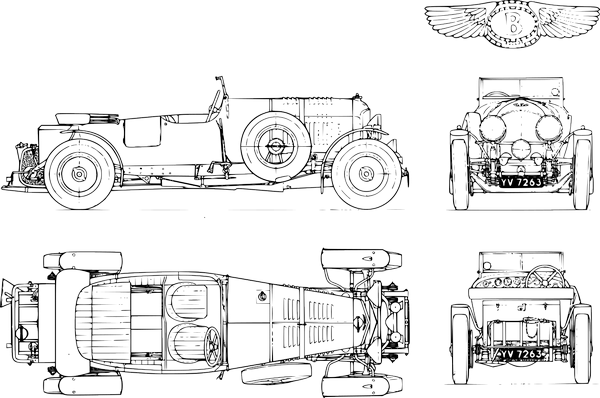
Now of all historic motor cars, no other make can boast of so many existing specimens, almost all in the pink of condition, with their dossiers safely in the keeping of the Mother Club, so once more I sent an S.O.S. to High Priest Stanley Sedgwick, Hon. Secretary of the Bentley Drivers' Club, who promptly and courteously referred me to YV 7263, in whose oil pipes circulates the pure untainted blood of the Bentleys. Its present owner, Mr. A. G. F. Oldworth, unhesitatingly afforded facilities for measuring up the car at his home at Cobham, and the car is drawn and photographed exactly as it exists today, very little changed since its racing heyday in 1929.
The 4-cylinder o.h.c. 4 ½ litre Bentleys "grew up" from the popular 3 litre cars in 1927, and in 1928 our hero YV 7263 first appeared as a works entry, driven in the Essex Club's six-hour race at Brooklands by Tim Birkin, finishing third at 72.27 m.p.h. Sharing the wheel with Jean Chassagne at Le Mum, Tim encountered fearsome tyre trouble, broke the lap record and finished 5th. Fifth position and fastest lap seemed to be this car's speciality during 1928 for the same story repeated itself in the Tourist Trophy, and at Boulogne, where Tim's 73.16 m.p.h. in the Georges Boillot Cup was an all-time record for the course. In 1929 the Hon. Mrs. Victor Bruce broke the Class C 24 Hour record at Montlhery in the same car, at 89.57 m.p.h., and it was then hurriedly prepared for Le Mans, in order to take the place of one of the blower cars, which were withdrawn. It's drivers, Lord Howe and Bernard Rubin, did not regard their chances of finishing as rosy, in view of the somewhat sketchy preparation, and their pessimism was justified when a magneto cross-shaft broke in the early stages of the race, and YV 7263 retired. By way of compensation, however, the old car carried B. Harcourt Wood into 4th place in the Irish G.P. and finished 5th once more in the 500 miles race, driven by the Hon. Brian Lewis and C. W. Fiennes. This brief biography of the Bentley as a "team" car concludes on a somewhat melancholy note with the retirement of Williams and Durant in the 1930 "Double Twelve" after a minor fire and axle trouble, but is more than sufficient to justify its place among the great ones of the past.

As perhaps, together with the 30/98 Vauxhall, the best known sports car of the old school, the general technical details of the 4 ½ litre Bentley will be familiar to most readers, although if its development were to be discussed in detail many pages could be written. By the time YV 7263 was built, a more sturdy frame and the large wide shouldered radiator marked these cars as bigger brothers of the 3-litre, and for Le Mans in 1928 the bodies were somewhat different from that shown in our drawing, having tank and spare wheels enclosed in a short "manxed" tail fairing. The classic open body is shown here, however, as the car was restored to this style, plus the addition of a luggage boot ahead of the fuel tank. The wings extend in a more generous arc than those fitted for Le Mans, and the third central headlamp is replaced by a lower placed pass-light carried above the front cross bracing. The typically Bentley lever-and-cam-action filler caps are fitted to the radiator and fuel tank, and another reminder of its racing days is the wheel adjuster for the brakes in the driving compartment floor. Other interesting external features for the modeller are the double Hartford shock absorbers, two pairs ahead of the front axle, and a pair before and behind the rear axle, and the trussing of the chassis side members, rather reminiscent of a railway coach! An external filler for the scuttle oil tank projects on the near side of the scuttle top, and the two-panel windscreen folds forward. The Rudge hub caps are of the offset ear variety, and these, in fact, form the motif of the Bentley Drivers' Club, so they should be correct in the model I hope you are going to make!
There are no valances below the frame, and the exhaust system is visible from the near side, terminating in the massive fantail, which used to be sprayed heartily with a fire extinguisher during refilling operations!
The dashboard is a most satisfying sight, with an array of instruments that wouldn't shame a fighter aircraft, all of which had to be read and memorised by the well disciplined team drivers in days gone by. The large revolution counter is centrally mounted, and reads to 6,000 r.p.m. though for practical purposes the needle is "in the red" between 3,500 and 4,000.
In addition to pressure and temperature gauges, speedometer, clock and ammeter, the instrument panel carries the air pump for the fuel system on the left of the rev. counter, and an array of switches for the lighting and dual magnetos. The large spring spoked wheel is corded, and has centrally mounted ball-ended controls for ignition and throttle, under a domed cover. A leather grab handle is fitted to the scuttle beading, the gear lever works in a gate on the driver's right, inside the body, with the handbrake external. An interesting feature is the brake linkage, which passes through the rear passenger partment.
The Bentley is, perhaps, hardly an ideal subject for a powered model, as the thought of so majestic a vehicle either popping or screeching along under the urge of a small two stroke, is distressing to a degree. If, however, anyone can manage a four cylinder four-stroke, even with side valves, what better car could you find for it? I have recently found that a surprising number of people collect these drawings purely from enthusiasm for the cars themselves, and with no model making project in view.
It is also apparent, from correspondence received, that some readers would prefer very much more detail in these drawings, which would enable them to build super-scale models with accurate dummy engines, transmission, steering details and driving controls. At the moment the demand does not justify the immense amount of work entailed in treating every car described in this way, but the provision of super detailed drawings of a limited number of popular types is still under review.