
Prototype Parade #230 | Model Cars December 1966 | Drawn & described by D. Windsor
Honda 3L V12 1966
T HE NEW HONDA V12 made its racing debut at the Italian G.P. on September 4th, and though numerous titbits were printed during its trials at Suzuka, it was only then the press could assess it properly.

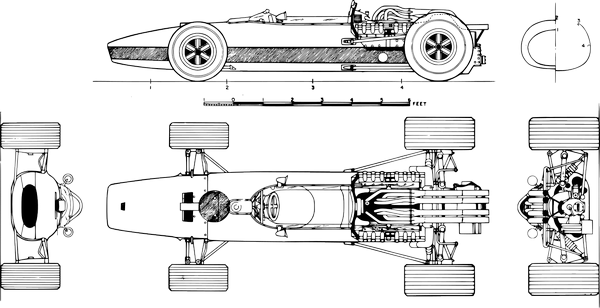
However, nothing is ever as simple as one hopes and, while comment was profuse, it was in many ways contradictory. Three or four sets of measurements were published, while criticism ranged from "beautifully made, of enormous complexity" (Autosport) to "The workmanship seems surprisingly crude and heavy in comparison with Lotus and BRM detail work" (Motoring News). Ultimately, the plans were done to measurements published in Autocar on appearance of the prototype at the end of August and these have subsequently been confirmed as correct.
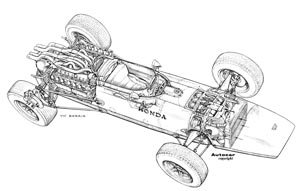
It is a complex car, as complicated as its exhaust system suggests, being conventional only in its monocoque construction and suspension layout. Honda's chassis designers went the whole hog on the new car and produced a full monocoque with two pontoons at the rear, similar to the BRM 2 litre cars and the Indy winning Lotus 38. Indeed the Honda resembles the Indy winner in many ways and this is not surprising as their chief test manager Sekiguchi said of Len Terry, "He is currently the world's greatest designer". The hipbath chassis, so popular under the 1½ litre formula, is at long last obsolete. The chassis unit was made by an aircraft company in duralumin with attention paid to ease of maintenance and with the suspension mounting points and stress areas in steel. The rear pontoons support the engine and also hold two of the 8 fuel tanks which altogether hold 70 gallons of 100 octane B.P.

The engine, which is now mounted longitudinally behind the driver, is a 90 degree V12 with the exhausts in the centre of the V and is an entirely new design. It has a capacity of 2,992 cc., with 4 valves per cylinder and a single 12 mm spark plug in a humped piston, not of truly hemispherical pattern. The bore and stroke are 78.0/52.2 while the claimed 400 bhp at 10,000 r.p.m. is probably a little optimistic. Power is taken from the the middle of the engine which subsequently looks like 2 V6s, the camshafts are also driven at their centres as are the timing gears. The output shaft runs back along the base of the V to the gearbox, fuel injection is by Honda's own port type method and the compression ratio is 1.5 to 1. The rev counter in true Honda tradition has no limit and goes up to 15,000 rpm, yet ironically Honda say they will not use transistorised ignition until they use high revs!
To transmit all the expected horses the Japanese firm have rejected the Howland gearbox previously used, and now make their own unit with 5 forward speeds, reverse, and full synchromesh as gear crashing is becoming prohibitively expensive with the new formula. An alternator is built onto the rear of the box, which has its own cooling system and radiator mounted on the near side with a scoop to collect air from beneath the car. Great attention has been paid to cooling and the engine has no cover, while the petrol itself is passed through a radiator before entering the fuel injection system. This radiator is mounted behind the roll-bar. The positioning of many of the smaller auxiliaries seems to be undecided and the fuel pump alongside the near side pontoon will probably not remain there long.
The half shafts are solid with Hooke joint universals at both ends, the necessary movement coming from the stub axles as on the Mexican G.P. winning car. Wheels are by Halibrand being 15 in. supporting Goodyear tyres considerably wider than those of the 300 b.h.p. Brabham. Suspension is conventional with a reversed wishbone, transverse top link and twin radius rods at the rear, unequal length wishbones at thu front operating inboard springs which are cooled by channeling air from the sides of the radiator (as on the Ferrari). The front hubs have the steering arms moulded into them, unlike western practice, and the roll bars are both adjustable without removal from the car. The stopping power is provided by Girling discs of the solid variety mounted inside the wheel hubs (only Ferrari have used the ventilated slotted discs available).
Body work is almost non-existent only; a detachable nose cone was fitted at Monza, and it is unlikely that any attempt will be made to hide all the internals until the position of the auxiliaries is finalised. In the nose there is an air outlet similar to the McLaren and Lola sports cars for creating a flow from the radiator over the car at speed, the Japanese mechanics would not say what the scoop or hump on top of the nose were for. At the rear the car is nicely set off by the twelve pipes running into the four tail exhausts without megaphones. The whole proved very heavy, scaling 740 kg at Monza. It is finished in white with a red stripe down each side and a red disc on the nose immediately in front of the cockpit. The numbers were black (18 at Monza) as was the leather lined cockpit and the 12 in. steering wheel. The gear shift stick is on the right, and the wheels are left metal colour, the exhausts being covered with special matt white heat-proof paint.
Drivers are Ginther and Bucknum with the possibility of a third next year; just who is the source of usual rumour!
Despite its crash at Monza the car showed surprising potential for its first race, and was on the point of taking the lead when the off side rear wheel locked, causing it to leave the road at high speed. It struck a tree side-on and it is a tribute to the new Honda's strength that Ginther escaped only with a fractured shoulder. By the time this is in print another may well have appeared in time for the Mexican G.P.
Dimensions: Wheelbase 8 ft. 2½ in.; Length 12 ft. 11 in. Rear 4 ft. 11 in. Body width 2 ft. 5 in. (to roll bar). Tyres ft. 7/15; 10.50/15.