


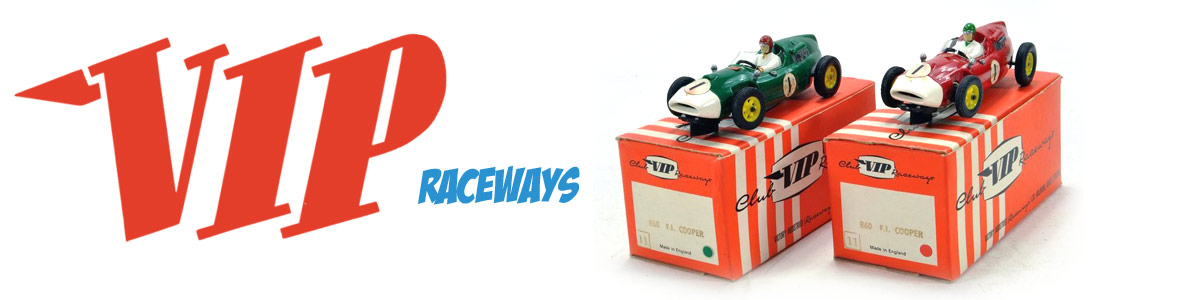
New VIP Raceways
1961-1965
VIP Raceways

The new VIP Raceways system first appeared at the London toy fair in February 1961. With stunning set-top artwork by the then relatively unknown artist Michael Turner, the new R1 sets were given a very warm reception by the trade press. The sets were available between 1961 and 1965 and just as with the earlier Roadway sets saw several changes during this period which I'll attempt to go through here. These sets generally include one R60 Cooper and one R61 Lotus but were also sold with two Coopers or two Lotus throughout the production period.
The Cars
1961 Guide

1963 Guide

1963 - Some time around 1963 a few standard cars were fitted with narrow red wheel hubs instead of yellow. These were probably intended for exclusive use on the Club special cars (Certainly from 1966 Club Special cars were fitted exclusively with wide red wheel hubs) but for some reason this did not happen and the majority of the narrow wheeled Club Special cars (first available in January 1963) were fitted with yellow hubs as original equipment. Club Special cars have a more powerful motor with silver sides and were only available separately as they were said to be too powerful for the standard sets!
February 1964 - All cars now fitted with VIP Special rear tyres. Previously these were exclusive to the Club Special cars although they were available in sets of four as a spare part (R81). These tyres offered more grip than the Dunlops when they were new but the Dunlops have fared much better with age!
The R1 set cars then remained unchanged until they were withdrawn in 1965.
The Set Box & Contents
VIP Raceways set


Changes
The first change made to the set was one which everyone within the company would have far rather made before the first sets went on sale. The track had been designed and produced for Victory by a sub-contractor and in it's finished form was presented with fairly sharp straight cut edges underneath - obviously not a desirable trait for a children's plaything. The contractor could fix the problem but the price demanded was quite astronomical and would have added about 10-15% to the cost of each set. The contractor had Victory over a barrel but perhaps didn't appreciate the fragile state of Victory's finances. With the additional mark-up the price of the sets would have been uncompetitive but Victory had to get the sets rolling before the end of the financial year to meet the demands of existing customers.
Confronted with a real-life Hobson's choice, Victory went ahead with production and Ralf Burgas was put to work immediately both night and day to find an affordable solution to the problem. To his credit, Ralf managed to design a tool fairly quickly which folded over the bottom edges of the track in one operation and by the middle of 1961, all new sets included this modified track. The colour of the sleepers was also changed from sand to grey perhaps to make it easier to identify the old track without actually removing it from the box.
Track underside

