


The Big Year?
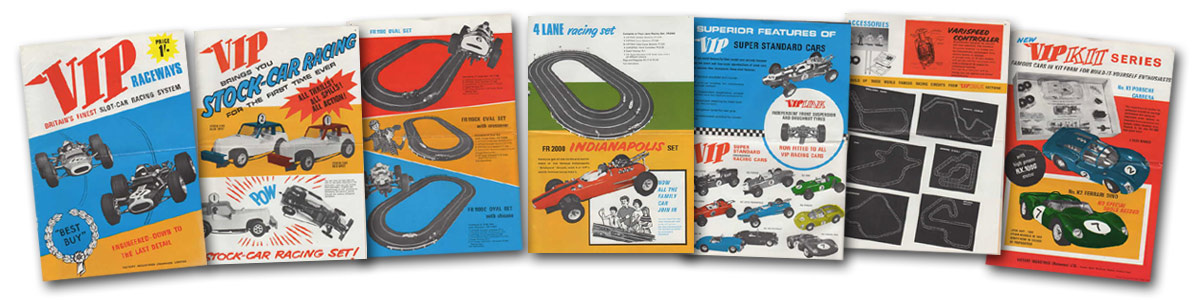
1968
Catalogue
1968 was to be the big year. For the first time ever, a proper catalogue was produced and Victory took a stand at the International Toy Fair in Nuremberg. The price list reflected the move from niche to mass market. Gone were the mass listings of spare parts and components, replaced by much greater focus on the sets, and range of cars.
VIP had overcome many obstacles over the years, some perhaps of it's own making. But the company was by this stage producing some of the best slot cars and track available, and in addition to its established reputation amongst the club racing community, it was also gaining recognition in the wider home racing market.
Victory's slot car sets had even scored a resounding first place in a head to head comparison with Scalextric by Which? magazine, a well trusted source of consumer advice. So 1968 held much promise for the company.
Catalogue

Bubble Burst?
Unfortunately, Christmas 1967 was precisely when the slot car bubble had burst. Manufacturers had been pouring sets and models onto the market as fast as they could produce them for the past 3-4 years and worldwide things had reached saturation point. People had bought sets for Christmas, but in the main they had been looking around for something else. The last thing shops and distributors wanted now was any more sets and Victory, like the rest of the trade found few orders at any of the trade fairs. Victory had put forward three new sets, none of which stimulated enough interest to go into production.
The Ferrari Dino, like the Porsche before it was also lined up to be produced in three version - The standard R69, Club Special R68S and kit version K.II, but orders for the kit version were also insufficient to make production worthwhile. A fourth reworking of the Club Specials offered a new laminated three-pole armature and Victory's fastest motor yet, but even here Victory found few takers. Club enthusiasts were now busy reworking their own motors to such an extent that no manufacturer could hope to keep pace with developments and Victory's motor was out of date even before it reached the shops.
If this paints a grim picture, its perhaps worth noting that Victory's sales don't appear to have plunged into terminal decline. Indeed, turnover seems to have continued at a steady pace throughout the year but with the market shrinking day by day, it was clear that aspirations of a massive boom in sales were pie in the sky, and Victory's 'young high flyers' must have wondered what their next move should be!
VIP Viper
In September, Victory released The Viper, their first and only model not to replicate any real vehicle. This and several other of the F1 cars around the same time were offered with shiny plated bodywork. Some appear silver and some appear gold but without any sort of reference material its unclear if both colours were offered or if this is simply the result of the less than perfect plating technique used. How and why the Viper came about isn't known, but I can only assume the gold version was something they thought "guaranteed to startle the opposition into a host of mistakes" to quote the only review I've seen of the car which appeared in Model Cars.
VIP Viper
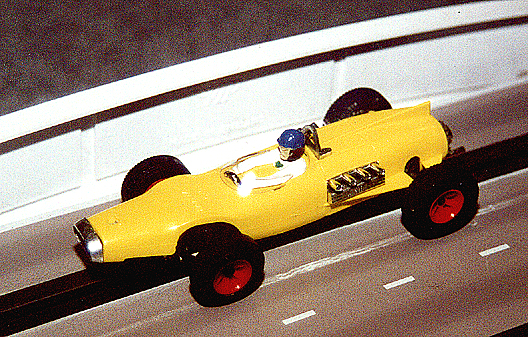
What was certainly unknown at the time the model was produced was that this was to be Victory's swan-song.
1969
The Factory Closes
Surviving records indicate that Victory did not have a brilliant year in 1968, but one which was far from disastrous. Had Fred Francis or Ivor Spence been in overall control of the company then I don't think this would have been anything other than a minor blip. Unfortunately they weren't and it came as a great shock to them and to the trade in general when it was announced early in the year that the company was to be closed by its owner.
This was done with little ceremony, all staff were laid off by the end of March and all tooling, stock, machinery and stores were sold off at auction on the 15th April 1969.
Sale by Auction
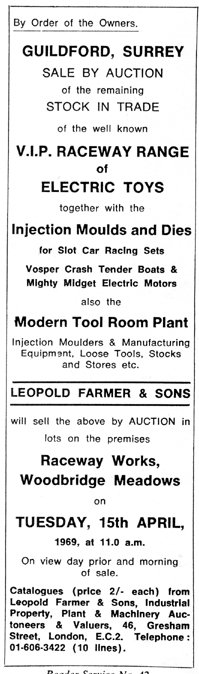
Sympathy has no place in the world of finance of course, but one can't help feeling that a company which had endured so many ups and downs over the years, which had offered so many products which are still loved and admired by enthusiasts around the world, and which was still operating profitably at a time when many slot car companies were going to the wall deserved a better fate.
There are no records to show what happened to any of the items sold at the auction although it is known that G&R Wrenn bought the remaining stocks of Mighty Midget motors, Vosper RAF Boats and Vosper triple screw yachts and all the associated spares. These items were listed in Wrenn price lists around 1970-71 but the dearth of any survivors in Wrenn packaging would indicate few were sold. Indeed some items were still in stock when Wrenn subsequently closed their doors in 1982 and their assets were sold on to Dapol but these were later destroyed in a fire at the Dapol warehouse.
On a final note, several wooden trays of unused MGA, Healey and yellow & blue Viper bodyshells turned up for sale at a slot car swapmeet around 1988 - perhaps there could be more still to be found!