The rally-style cumulative time format is perfect for a rally proxy - and it certainly worked well for our WHO Rally-Sprint in 2021. Glad you're using it.
We went with a 180-second maximum time on stage - which was also the default time for an DNF across all our stages. Our stage lengths varied considerably - from a 13.9 second winning time to 84.78 seconds. The maximum time means the host can decide if a car is running very slow or coming off on every corner, then it won't get in the time limit and get a default. Not a mechanical DNF, but an authentic rallying 'out of time'.
A DNF meant a car was immediately out of contention for the overall or a class win, so clear guidance on a shake-down session and any repairs is important. We controversially required changes (eg guide depth) or repairs to be made
after a stage, hence the car receiving a 180-second default time, if the car could not get round the stage or was out of time. It could be argued that a rally car only gets a shake-down on a stage or two before the event begins - it does not get a practice run through each stage.
I'll be running two stages over the second weekend in March. One will be on the Brighton Ice Rink...


It's a tight, low-grip course, routed into PVC foam board with copper tape...

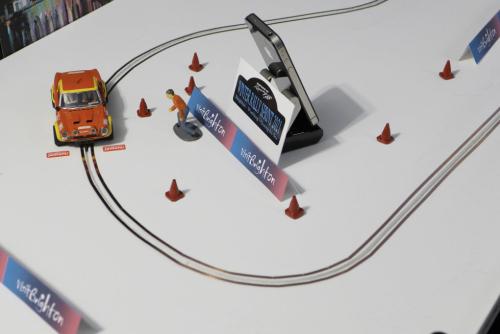
I'll be using the Laptracker-Auto Timer app for timing...

I haven't quite decided on the second stage... The choice is a flat Ninco asphalt/off-road layout based on my Extreme Slotting stage, but with more tarmac than shown here - and no Rally-Raid obstacles!

A repaved (Ninco/Policar) Devil's Dyke Hillclimb...


Or my permanent single-lane Scalextric Sport hill-climb that I've had a lot of fun developing functionally, but a proxy appearance would encourage me to get some scenics in place...
I've got a few months to make a decision on that second stage...
Expect a couple of standard (Class A) Ninco cars to be entered into Events 2 & 4.


![[+]](https://slotracer.online/community/images/bootbb/collapse_collapsed.png)


