

7th-Aug-23, 08:34 AM
BAck in 1981, I attended the Grand Prix at Kyalami, When turbo cars were 'taking' off, and being a Tifosi, my love for Ferrai made thes cars of real interest to me. In 82 I was able to get into the pits on the setup days and was upclose and personal to the C2. Then with the loss of Both Gilles and Didier later that year, the story becam poignant for me. SO have always had an interest in these cars and am really please I have been able to lay my hands aon several.
History of the Cars and the Slot car Replica's:
126C (1981): Comprex vs Turbo
The Ferrari 126C was designed to replace the highly successful but obsolete 312T series in use since 1975. The basic chassis was almost identical to the previous car but the smaller and narrower V6 engine with forced induction, better suiting theground effect aerodynamics now needed to be competitive (the previous car's wide flat-12 boxer engine obstructed the airflow necessary to generate efficient ground effect), and was a better package overall. During engine development Ferrari started experimenting with a Comprex presssure waave supercharger supplied by a Swiss company; this car version was initially called 126BBC from the name of Brown Boveri Comprex and later named 126CX.
The system was praised by drivers for driving like a naturally aspirated engine but having an extended power range, thus eliminating the notorious lag of the turbocharger. However the system was rather tall in the car and there could be some mixing of exhaust and intake gas so the team opted for the fitment of twin KKK turbochargers producing around 600 bhp (447 kW; 608 PS) in qualifying trim, detuned to 550 bhp (410 kW; 558 PS) in race trim. The car fitted with turbochargers was called 126CK.
Enzzo Ferrari had hired Nicola Materazzzi in December 1979 to work with Forghieri and Tomaini and specifically for his experience with the turbocharging in the Lancia Stratos Gr 5 Silhouette cars. He would bring technical know-how in the team to match the knowledge that Renault had built over time. Materazzi thus saw the advantages of the comprex system but also its difficulties and prepared also a second iteration with two smaller Comprex systems driven by hydraulic clutch instead of a belt but this was not used since the turbocharger was deemed simpler and worth pursuing. Hence Materazzi proceeded to perfect the following iterations of powertrain to obtain increased power and reliability.
The 126CK was first tested during theItalian GP in 1980. In testing it proved far faster than the 312T5 chassis the team were then using and Gilles Villeneuve preferred it, though he had reservations about the handling. Early unreliability of the turbo engine put paid to Villeneuve's 1981 championship hopes but he did score back to back victories in Monaco and Spain, as well as several podium places. Because of the problematic handling the 126CK was at its best on fast tracks with long straights. The car proved to be very fast but Gilles Villeneuve found the handling to be very difficult, calling the car "a big red Cadillac".
According to Villeneuve's teammate Didier Pironi and English engineer Harvey Postlethwaite who arrived at Ferrari well into the 1981 season, it was not the mechanical aspects of the chassis that was the main cause of the car's handling problems, but in fact it was the aerodynamics of the car. Postlethwaite later said that the 126CK "had a quarter of the downforce that the Williams or Brabham had that year". The poor aerodynamics of the car, coupled to the chassis' hard suspension (all teams in 1981 were running with hard suspensions to increase aerodynamic efficiency), created a tendency to make the car slide into corners before the ground effect pulled the car back on to the track. This had the undesired effects of exposing the drivers to even larger g-forces than the Williams orBrabham and making the car tend to overuse its tyres. The engine had massive turbo lag, followed by a steep power curve, and this upset the balance of the chassis. Although the Ferrari engine was the most powerful engine that year, even more so than the Renault - the combination of a severe lack of downforce and an abruptly powerful engine made the car an annoying menace to race against. At the Ostereichring one gaggle of 6 naturally aspirated, better handling cars formed behind Didier Pironi for a number of laps, followed by three other cars shortly afterwards: none of them, however, could find their way past easily due to the Ferrari's power advantage on the very fast Austrian circuit, even though the car was very clearly slower going through the Austrian circuit's fast, sweeping corners. The same thing also happened at Jarama that year; 4 cars were stuck behind Villeneuve on the tight and twisty circuit, but he was able to hold off the cars behind him thanks to the car's power advantage and fair mechanical grip. Monaco and (less so) Jarama were slow circuits where aerodynamic downforce was not as important as mechanical grip, so combined with Villeneuve's famed ability behind the wheel the car was able to perform better than expected at these two races.


This version of the car has been modelled by Kostas Dzingovic under the name Golden era Slot cars.His cars are not cheap but the quality and detail are out of this world.
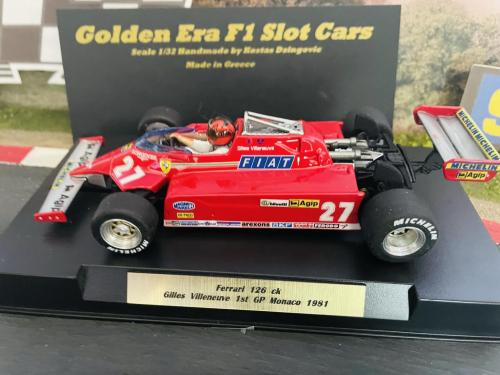


His modelling of Gilles is simply outstanding. A lttle more higlihting of the rear deatil would be great. (I have already started on that :) )
The front and rear wings are attached quite strongly by tiny magnets and thus are protected in racing accidents. To be honest mine will only see test laps
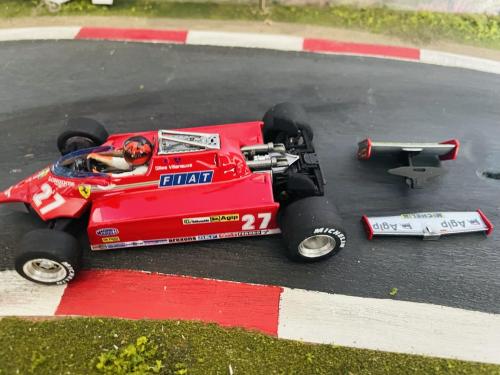

126C2 (1982)
The arrival of Harvey Postlethwaite led to a total overhaul of the car in time for the 1982 season. The turbo engine was further developed and reliability found, while an all-new chassis and bodywork were designed, featuring Ferrari's first genuine full monocoque chassis with honeycomb aluminum panels for the structure, which made it more similar to its British specialist competitors' cars than any of Ferrari's previous F1 cars had been since 1962. Smaller, nimbler and with vastly improved aerodynamics, the 126C2 handled far better than its predecessor, although due to its heavier weight thanks to the turbo-charged engine made it slower around corners than its rivals. Villeneuve and Pironi posted record times in testing with the new car and began the season with several solid results, even though Pironi had a gigantic accident during testing at the Paul Ricard circuit, of which he was lucky to escape alive. The car made its debut at South Africa in January of that year, where both cars retired and at the Long Beach Grand Prix in America 2+1⁄2 months later, the car was fitted with an unusual configuration of two thin rear wings, each individually as wide as the regulations allowed, but placed side-by-side and staggered fore and aft, making it effectively a single double-wide wing. This was done as a deliberate exploitation of rule loopholes in retaliation for Williams' "water-cooled brakes" exploit at the previous race in Brazil, and to send a political message to the governing body, which was part of the FISA_FOCA wars, which resulted in disqualification for Villeneuve, who finished the race in 3rd. Then came the infamous race at San Marino after which Villeneuve accused Pironi of having disobeyed team orders. The fallout from the race preceded Villeneuve's death in an horrific accident during qualifying at the next round in Belgium, which left Pironi as team leader. Pironi himself was nearly killed in a similar accident in germany, putting an end to his motor racing career, but this did not stop Ferrari from winning the constructors' championship that year. The 126C2 was further developed during the season, with new wings and bodywork tried, and the engine's power boosted to 650 bhp (485 kW; 659 PS) in qualifying trim and around 600 bhp (447 kW; 608 PS) in races. An improved chassis was designed and developed mid-season that was introduced for the French Grand Prix that changed the rocker arm front suspension to a more streamlined pull-rod, rising rate suspension. A thinner longitudinal gearbox was also designed and developed to replace the transverse gearbox to promote better undisturbed airflow from the underside of the ground-effects chassis's side-pods


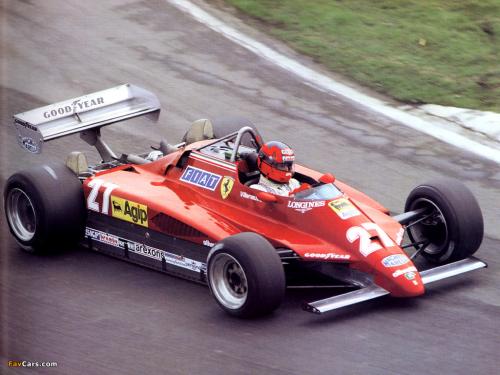
The Model versions of the car has been modeled firstly way back by Stryker, and then more recently by George Turner. Last but not least Policar (SLot.it) have released firstly the USA version as driven by Didier Pironi, and then the car as raced by Gilles Villeneuve in Belgium where he sadly died when hititing the back of Jochen Mass car that was slowing with an issue. For me that day is etched indelibly in my memory.
The first issue was a resin kit by the late Jon Stryker.

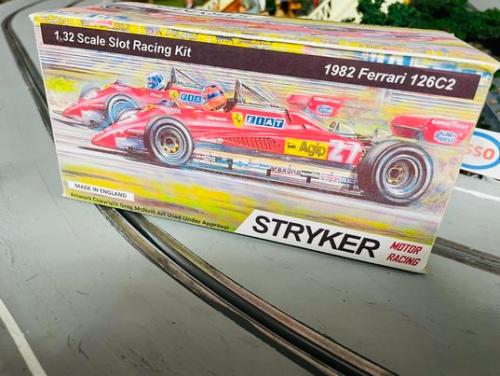
the second modelled version was by the inimitable George Turner in resin:

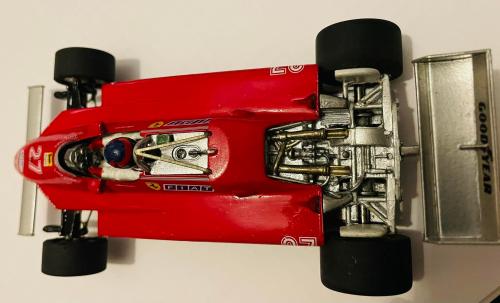

Next up was the 1982 USA GP version by Policar and the first mass produced by a modern manufacturer. This was the twin wing version which Ferrari tried to maximise wing effectiveness, but which was promptly banned by the FIA
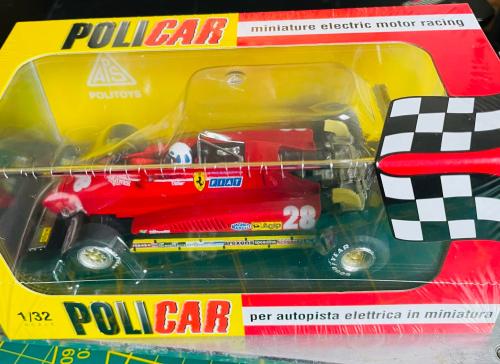

lastly (so far) the Belgium GP car of Gilles Villeneue last race.

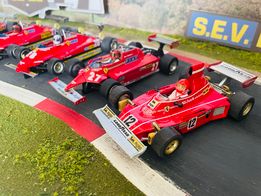
Some side by side pics of the cars -including one with a B3 that was a printed car by Nonoslot for comparison


History of the Cars and the Slot car Replica's:
126C (1981): Comprex vs Turbo
The Ferrari 126C was designed to replace the highly successful but obsolete 312T series in use since 1975. The basic chassis was almost identical to the previous car but the smaller and narrower V6 engine with forced induction, better suiting theground effect aerodynamics now needed to be competitive (the previous car's wide flat-12 boxer engine obstructed the airflow necessary to generate efficient ground effect), and was a better package overall. During engine development Ferrari started experimenting with a Comprex presssure waave supercharger supplied by a Swiss company; this car version was initially called 126BBC from the name of Brown Boveri Comprex and later named 126CX.
The system was praised by drivers for driving like a naturally aspirated engine but having an extended power range, thus eliminating the notorious lag of the turbocharger. However the system was rather tall in the car and there could be some mixing of exhaust and intake gas so the team opted for the fitment of twin KKK turbochargers producing around 600 bhp (447 kW; 608 PS) in qualifying trim, detuned to 550 bhp (410 kW; 558 PS) in race trim. The car fitted with turbochargers was called 126CK.
Enzzo Ferrari had hired Nicola Materazzzi in December 1979 to work with Forghieri and Tomaini and specifically for his experience with the turbocharging in the Lancia Stratos Gr 5 Silhouette cars. He would bring technical know-how in the team to match the knowledge that Renault had built over time. Materazzi thus saw the advantages of the comprex system but also its difficulties and prepared also a second iteration with two smaller Comprex systems driven by hydraulic clutch instead of a belt but this was not used since the turbocharger was deemed simpler and worth pursuing. Hence Materazzi proceeded to perfect the following iterations of powertrain to obtain increased power and reliability.
The 126CK was first tested during theItalian GP in 1980. In testing it proved far faster than the 312T5 chassis the team were then using and Gilles Villeneuve preferred it, though he had reservations about the handling. Early unreliability of the turbo engine put paid to Villeneuve's 1981 championship hopes but he did score back to back victories in Monaco and Spain, as well as several podium places. Because of the problematic handling the 126CK was at its best on fast tracks with long straights. The car proved to be very fast but Gilles Villeneuve found the handling to be very difficult, calling the car "a big red Cadillac".
According to Villeneuve's teammate Didier Pironi and English engineer Harvey Postlethwaite who arrived at Ferrari well into the 1981 season, it was not the mechanical aspects of the chassis that was the main cause of the car's handling problems, but in fact it was the aerodynamics of the car. Postlethwaite later said that the 126CK "had a quarter of the downforce that the Williams or Brabham had that year". The poor aerodynamics of the car, coupled to the chassis' hard suspension (all teams in 1981 were running with hard suspensions to increase aerodynamic efficiency), created a tendency to make the car slide into corners before the ground effect pulled the car back on to the track. This had the undesired effects of exposing the drivers to even larger g-forces than the Williams orBrabham and making the car tend to overuse its tyres. The engine had massive turbo lag, followed by a steep power curve, and this upset the balance of the chassis. Although the Ferrari engine was the most powerful engine that year, even more so than the Renault - the combination of a severe lack of downforce and an abruptly powerful engine made the car an annoying menace to race against. At the Ostereichring one gaggle of 6 naturally aspirated, better handling cars formed behind Didier Pironi for a number of laps, followed by three other cars shortly afterwards: none of them, however, could find their way past easily due to the Ferrari's power advantage on the very fast Austrian circuit, even though the car was very clearly slower going through the Austrian circuit's fast, sweeping corners. The same thing also happened at Jarama that year; 4 cars were stuck behind Villeneuve on the tight and twisty circuit, but he was able to hold off the cars behind him thanks to the car's power advantage and fair mechanical grip. Monaco and (less so) Jarama were slow circuits where aerodynamic downforce was not as important as mechanical grip, so combined with Villeneuve's famed ability behind the wheel the car was able to perform better than expected at these two races.
This version of the car has been modelled by Kostas Dzingovic under the name Golden era Slot cars.His cars are not cheap but the quality and detail are out of this world.
His modelling of Gilles is simply outstanding. A lttle more higlihting of the rear deatil would be great. (I have already started on that :) )
The front and rear wings are attached quite strongly by tiny magnets and thus are protected in racing accidents. To be honest mine will only see test laps
126C2 (1982)
The arrival of Harvey Postlethwaite led to a total overhaul of the car in time for the 1982 season. The turbo engine was further developed and reliability found, while an all-new chassis and bodywork were designed, featuring Ferrari's first genuine full monocoque chassis with honeycomb aluminum panels for the structure, which made it more similar to its British specialist competitors' cars than any of Ferrari's previous F1 cars had been since 1962. Smaller, nimbler and with vastly improved aerodynamics, the 126C2 handled far better than its predecessor, although due to its heavier weight thanks to the turbo-charged engine made it slower around corners than its rivals. Villeneuve and Pironi posted record times in testing with the new car and began the season with several solid results, even though Pironi had a gigantic accident during testing at the Paul Ricard circuit, of which he was lucky to escape alive. The car made its debut at South Africa in January of that year, where both cars retired and at the Long Beach Grand Prix in America 2+1⁄2 months later, the car was fitted with an unusual configuration of two thin rear wings, each individually as wide as the regulations allowed, but placed side-by-side and staggered fore and aft, making it effectively a single double-wide wing. This was done as a deliberate exploitation of rule loopholes in retaliation for Williams' "water-cooled brakes" exploit at the previous race in Brazil, and to send a political message to the governing body, which was part of the FISA_FOCA wars, which resulted in disqualification for Villeneuve, who finished the race in 3rd. Then came the infamous race at San Marino after which Villeneuve accused Pironi of having disobeyed team orders. The fallout from the race preceded Villeneuve's death in an horrific accident during qualifying at the next round in Belgium, which left Pironi as team leader. Pironi himself was nearly killed in a similar accident in germany, putting an end to his motor racing career, but this did not stop Ferrari from winning the constructors' championship that year. The 126C2 was further developed during the season, with new wings and bodywork tried, and the engine's power boosted to 650 bhp (485 kW; 659 PS) in qualifying trim and around 600 bhp (447 kW; 608 PS) in races. An improved chassis was designed and developed mid-season that was introduced for the French Grand Prix that changed the rocker arm front suspension to a more streamlined pull-rod, rising rate suspension. A thinner longitudinal gearbox was also designed and developed to replace the transverse gearbox to promote better undisturbed airflow from the underside of the ground-effects chassis's side-pods
The Model versions of the car has been modeled firstly way back by Stryker, and then more recently by George Turner. Last but not least Policar (SLot.it) have released firstly the USA version as driven by Didier Pironi, and then the car as raced by Gilles Villeneuve in Belgium where he sadly died when hititing the back of Jochen Mass car that was slowing with an issue. For me that day is etched indelibly in my memory.
The first issue was a resin kit by the late Jon Stryker.
the second modelled version was by the inimitable George Turner in resin:
Next up was the 1982 USA GP version by Policar and the first mass produced by a modern manufacturer. This was the twin wing version which Ferrari tried to maximise wing effectiveness, but which was promptly banned by the FIA
lastly (so far) the Belgium GP car of Gilles Villeneue last race.
Some side by side pics of the cars -including one with a B3 that was a printed car by Nonoslot for comparison
![[+]](https://slotracer.online/community/images/bootbb/collapse_collapsed.png)

