
Thread Rating:
  • 0 Vote(s) - 0 Average
  • 1
  • 2
  • 3
  • 4
  • 5

Braking Options explained
#1

Background

A description of the factors involved in selecting and optimising braking options.

1. Simple fixed
Available since the club wired (3 wire) brsca style controllers & plugs came into common use.
(2 wire controllers do not have brakes)
The motor is directly shorted out when the throttle is released.


2. Adjustable fixed
Became available shortly after 3 wire braking was introduced.
A variable resistor was Introduced such that the short across the motor can be "softened" so that over braking can be avoided.
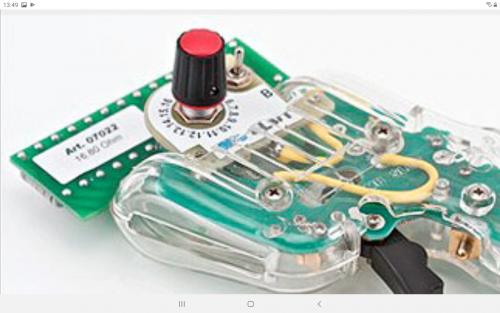
   
A car will have an optimal initial braking force.
At the optimal point, the car will come to a halt quickly.
Beyond the optimal, the tyres skid & skip, the pod hops, the car shakes, compromising corner entry.

Some cars are much better left to roll into the corner.
"Full brakes" reduces the speed too much, no matter how short the time it is applied.

3. Sweep
This function became available with digital pulse width modulation controllers like the Slot.IT SCP.
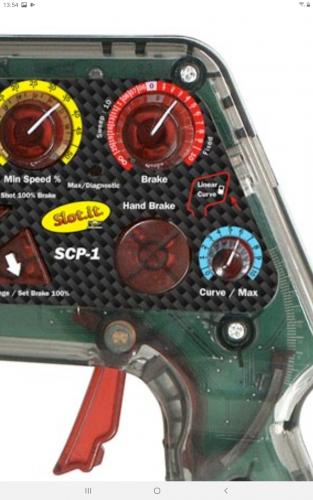
   
Braking force is initially hard and progressively releases as the car enters the corner.
Sweep time can be adjusted such that the progression from hard initial braking to the full release point can be optimised for the car and the track, enabling slower or faster release as required.
This braking method ensures the optimal corner entry speed even if the driver brakes a little early.
Note that sweep braking is not "anti-lock" braking but is the best approximation that can be made without the car carrying sensors and feedback mechanisms.

4.Adjustable Start Point Sweep.
Using Sweep time braking, there is no method on the Slot.IT SCP2 to initially engage the brakes at anything less than 100%
Why would you need this?
I started thinking on this problem when I was driving a car where the initial bite of the brakes was triggering such bad behaviour in the car that I had to set the throttle to a fixed adjustment. (2 above)

Just as for "adjustable braking" , the brakes engaging 100% at the start of the sweep can cause the tyres to lose traction and the car to shudder.

How to work around this limitation?
A. Some clubs have an old school rheostat adjustable brake fitted to the plug in point.
If the plug in point has a rheostat, adjust in conjunction with Sweep brake.
If the plug in point does not have a rheostat, you can buy a "choke box" that plugs into the plug point. Your controller plugs into the choke box.
This is a very expensive version of a choke box. 
   

B. Create a linkage inside your controller's plug and insert a resistor of suitable specification to emulate a choke box.

I'm hopeful that the recently released Slot.IT SCP3 controller might enable this feature without the nasty work arounds described above.
If anyone has a Slot.IT SCP3 controller (and the associated phone App) and has experimented with this, please let me know what you found.

A disclaimer.
Everything above is my own opinion.
Feel free to disagree, I'm always open to listening to alternative view points.
There is always something new to learn in this sport

Alan W
Nonfractal
[+] 4 members Like Nonfractal's post
Quote
#2

Interesting thread Alan, no experience of Slot.It as I use a Truspeed MT11 controller which seems to work differently and possibly does what you need:

"A single rotary control sets the braking strength and has a built-in hold circuit (similar to the PWM controller) to release the brakes once the car has slowed to a speed relative to the amount of braking you have selected. The useful feature of this design is that the motor drives the brake circuit in such a way that the faster the car is going, the harder the brakes are applied. As the car slows, the brakes are gradually released to give very balanced and predictable control. The brake and hold remain balanced to leave you free to race confidently."

My reading of this is that you can run the brakes at less than 100% and still have the 'sweep' function but I may be wrong, how do you interpret it?
Quote
#3

It all sounds terribly complicated! My SCD controller came with adjustable brakes and I never used it so just shorted the control out so I get maximum braking all the time like what I did when I were a lad. I guess I'm just used to that and beyond help Cool 

I tried the Truspeed and Steve set it up with the brakes on max as I like it. Couldn't get on with using the fingers though so went back to a 'proper' thumb controller.
Quote
#4

(25th-Feb-20, 05:00 PM)Gordon Steadman Wrote:  It all sounds terribly complicated! My SCD controller came with adjustable brakes and I never used it so just shorted the control out so I get maximum braking all the time like what I did when I were a lad. I guess I'm just used to that and beyond help Cool 

I tried the Truspeed and Steve set it up with the brakes on max as I like it. Couldn't get on with using the fingers though so went back to a 'proper' thumb controller.

So Gordon,  don't you notice the difference between braking say a Scalextric F1 car with an ff050  "sod-all brakes" slimline motor, and an NSR GT with a thumping grreat boxer motor?  Or do you just change driving style accordingly.

- Oh of course, it anyone races on plastic, and have the magnets still installed, this discussion loses relevance.
[+] 1 member Likes slotloco's post
Quote
#5

(25th-Feb-20, 08:06 PM)slotloco Wrote:  
(25th-Feb-20, 05:00 PM)Gordon Steadman Wrote:  It all sounds terribly complicated! My SCD controller came with adjustable brakes and I never used it so just shorted the control out so I get maximum braking all the time like what I did when I were a lad. I guess I'm just used to that and beyond help Cool 

I tried the Truspeed and Steve set it up with the brakes on max as I like it. Couldn't get on with using the fingers though so went back to a 'proper' thumb controller.

So Gordon,  don't you notice the difference between braking say a Scalextric F1 car with an ff050  "sod-all brakes" slimline motor, and an NSR GT with a thumping grreat boxer motor?  Or do you just change driving style accordingly.

- Oh of course, it anyone races on plastic, and have the magnets still installed, this discussion loses relevance.

Ah well, I have never raced a Scalextric car at all - ever! Do I get a prize?

I do drive several cars with NSR boxer motors and love them just as they are. Ditto the Thunderslot car. All on wood.

I just drive the car the way it is. Seems natural to me Sun
Quote
#6

(25th-Feb-20, 02:44 PM)CMOTD Wrote:  Interesting thread Alan, no experience of Slot.It as I use a Truspeed MT11 controller which seems to work differently and possibly does what you need:

"A single rotary control sets the braking strength and has a built-in hold circuit (similar to the PWM controller) to release the brakes once the car has slowed to a speed relative to the amount of braking you have selected. The useful feature of this design is that the motor drives the brake circuit in such a way that the faster the car is going, the harder the brakes are applied. As the car slows, the brakes are gradually released to give very balanced and predictable control. The brake and hold remain balanced to leave you free to race confidently."

My reading of this is that you can run the brakes at less than 100% and still have the 'sweep' function but I may be wrong, how do you interpret it?

It had never occurred to me that the single brake control on the tru-speed controllers could achieve this function.
It appears that truspeed PWM controllers are always in an adaptive mode and they apply brakes depending on  the feedback from the motor.
I'm a bit confused regarding how the controller could achieve this, after all, there is no way that the controller can mitigate against the track surface and the tyres without sensors on the wheels (real anti lock braking) 
Once the tyres lose traction, the feedback from the motor speed isn't a measure of the speed of the car. 
Are stationary wheels evidence that the car had come to a halt or that the car is skidding? 

Likely that Steve Hills from TruSpeed  is the only person who could answer this question. 
Alan
[+] 1 member Likes Nonfractal's post
Quote
#7

I will ask him.
[+] 1 member Likes CMOTD's post
Quote
#8

Hello gents. 
My thanks to Brian Rogers for bringing this to my attention. 
All the technical comments seem accurate to me.

Nonfractal: Alan, a good initial posting topic. 

CMOTD: The MT I braking is as you described, but not so for the MT II. 
Your idea that is has what you're describing about the progressive release is correct though.


To answer Alan's question "Are stationary wheels evidence that the car had come to a halt or that the car is skidding? "
Yes, if you have a way to measure the voltage on the motor, then, provided you're not using a short circuit brake, it will indicate the speed.
It won't of course apply to acceleration because, as you correctly point out, that would need sensors on the wheels. 
During braking however, if the motor stops there is no voltage, so the brake circuit can determine that and let the brakes go. 
It's not easy, but that's what I'm trying to perfect. 

In the designs for the new TruSpeed Apex controller, the brakes will have 4 functions. 
  1. ATTACK      Rate at which the brakes are applied to the level set by the brake strength adjustment.
  2. BRAKES      Braking strength.
  3. HOLD          Speed at which the brakes will release.
  4. DECAY         Rate at which the brakes will decrease once the HOLD level has been reached.
I know this may all sound complicated and unnecessary, but at the prototype stage all these will be available to test the viability. 

Let me know if I've left anything out. 

Regards,
Steve Hills.
[+] 6 members Like Steve Hills's post
Quote
#9

I don't understand much of what has been said above...but I sense that I need to if I am to progress as a slot Racer! 

Back to the top, again...
[+] 2 members Like BAracer's post
Quote
#10

For better understanding, perhaps it would also be helpful to consider the electrical principals at work here as these apply to DC motors.

When the armature of a DC motor is turned by mechanical power it produces electrical power (IOW: the motor becomes a DC generator.)  Placing a resistor in the circuit connected to the windings of the armature creates a "Load".  Energy from the electrical power produced by the `generator' (ie: motor driven by mechanical power) performs work in overcoming the load imposed by the resistor, this work produces heat in the resistor which is dissipated in the form of heat.  The work removes energy from the system (circuit), slowing the armature rotation.

   (For more on this, look into "Counter Electromotive Force" or "Back Electromotive Force")

Like motors, generators (motors turned by mechanical power) vary in characteristics.  An FC-130 from a Scalextric varys from an King EVO3 from NSR.  A given resistance or "load" will have different energy dissipation or "braking effect" on motors according to their characteristics.

For a given motor, when driven like a generator, varying resistance or "load" will increase/decrease "braking effect".

When this resistance is applied in an analog fashion through a fixed resistance or a variable potentiometer set to a particular point, then braking effect is fixed.  It can be changed by swapping resistors or changing position of the pot.

The magic begins when someone conspires to apply resistance digitally, or electronically, if you prefer.

Now there is little difference if all that is accomplished digitally is that the same fixed load or resistance (2) is achieved with the same timing as if it were done in an analog fashion with a physical resistor or potentiometer.

But suppose some bright spark figures out how to ramp up the resistance to a determined level and vary the speed at which the ramping-up occurs (1).  Next suppose they figure out how long to sustain the determined level of resistance (3).  Then suppose they reverse their ramping-up rate to create a variable rate ramping-down effect (4).

Well, by crikey.  Then they'd have something.

Put another way, it might look like this:

2.  BRAKES      Braking strength.
1.  ATTACK      Rate at which the brakes are applied to the level set by the brake strength adjustment.
3.  HOLD          Speed at which the brakes will release.  (Actually, Duration for which brakes will be applied at desired max)
4.  DECAY        Rate at which the brakes will decrease once the HOLD level has been reached. (Rather, after HOLD duration has expired.)

Providing user controls for changing the individual parameters enables racers to tune to suit a particular car's characteristics as these change through an event.  Likewise, controls enable racers to adjust settings to optimize braking control to suit a variety of different cars.
[+] 4 members Like Slalom4me's post
Quote


Possibly Related Threads...
Thread / Author Replies Views Last Post
Last Post by Kevan
30th-Apr-25, 11:11 AM
Last Post by Savage GT
13th-Jun-21, 07:46 AM
Last Post by dvd3500
21st-Feb-21, 11:42 AM

Forum Jump:


Users browsing this thread: 3 Guest(s)