
Thread Rating:
  • 0 Vote(s) - 0 Average
  • 1
  • 2
  • 3
  • 4
  • 5

Basic Tuning Series For Scalextric
#11

Scalextric Tuning 6 – Fixing Understeer


Understeer is when the front of the car goes straight on in a corner…

It’s what Americans describe as the car being ‘tight’ – the front fails to turn and the rear-end does not slide out. I looked at the opposite – oversteer – in Part 5 of this tuning series, something that really troubles our test car, the Mustang GT4.

We all have our own driving style, so some of us might like a bit of oversteer on a slot car – but no-one likes understeer! It means a slot car de-slots too easily going into a corner, which is really annoying. For quick lap times and successful overtaking manoeuvres, you want to be able to throw the car into a corner and be as late on the brakes as possible.

The Mustang is naturally an oversteering car, but there were two things we did in Part 2 “Tweaking a New Car” that help control understeer – re-profiling the braids and loosening the body screws. Also, by fixing oversteer, we now have a car that is slightly more prone to understeer – that’s how tuning goes…

In this blog post I am going to concentrate on the front end of the car – getting the guide down into the slot, reducing grip on the front tyres and adding a little weight to the car. I am sticking with all the standard parts that came with the Mustang and introducing important techniques for future tweaking and tuning.

But first, I need to do some maintenance on our Mustang GT4 test car and give our Jadlam SL6 test track a good clean. Unbelievably, the last tune-up session was five months ago, so I’d expect performance to have dropped off. I cleaned the track as I usually do with a slightly damp cloth and then run a car round with a drop of INOX MX3 on each braid. I then rolled the Mustang’s rear tyres on masking tape. Over a couple of two minute races, the ARC app gave a best score of 23 laps and a best lap time of 4.82 seconds. That’s not where we were back in December – hitting a high of 26 laps and a best of 4.23 seconds. However, it did remind me how much fun this car is to drive – I just love the controllable tail-out action the Mustang provides.


The car did need cleaning and perking up. I methodically worked through my maintenance tips (see Part 3 here), plus I removed the rear axle and ran the motor at a steady 6 volts for about 5 minutes. I then scuffed up and cleaned the rear tyres, cleaned and tweaked the braids and put everything back together with the body screws loosened off. Another two minute run gave me a score of 27 laps and a best lap time of 4.19 seconds. That’s more like it! In fact, that’s the best run ever for the Mustang on our SL6 test track. Can we get it quicker?

Front Wheel & Tyre Truing

Although the front wheels and tyres don’t drive the car, they are important in improving handling. Scalextric front wheels are notorious for lifting the guide out of the slot – a major cause of understeer and of de-slotting – so we are aiming to reduce the diameter, so the tyres just touch the track. We also want the wheels and tyres to be nice and round. Any lumps or bumps on the wheels risk bouncing the front of the car and causing a de-slot.

The first thing to do is look at the Mustang on a piece of track or a set-up plate. My set-up plate is a strip of acrylic with a groove cut for the guide – a flat piece of track works just as well. Looking closely at the front wheels – and turning them with my finger – I can see that the tyres are barely touching the plate. This is excellent news (well done Scalextric!) and probably a reason the Mustang doesn’t suffer from understeer. However, I will want to sand the wheels and tyres so they are nice and round and ‘true’.


To do this, I can’t use my DIY Tyre Truer as I did in Part 5 – the front wheels aren’t powered. Instead, I am going to use the sanding block and rotate the front axle with my Dremel 3000 (other multitools are available). It is a bit of a fiddly process and an extra hand would always be useful, but you can see from the photos how I do it. 

The aim is to remove any moulding lines or bumps from the plastic wheel – and there was quite a big moulding line down the centre of the Mustang’s wheels. When both sides are done we can look at the tyres. As the front and rear tyres are a similar size, I can simply swap the fronts onto the back and true them as I did in Part 5. Because the Mustang’s wheels aren’t lifting the front of the car, I don’t need to remove much from the tyres – just make sure they are round. Remember, patience is key – a count of “1,000 – 2,000 – 3,000 – 4,000 – 5,000” and then lift and rest.

Once the wheels and tyres were trued, I reassembled the Mustang and got a measure of if there were any improvements. A test run delivered a score of 26 laps and a best lap time of 4.26 seconds.


To be honest, I’d only expect a performance improvement on cars with big front wheels that suffered badly from understeer. The aim with these cars is to remove enough rubber so that the tyres are just above the surface of the set-up block or track surface. That might take a lot of time and patience. An alternative is to source and fit ready-made low-profile tyres – we’ll look at this in Part 8 “Upgrades”.

During the test run, it feel like I’d upset the balance of the car a little. Truing the front tyres makes them more grippy - giving my 'bite' on the track - and that did unsettle the front of the car in some corners.

Reducing Grip

We spent a lot of time in Part 5 increasing the grip of the rear tyres to fix the Mustang’s oversteer. Here we’re going to decrease the front end grip to fix understeer. In theory, a slot car rides on its guide at the front and rear wheels at the back – a triangle. The front wheels only act as stabilisers to stop the front of the car tipping. When the front tyres stabilise the car, we don’t want them to grip or ‘dig in’ as that will upset the stability of the car. We just want them to stabilise any tipping – that’s why we reduce the grip.

There are many ways of doing this, but the method I prefer is painting the tyre surface with two thin layers of nail varnish. I can’t say I know a lot about nail varnish, but what I use was from the pound shop – ‘high-gloss’, clear and comes with a brush in the cap. I paint it on sparingly, let it dry to the touch and then apply a second thin coat. Just the tread of the tyre is important, the side walls don’t matter.


After the second coat had completely dried – about 45 minutes – I returned the Mustang to the test track and a two minute run gave me a score of 27 laps and a best lap time of 4.19 seconds. The balance of the car was right back in the sweet spot.

Adjusting the Guide

There are two really important things about a slot car guide: it must rotate freely and the blade should sit as deeply as possible in the slot. If the guide doesn’t turn or the blade lifts up, understeer will be a problem.  In Part 2 we looked at checking a new car to make sure everything was moving freely and pre-profiling the braids to get the guide blade sitting low. Just now we made sure the front wheels weren’t lifting the guide at all. Now let’s look at the guide itself.

The Scalextric Quick Change guide has a few issues, one being that it can be a bit ‘floppy’. Ideally, the guide should only move in a circular motion, not pivot front and back and side-to-side. The problem is that the flanged screw sits about 1-2mm above the guide socket in the underpan. The guide can be tightened a little by sanding the top of the guide stem so the flange of the retaining screw sits snuggly on the underpan. This is best done with the guide removed from the underpan. Be careful not to pull the wires – feed them out gently from the inside.


By adjusting the screw, you can now adjust the tightness of the guide – you want it to rotate nicely, but wobble as little as possible. It’s not a perfect fix, but can improve stability going into a corner. For the Mustang, it felt good – a two minute run with the ARC app gave me a score of 27 laps and a best lap time of 4.26 seconds.

One other thing to look out for is worn and bushy braids – they can lift the guide up too. Keeping the braids neat and replacing them when they become worn and bushy will help keep that guide deep in the slot.

Adding Weight to the Front

We played with some weight in Part 5 – adding about 1 gram either side of the motor made a noticeable difference to the handling of the Mustang. Increasing the weight at the back does shift the balance away from the front of the car, so can increase understeer. That’s true in real cars and slot cars. Getting a balance is important.

I played with just a little bit of Blu-Tack at the front of the car – as near to the guide as possible. There’s not a lot of space in that part of the car and it’s important not to interfere with the guide or the rotation of the front axle. I squeezed in about 1.5g – 0.75g each side. A more dense material like tungsten putty or lead sheet will be much better for permanent ballast, but Blu-Tack is perfect for experimenting.


Driving the Mustang with extra weight at the front, I noticed an immediate difference – I could safely carry more speed through the corners. A test run clocked up a score of 27 laps and a best lap time of 4.19 seconds. I was getting tired, so wasn’t pushing quite so hard as earlier - yet the car felt easier to drive and I could match my best two-minute score and fastest lap without maximum attack or full concentration.

The Mustang still has its traction magnet fitted, so the downforce from that will be more of a factor than any weight we add. However, with the magnet removed, weight becomes a vital component of tuning a Scalextric car. We will look at this in Part 9 of this Tuning series.

Adding too much weight means the car’s braking and acceleration is reduced. In terms of understeer, a heavy car needs to brake earlier and its momentum makes it more likely to go straight on. Extra weight over the guide might keep the guide in the slot for longer, but there is a balance… The correct placement of a small amount of weight is likely to be more effective and record faster lap times than a car with lots of ballast thrown in.
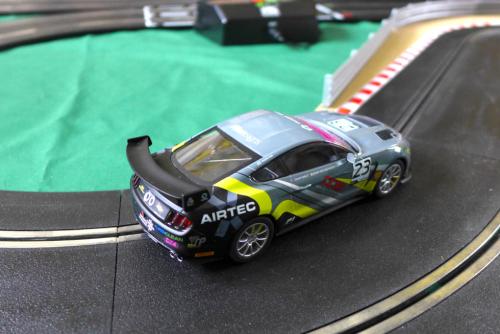
   

That’s it for understeer – at least for now. Although not a big deal for the Mustang, the front tyre truing and varnishing is an important tweak on any slot car. So is tightening the guide and beginning to look at a little weight up front.

Next time we’ll look at ‘Body Float’ – progressing from the basic loosening of the body screws from Part 2 to give a car that handles more predictably around any circuit – and will certainly help any car suffering from understeer.

I hope you’re finding these tuning tips useful – and understanding some of the principles behind them. Whether you race at home or are looking at trying out some club racing, being able to tune your cars certainly increases the enjoyment of this great hobby of ours.
[+] 6 members Like woodcote's post
Quote
#12

Scalextric Tuning 7 – Body Float


Despite a firm basis in science, body float is a very satisfying ‘dark art’ of slot car racing…

If my school teachers had used slot cars to teach us physics, I reckon I’d remember a lot more. Body float is one of those slot car tweaks that is obviously based on sound scientific principles, but all I can tell you for sure is it works – making a slot car handle significantly better in corners and reducing lap times.

In this post, I’ll do my best to try and understand the science and then go through some steps to increase the body float on our test car, the Scalextric Ford Mustang GT4. We’ll see how much different the modification make to a two-minute test run on my Jadlam SL6 test track.

Why do we need Body Float?

In Part 2 of this series “Tweaking a New Car” we looked at loosening the screws so the body is loose on the underpan. That’s basic ‘body float’.

Imagine you’re driving a full size road car and you turn a corner a little too quickly… The car will struggle to turn in and will start to tip a bit to the outside. The wheels on the inside will start to squeal, indicating they are lifting and losing grip. Inside the car, you’ll notice the driver and any passengers are tugged towards the outside of the corner – and it’s the same for any luggage or loose items.

What’s happening here is a type of inertia – a resistance to changing direction. We all know that when a slot car crashes in a corner it’s a combination of the car wanting to go straight on and it tipping over. Scalextric cars are nicely detailed scale models. However, that means their body shells are reasonably heavy and many cars have quite a high ‘centre of gravity’ – meaning more weight up high and more of a tendency to tip over going round corners. That weight is pulling the inside wheels up and off the track.

The standard traction magnets certainly help mask this effect, but there are three simple ways of overcoming that tipping…

    • Adding more weight down low in the underpan to lower the centre of gravity
    • Adding stronger traction magnets
    • Getting the body to ‘float’

Adding a little weight to the underpan (also called 'the chassis') can be useful to overall handling, as we’ve seen. However, the sort of weight required to lower the centre of gravity would make most cars pretty heavy! That means they’d struggle to slow down and to accelerate, certainly making cornering tricky and not necessarily reducing lap times. It is a similar problem with stronger magnets, there are some big disadvantages – especially lower top speed, overheating and reduced motor life.

Which leaves us with body float. The theory is that if the body is ‘floating’ a little, its weight is not transferred immediately to the underpan as the car enters a corner – which prevents the inside wheels lifting. Put another way, this lowers the effective centre of gravity and helps the car corner better – making the car less likely to tip, lose traction or fall over. 


Simple Body Float – Loosening the screws

We already looked at this in Part 2, but here’s a recap. Using a cross-head screwdriver, simply loosen each of the screws holding the body by one full turn anti-clockwise. For the Mustang, there are three screws – other cars may have four screws holding on the body. Before loosening, the body and underpan of the Mustang felt locked together. Afterwards, there’s some side-to-side movement, a rattling sound and a tiny gap opens up. This is all very good. Few Scalextric cars will give this degree of body float simply by loosening the screws, but it is worth doing in any case.

Did loosening the body screws help? Back in Part 2, I reported that there wasn’t a dramatic change to the feel of the car, but a two-minute test saw the Mustang improve by one lap and drop it’s best time of 0.39 seconds.

A couple of final thoughts on screws… 

    • loosening screws too much will cause them to drop out on the track. This is never good, but on a digital layout they are likely to cause a short circuit or ‘power overload’ warning if they end up in the slot. Adding a little tape over the screw holes will save any disasters should they fall out.
    • Upgrading the body screws to longer versions reduces the risk of the screws falling out. Using screws with no thread immediately under the head will improve body float a little. I’ll look at upgrades in the next part of this tuning series (Part 8 – Upgrades).


Advanced Body Float – Sanding edges and cutting off lugs & braces

The aim of more advanced body float is to ‘de-couple’ the body from the chassis as much as possible. That usually means removing all tabs and braces that connect the body and the underpan, plus lightly sanding the edges (sides, front and rear) of the underpan so there is a gap of half to one millimetre between the edges and the body. These modifications should allow the body to move by about a millimetre up-and-down, side-to-side, front-to-back, as well as tilting in three dimensions.

How well we can achieve this aim on a Scalextric car depends on the layout of the body and chassis. It’s completely possible on a car that has a simple flat underpan with no interconnecting parts, but once there are raised pieces (bumpers, valances, grilles, front and rear splitters etc) connecting to body, it does become difficult.


On our Mustang GT4, the underpan is wider and longer than the body – with a front splitter, side sills and rear diffuser. That means sanding the edges of the underpan will not aid body float on this car. Loosening the screws did mean the body could float over the top of the chassis, which is good enough.


Inside the Mustang, there are braces from the interior to the rear axle and motor – and a large tab on the right side of the underpan. Four small tabs on the underpan hold the body on the side sills and two tabs on the body hold the rear light board, plus one each for the two separate headlight boards. All these tabs and braces will be removed to cut the connection between body and chassis.


There’s one final thing to look at – the body posts. On the Mustang, the three body posts (two front, one rear) sit on top of corresponding stubs on the underpan. These stubs have a small flange to hold the body post in place and will limit any side-to-side and front-to-back float. Those flanges need to come off – either by sanding or trimming with a scalpel. If you are racing in a group or at a club that has rules, check you can do this. There may be a rule against lowering the car (ie trimming down body posts), but removing material from the chassis to aid body float may be acceptable. If in doubt, ask.


With these modifications complete, the Mustang reassembled and the screws loosened as before, I had a car with surprisingly good body float. A two minute run on the SL6 test track gave me a score of 27 laps and a best lap time of 4:19 seconds.

Another thing I noticed, is that the rear light board sits very close to the body post and the wires have clearly got caught and squashed between the body post and underpan stub. That won’t help body float. You could simply remove the rear lights to free up the rear post. I don’t want to do that – and rear lights are required for my club racing – but what I could do later is de-solder the wires and attach smaller gauge wire to the rear side of the board, taking them out of the way of the body post.


That’s pretty much as far as I’m going to go with tuning the Mustang’s standard parts. There are other things we could do – sanding out the inside of the body to reduce its weight; removing the lights; gluing the axle bushings; making the underpan more rigid, running in the motor and gears etc – a couple of which will be covered in the final part of the series.

Next I will look at fitting some upgrade parts from Slot.it and NSR to the Mustang – a couple of which I’ll carry over to Part 9, where I’ll show you a non-magnet set-up. That’s the set-up which I’ll be using at my Scalextric digital club. The final part will look at a few more preparations for racing the Mustang at the club and how to develop and maintain a race car.
[+] 5 members Like woodcote's post
Quote
#13

Scalextric Tuning 8 – Using Upgrade Parts


So you’re going to spend your money looking for that ‘unfair advantage’?

Tuning of the Scalextric Mustang GT4 has been all about getting the most out of the standard components. Apart from a few basic tools and materials, I’ve not used a single upgrade part. I think this is the best way to understanding how a Scalextric car works, learn new skills and how to problem-solve issues. Every increase in performance – small or large – is down to our hard work.

Of course - if you want to spend money - there are shortcuts to performance. To be able to use upgrade parts successfully, it really helps to have a solid grounding in methodically tuning a standard car with standard parts. See it as an apprenticeship...

In this blog post I will look at some of the tune-up parts available that will fit into a standard Scalextric car. I'll be improving our test car and creating a second car – a monster of a Mustang!

Slot.it and NSR performance parts

Over the past twenty years, Slot.it and NSR have been at the forefront of creating high-performance slot cars for home and club racing. Both companies started by producing tune-up parts – and many of these parts will fit into a Scalextric car. Having said that, the Slot.it and NSR components are designed to work in a performance slot car. Simply throwing powerful motors or super-sticky tyres at a Scalextric model won’t necessarily make it faster round a lap. But carefully selecting – and testing – tune up parts can make a difference...

Upgrading Our Mustang GT4 Project Car

First, I need to set a benchmark time. The Mustang is as it was at the end of Part 7 – all standard parts – plus a fresh scuff of the tyres. A two minute run on my Jadlam SL6 test track gave an impressive 27 laps and a best time of 4:17 seconds – we do have a pretty good car now. Don't forget our first two minute run at the start of Part 2 - 15 laps and a 6.96 second best lap. Can we go even faster? 


I’m going to start with a couple of small changes...

1. Better Screws

One useful way to improve body float is to use a screw that has no thread under the head. This allows the body to move more freely without the screw being so loose it risks falling out. Losing screws is something that has happened quite often to the Mustang in these tests –  and that can cause a short circuit or power overload if the screw fall into the slot. I’ve replaced the standard screws with Slot.it SICH53 Metric screws, but the CH51 version are a few millimetres longer and might possibly be a better choice. The important thing is to use a ‘small head’ metric screw – the large head versions won’t fit in the Scalextric underpan. 


The new screws certainly give a better ‘rattle’ and more front-to-back movement. On a couple of warm-up laps, the car didn’t feel quite right. The rear of the body was very loose, so I tightened that screw to give more normal body float – and the behaviour of the car on track was much improved. I guess that goes to show how small changes can make a noticeable different to the handling of our car – and that’s a reason why I’ve changed and tested only one thing at a time during this Tuning series.

A two-minute timed test run gave 26 laps and 4:17 seconds. No difference, but no risk of the screws falling out!

2. Racing braid

Using a very thin braid helps keep the front of the car stable and copper braid gives better conductivity. Many slot racers use NSR Ultra Soft Braid. This is available in 1 metre length so you can cut it how you want – or in ready-cut packs of ten (enough for five cars). There’s also a choice of bare copper braid or tin plated. The plated braid is more rigid and harder wearing. The bare copper is softer, but needs more regular tweaking.

Although the NSR braid is the racer’s choice, it might not be ideal for you. It needs more care and attention and can also get damaged on lane changers and crossover pieces – any strands that break off are likely to cause a short circuit / power overload on a digital or ARC powerbase. A more robust alternative is the Slot.it SISP19 Competition braid, which is a little thicker.

Cutting and fitting braid to the Scalextric Easy Change guide requires a bit of practice. Make sure you use a pair of sharp and strong scissors to cut the braid cleanly. First, remove the original braids, measure the length and cut a length of racing braid about 2-3mm longer. Insert the new braid into the slot at the back of the braid plate, lining up the trailing edge with the rear of the plate. Then wrap the longer end down, forward, up and back. 


The braid shouldn’t be super-tight under the plate, but neither too loose. Repeat with the other side. If the trailing edges are uneven, you can cut them before fitting the braid plate back on the guide. This will create lots of little strands of copper – you don’t want this getting anywhere – in the motor or digital chip, for example – where it can cause a short circuit and serious damage. Finally, insert the braid plate on the guide – back first and then the front. Make sure the plate sits exactly over the guide plate underneath. If it isn’t, you won’t get full power from the track.

With NSR Ultra Soft copper braid fitted, how did our Mustang get on? The new braid did need some laps to bed in, but I felt it gave a smoother and more responsive drive. A 2-minute run gave us 27 laps and a 4:25 second best lap...


The Mustang hasn’t has an issue with understeer, so I’m not surprised this didn’t give any big improvement. I did like how the Mustang drove with the NSR braids, so I think I’ll keep them.

3. Front Tyres

Reducing front grip and getting the tyres to only just touch the track is crucial to tackling understeer – as we saw in Part 6. This isn’t a problem for the Mustang – the front is set up nicely and all we did was to true the front wheels and tyres and then add a coating of nail varnish to reduce the grip.

It is possible to fit low-profile zero-grip tyres – both NSR and Slot.it make them. However, the front wheels of the Mustang are big and wide – and I couldn’t fit any of the zero grip tyres I had handy. Looking at the dimensions, the Slot.it SIPT15 zero grip tyres are probably wide enough to fit. These might be a good choice for Scalextric GT cars. I use the SIPT19 tyres on my BTCC front tyres – these are very low profile and work very well.

4. Rear Tyres

Rear grip has always been an issue with the Mustang. With careful truing - and softening the rubber with some oil - I have achieved a decent balance of grip and handling with the tyres that came with the car. However, I want to see if simply adding some Slot.it or NSR tyres would have been an effective shortcut.

Performance slot car tyres come in various compounds and sizes. Getting the right compound for a specific track surface can be a tricky process. If you’re racing at a club, ask what other people are using. Most of the recent (after 2016) Scalextric GT and BTCC cars have wheels that are the same size and profile as the ‘European standard’ hubs made by Slot.it and NSR. This means that tyres from those brands will fit the Scalextric hubs perfectly. For these cars, I like the Slot.it P6 compounds for racing on Scalextric Sport track – although I’m starting to experiment with the new NSR ‘RTR’ (ready to race) tyres. The benefit of both compounds is that they need very little preparation – you can slip them on the wheels and off you go.

For the Mustang, I’ll run a tyre test with a pair of Slot.it SIPT24 P6 compound GT tyres and NSR 5260 RTR GT tyres. The NSR tyres are also available in black.

I ran the Slot.it P6 tyres first. These are slightly narrower (9mm vs 10mm) and lower profile (21mm vs 22mm) compared to the Scalextric tyres.  On the test track, the car felt much ‘tighter’ – in that the rear didn’t step out as much. But when it did, the car broke away and I couldn’t save it. That meant I was reducing my corner-entry speed in some places. As we saw when I softened the Scalextric tyres with oil, more grip can make a car trickier to drive – especially one with a high centre of gravity like the Mustang. We solved that in Part 5 by adding some extra weight to lower the CoG. In a 2-minute run, the Slot.it P6-shod Mustang covered 27 laps and set a best time of 4:21 seconds. Not bad.


With the red NSR RTR tyres fitted, the car was sensational. The NSR tyres are the same width (10mm) and lower profile (20.2 vs 22mm) compared to the Scalextric tyres. What made the NSR tyres so good was the extra grip combined with very catchable slides when I passed the limit of adhesion. Of course, the low profile tyre will get the magnet lower to the track rails and give more magnetic downforce, but I’m not sure that was the whole story. A 2-minute run gave 29 laps and a best lap of 3.96 seconds


And it was a much easier drive than with the Slot.its. As an off-the-shelf replacement, these NSR RTR tyres get my recommendation. That’s a first sub-4 second time and a huge 29 laps in two minutes. Awesome!

I’ll leave the project car there for now – with the NSR rear tyres, braid and Slot.it screws. Those will stay on the car for the next step, when we remove the traction magnet.

However, I’ll now go off on a bit of a tangent – a quick look at other upgrade parts in a completely new chassis...


Building The Monster Mustang

There’s no time for a blow-by-blow walk through of how I built this second car. Essentially, I stripped out all the components from the chassis – apart from the traction magnet and the flat bit of the DPR hatch. I then built up the car with performance parts – some from my parts box and some from an NSR Audi GT car.


From back to front...
  • Rear axle: NSR 50mm axle
  • Rear wheels: NSR 17 x 8mm ‘Air System’ aluminium wheels + plastic inserts
  • Rear wheels: NSR Supergrip
  • Axle bearings: Bronze Low Friction (3mm width)
  • Motor: Slot.it MX16 – 23,000 rpm and 170 gcm torque at 12v
  • Gears: 9-tooth pinion and 25-tooth crown gear
  • Wire: flexible silicone
  • Front axle: NSR 50mm axle + NSR 2mm brass axle spacers
  • Front wheels: NSR 17 x 8mm standard aluminium wheels + plastic inserts
  • Front tyres: NSR low grip
  • Guide: Slot.it CH10 universal screw mount guide + NSR 4819 Pick-up spacers
  • Braid: Slot.it Competition braid
  • Body Screws: Slot.it SICH53 small head Metric screws.

So how did it go? Well… it was certainly a monster! Of course, I went against all the advice of this Tuning series by throwing all the parts together and not testing each one to see if it was an improvement. What I had was a car that was a little too powerful and rather top-heavy for the twisty little SL6 test track. I added about 12g of weight into the underpan and that settled it down. On a larger track, the MX16 motor would have space to express itself, but not so much on the SL6.

It took a while to learn how to drive the Monster Mustang, but I finally committed to a timed run and put in 28 laps and a best time of 3:85 seconds. The car was faster over a lap than the final magnet version of our project car, but it wasn’t as easy to drive on the SL6 track.


Had I bought all those parts separately – in addition to the price of the Scalextric Mustang – this hybrid monster would have cost considerably more than buying an NSR GT3 model! And I’m still left with a less than perfect chassis… the NSR and Slot.it cars are designed to get the best out of these high-performance parts. Moving the wheels back onto my bog-standard NSR Audi R8, I fairly effortlessly banged in 30 laps and a fast lap of 3:37 seconds


That was with the NSR magnet fitted. With the magnet removed, I managed 24 laps and a best of 4:67 seconds – which is right up there in the Scalextric magnet car range and an impressive non-magnet benchmark to carry over to next time.

I think that test shows that if you want a super-quick performance car, buy an NSR or Slot.it. Don’t spend your money throwing tune-up parts at a Scalextric model!

Next time, we remove the traction magnet from our Mustang and see what happens...
[+] 6 members Like woodcote's post
Quote
#14

Andy,

These are all excellent articles. Thank you for taking the time to write them.   Thumbup

I may have a different opinion about hopping up Scalex Mustangs. Some cars are simply worth the upgrades.

   
[+] 1 member Likes KensRedZed's post
Quote
#15

Scalextric Tuning 9 – Non-Magnet Mustang


Want a different driving experiences? Go mag-less…

Many home-based Scalextric fans thoroughly enjoy racing without magnets. It’s a bit slower, but there’s more feeling, more realism and a lot less damage when you crash. Almost all slot car clubs race without magnets and magnet-racing can be rather looked down upon. Personally, I enjoy both. It depends on the cars, on the track layout and on my mood.

Running a Scalextric car ‘non-mag’ or ‘mag-less’ is not just a case of whipping out the traction magnet. The cars are designed to run with that extra downforce and they can become a real handful without it. We’ve seen in this tuning series that magnets do solve a lot of issues – from increasing rear-end grip to lowering the centre of gravity. However, if you’ve followed the eight tuning articles so far, you have the perfect grounding to tune your Scalextric car for non-magnet running.

Again, the Scalextric Mustang GT4 will be our test bed – and the Jadlam SL6 layout our test track. Such a short and twisty circuit won’t be ideal for non-magnet running, but it’s what we’ll start with. First, I set a baseline with the car as it finished Part 8 – magnet fitted, NSR braids, Slot.it screws and the treated standard tyres. It was a very hot day and I did 26 laps and a best time of 4:30 seconds.


Out With The Magnet!

Scalextric magnets are fitted securely for safety reasons – swallowing a neodymium is a big health hazard. The retaining tabs on the underpan hold the magnet tight and I’m always a little nervous in case I crack the underpan as I try to lever out a magnet. The safest way is usually to cut off one of the lugs – if you want to replace the magnet, you’d need to glue it back in place. However, the magnet in the Mustang does come out with a bit of firm but careful wiggling with a flat-headed screwdriver. It is important to remove the rear axle and the motor to give plenty of room to work in.


The first thing to do with the Mustang is try the magnet in the alternative pocket in front of the motor. I mentioned this way back in Parts 1 and 4 of this series – and I’m finally going to do it. This is the magnet pocket for the Drift 360 Mustangs and there is less downforce on the rear wheels with the magnet in this forward position. I put the Mustang on track and it wasn’t too different at all – a little more ‘give’ at the back, but really enjoyable to drive. In two minutes, I did 26 laps and a best time of 4:50 seconds – not far off today’s baseline score. The Mustang is unique amongst current Scalextric models to have this option, but a ‘front-magnet’ Mustang GT4 racing class might be a lot of fun – especially with all those tuning tips and upgrades we’ve looked at.

Okay, so after that brief ‘less-magnet’ interlude, I’ve removed the magnet entirely and stuck it on an old metal lighter fluid tin on my workbench – the perfect place to keep my unused magnets.

First Track Test – Tyre Choice

My Mustang is already nicely tweaked and developed. There’s a little bit of weight front and back; trued and softened rear tyres; trued and varnished front tyres; upgraded and re-profiled braids; tightened guide stem; tabs and braces removed from the body; plus loosened Slot.it screws. I needed another benchmark, so I ran my Scalextric Aston Martin Vantage – which has been my car in GT races at our digital club. In two minutes, I did 22 laps and a best of 5:28 seconds.


Driving without magnets is different. Without the downforce, the rear of the car is more twitchy in corners, but it’s also very smooth when you get into a rhythm. The lower cornering speed takes time to get used to, but there’s more scope to be right on the edge of grip – you can feel it, catch a slide and it’s not the ‘on-or-off’ cliff-edge that is so common with Scalextric cars fitted with magnets.

The Mustang isn’t perfectly set up for non-mag running yet… It took me a few runs to get into the non-mag vibe, but when I did the ARC app scored the Mustang at 20 laps and a best time of 5.73 seconds. It was fun to drive – certainly tail-happy, but smooth. What I did notice was a lot of wheel-spin accelerating hard onto the long straight of the test track – a real sign of grip issues at the back.


That was with the standard tyres I’ve worked on. Swapping to the Slot.it P6s improved the grip, but there was still wheelspin. A two minute run gave 20 laps (almost 21…) and a best lap of 5:61 seconds. Changing to the red NSR RTR tyres that were so good in Part 8 gave even more grip. The wheelspin was gone and the car was much more grippy – but less predictable – in the corners. I had to adjust my driving style again, but I managed a timed run of 21 laps and a best lap of 5:38 seconds.

Weight and Weight Distribution

The Mustang is a different car to my Aston Martin Vantage, but I’m already not too far off its benchmark time. The Aston is an easy car to drive – I often share it with novice drivers in our GT team endurance races and they get to grips with it pretty quickly. The Mustang with the NSR tyres handles very differently. I’m going to have to tweak the weight to try and get it more predictable and less ‘tippy’ – the inevitable challenge of a car with a higher centre of gravity.

Currently, the Mustang weighs in at 84g, compared to 86g for the Aston. Out-of-the-box they are similar. I’m going to add weight and move it around in the Mustang – and then see how it handles. There is an established formula that weight should be distributed 60:40 – that’s 60% at the back and 40% at the front. You can measure this with two scales – one under the back wheels and the other under the front. However, any formula is only a start – the characteristics of the car, the track layout and the driver will mean that formula needs to be adjusted.


Another way to look at it is more pragmatic – if the car understeers, it needs more weight just behind the guide; if the car tips, it needs more weight in the centre to lower the centre of gravity; and if the car is too tail-happy, move weight forward – but not too much that the rear wheels don’t bite.

Tweaking The Non-Magnet Mustang

I’m going keep an eye on the weight distribution, but follow the pragmatic route with the Mustang. The first task is to fit some 2mm thick lead sheet into the rear magnet pocket. I measured this at 25 x 7.5mm. The lead is soft, so can be cut with a Stanley knife, using a metal ruler as a guide. I take care when I cut and always wash my hands after handling lead. The piece of lead weighed 3g and fitted perfectly into the rear magnet pocket.


A first test wasn’t good – I’d upset the balance of the car. Remembering how well the Mustang handled with the magnet in front of the motor, I cut another magnet-sized piece of lead and fitted it into that front pocket. I also removed the Blu-Tack at the rear. That was 6g added and 1.75g taken away. The car felt much better on track, although there was a little bit of understeer. A two-minute test run gave 21 laps and a best of 5:32 seconds.

Next, I wanted to add some more weight to the front of the car. I removed the Blu-Tack (1.25g) and looked to added 4.25g of lead weight in front of and either side of the guide. I need to leave the DPR hatch clear (this will be a digital car), so this was the only place to put it. I cut a stencil from thick paper and then cut the lead sheet using the stencil as a guide. The new weight needed some trimming and sanding and was then temporarily fixed in the car using double-sided tape.


Back on the test track, the extra weight had altered the handling again. The car was much more planted at the front, with a bit more ‘give’ at the back. I liked the feel and the Mustang was certainly easier to drive, lap-after-lap. A timed run gave 21 laps (almost 22) and a fast time of 5:38 seconds – frustratingly no tangible improvement in the fastest lap, although the more comfortable handling did mean the Mustang travelled further in the two minutes.

More Tyre Testing & Fine-Tuning

I tried the car with the Slot.it P6 tyres again – just in case they were better with the extra weight. The Mustang was extremely fun to drive – rather loose at the back, but easy to control. I though the performance would be better, but a two-minute run gave just 20 laps and a 5:55 second best lap – pretty much the same as before.

I wasn’t perfectly happy with the car with the NSR tyres, so I added 1g of Blue-Tak either side of the motor in front of the rear wheels. That made the overall weight nearly 94g – and it felt heavy to me on the track. However, the balance of the car was improved slightly – I managed 21 laps and a fast time of 5:26, two-hundredths of a second quicker than the Aston’s benchmark. I called it a day on the test track.


Going back to the weight balance formula, this final version of the car weighed 92.8g in total – 50.8 at the back and 42g at the front. That’s a ratio of 55:45 – not far off the recommended 60:40. Maybe it’s a little too much at the front – especially as the Mustang hasn’t suffered from understeer.

In any case, the tweaking has not ended – it will continue when I race the car at my club. Before I glue the weight in the front, I will trim it down a little – to about 3g. And then I’ll fine-tune the weight alongside the motor. I’ll be doing the fine-tuning on the big, flowing Scalextric Sport layouts we race on, rather than a tight, twisty home track. But I think I have a decent car to develop.


In the final part of this Scalextric Tuning series, I’ll look at the process of developing a race car between events. From crunching data to taking notes at the track, we’ll be using many of the techniques we’ve learned so far to get the best out of the Mustang. Plus I’ll introduce a couple more  to maximise performance.
[+] 6 members Like woodcote's post
Quote
#16

Scalextric Tuning 10 - Developing a Race Car


Once started, the tuning process never ends…

I had hoped to finish this ten-part tuning series with the Mustang GT4 racing at my local Scalextric digital club. However, the club hasn’t yet returned after our lockdown layoff – and I doubt the Worthing GT Championship will resume until next year. So this final part will focus on my usual method to prepare and develop a car for digital club racing.

In this post, I’ll be looking briefly at blueprinting, gluing the motor and axle bushings, plus fitting and testing the digital chip. I’ll also explain how ongoing development can improve a well-prepared car and turn it into a contender

Slot Car Clubs

There are all sorts of slot car clubs – from families and friends racing on the living room floor, to international groups hiring sports halls to run 24-hour races on huge replicas of the Le Mans circuit. I’ve enjoyed both those extremes – and everything in between. Of course, every club is different – from the cars they race, the tracks they race on and whether the format is one-car-per-lane ‘analogue’ or a multi-car digital.

At my club – WHO/digital – we race mostly bog-standard Scalextric cars on Scalextric Sport track, using the Scalextric digital system.


You can see my race box containing the Ford Mustang (GT Championship), a Honda Civic (BTCC), Ford Sierra (Group A Saloons) and Porsche 956 (Slot.it Group C) for our Digital Saturdays – plus an AMC Javelin (Trans-Am) for Wednesday evening events. There’s also a small tool kit, some spare braid, body screws and a digital chip – just in case!

Each club has its own rules and regulations. Ours are very simple. My Scalextric cars have all been prepared using the steps I’ve outlined in this series. However, there are a few extra things I do…

Blueprinting

Common in all forms of motorsport, ‘blueprinting’ means stripping down your car and rebuilding it, making sure the parts are as good as possible and fit together perfectly. In a Scalextric racing class where parts must be standard, you’ll want to use the flattest underpan, straightest axles, roundest wheels, smoothest gears and most powerful motor. 


In Part 8 – Using Upgrade Parts, I stripped out the standard components from a second Mustang GT4 to build the ‘Monster Mustang’ with NSR and Slot.it parts. I will look through the parts I removed and see if any of them are better than those I already have in the car. Whatever parts are left over can serve as spares for my race programme.

Gluing the Motor & Rear Axle Bushings

In Part 9 – Removing the Magnet, the newly mag-less Mustang suffered from wheel-hop under acceleration. Although the NSR tyres and some weight improved things, I still want to tighten up the drive train. Gluing the motor was also mentioned back in Part 5 – Fixing Oversteer when I was truing tyres. The main reason we tighten up the drive train is to conserve energy and prevent unnecessary wear and tear. It also makes the back of the car more rigid, which should improve handling under acceleration – reducing wheel-hop.

First, I remove the motor and rear axle, clean the surfaces I’ll be gluing with lighter fluid (naphthalene) and then I put a couple of dabs of glue between the rear of the motor can and the motor mount – avoid gluing any moving parts! The glue can be a flexible glue (Shoe Goo or E6000, for example) or a superglue. I used E6000. Then I re-fitted the motor and let the glue set. When the glue was set, I fitted tungsten putty either side of the motor to replace the Blu-Tack I’d used before.


Next it’s time to glue the rear axle bushings. I find superglue is best for this. After cleaning the surfaces to be glued, I placed a small drop of superglue in the socket and smoothed it round the edge with a cocktail stick. I prepared both sockets this way before pressing the axle into place. I checked the bushings clicked in fully and left the glue to set – making sure the wheels were off the ground, so not to push the bushings up.

Does it make a difference? A test run on the Jadlam SL6 test track gave me a smooth handling car with good acceleration on the long straight and none of the wheel hop. The car sounded quieter under acceleration, suggesting less movement and better gear mesh. So I’m happy. A two minute run wasn’t spectacular – 20 laps and a best of 5:55 seconds. That was slower than last time, but everything I drove today was well below par. Blame the driver.

Fitting The Digital Chip

The Mustang GT4 is a Digital Plug Ready car and the C8515 chip is just plug and play. I’ve left digital conversion to this stage for two reasons: Firstly, I wanted to tune the car without the added complexity of digital – and second, some of the steps (tyre truing, for example) risk damaging the chip. Adding the chip introduces about two grams towards the front of the car, so there shouldn’t be any extra tweaking necessary.

Once fitted, I always check the wires at the front do not stop the front axle rotating; the chip doesn’t interfere with the cockpit to prevent body float; and the Ferrite Man (see Part 1 – Parts of a Slot Car) is fully isolated from the motor can.


I also check that the LED is not poking out the bottom of the underpan too far – it shouldn’t be anywhere near touching the track. I check this on my acrylic set up block by passing a strip of plastic (1.2mm thick) under the car. In the case of the Mustang, the plastic strip lifts the front of the car up when it passes under the LED – it’s too low. This means the end of the lens will get worn and that might stop the LED communicating reliably with the track sensors. Scalextric have given us lovely low and flat underpans recently, but the chips are still designed for older cars that sat higher.

To fix this issue, I remove the chip from the car and very carefully slice off the two plastic retaining lugs at the front of the chip. I then pop the circuit board off the front plastic legs, so it is angled up – the tip of the LED moves to a position flush with the bottom of the flap. The board should stay in this position without adding any glue, spacers etc. The angle can make re-fitting the plastic plug into the underpan a little tight, especially with the older chips with the large silver capacitor.


If you’re wondering why I’m using an older ‘Rev G’ version of the C8515 digital plug, then I’ll briefly explain… The latest version (Rev H) is a big improvement – it handles more powerful motors and gives a slightly more power. However, for non-mag cars that are top-heavy, I prefer the power profile of the older chip for racing on our big club tracks. I discovered this when developing my AMC Javelin – swapping the chips made the car easier to drive and a potential race winner. However, I use the latest chip (without the big silver capacitor) on most of my DPR cars – more power is a good thing!


Finally, the Mustang gets a quick digital shake-down on the SL6 layout with an ARC Pro powerbase and a digital lane changer fitted. I want to see that the chip works, communicates with the powerbase, counts laps and successfully triggers lane changes. I want to be totally confident my car will work when I get to a club event. The good news is that the Mustang passed all those tests with flying colours. In fact, it handled slightly better than earlier and a gentle two-minute run gave 20 laps and 5:46 seconds. That’s the final timed run of this development process.

At The Race Track

Preparation at home does save time at the track – you know the car works. That means you can spend the practice session familiarising yourself with the track layout, relaxing and being sociable.

This first event will be all about understanding the character of the Mustang on the big tracks we use. I will focus on adjusting my driving style and evaluating the car’s handling. I’ll record lap scores and times (taking a photo of the race screens with my phone), plus jotting down my impressions – and any feedback from my co-drivers – in a notebook or on my phone. I’ll be looking for what’s good and what isn’t – especially whatever factors might be causing crashes and where on the circuit I’m losing out to the better cars. Those notes will be useful as a reminder of what I need to work on between races and as a record of how any tweaks improve the car.

What I’ll avoid are any hasty changes. So far, all my tuning steps have been methodical and thoroughly tested. Rushed changes at the track won’t help. If the car is awful, I might try one thing to improve it. That might be using Slot.it P6 tyres to give more ‘slide’ if the car is very tippy in corners. Or it might be adding some weight in one place, depending on what the problem is. I’ll take those P6 tyres and some Blu-Tack just in case.

Between Races

The time between races is important – a good start are the maintenance tips in Part 3 – Maintenance & Repairs. Done soon after the race, any repairs can be completed and new parts sourced and fitted. Once the car is clean and back to its best, any tweaks can be looked at. Any mention in my notes of oversteer, understeer, centre of gravity, wheel hop and weight should lead me to the solutions we’ve looked at in this series. Of course, an improvement in one area can make other characteristics worse. It’s a case of changing one thing at a time and testing it – at home and then at the club track.

At WHO/digital, we race on a different layout at each event – a good all-round set-up is what I’m looking for. With more experience of the Mustang, I might come up with a ‘fast-flowing’ set-up and a slightly different set-up for more twisty tracks. At clubs that always race on the same track, searching for the perfect set-up is the aim.

Learning From Others

It is exciting and satisfying to develop a race car. However, you can’t do it entirely on your own – gathering information and advice is essential to progress. I discovered a few things as a youngster, tuning Scalextric cars at home – most of it handed down by my dad and older siblings. I’ve picked-up much more from the people I’ve raced with in recent years – and from resources I’ve found in books, magazines, plus online forums and blogs.

Two WHO/digital racers who’ve generously shared their knowledge are Mike Dadson and Gary Skipp. Gary has written tuning articles for the Scalextric website, his DiSCA website and also starred in an excellent video for the Scalextric Test Track team (https://youtu.be/nod0pK00zvU). Mike holds tuning sessions at his home for new WHO/digital racers – if you’re lucky, you might find something similar at your local club. Racers don’t always have time to help or answer questions at a busy club event, but do ask – detailed help and advice might be offered via phone or email in between events.

Scalextric Tuning – It’s a Wrap…

That’s it for this Scalextric Tuning series. I really hope you’ve learned something from these ten blog posts. Most of all, I hope you’ll carry on with your slot car tuning and development. I certainly haven’t covered everything – but there’s lots of information out there and lots of slot car racers that are far more skilled and successful than me. However, by focusing on one standard Scalextric model, this series of blog posts should offer you a solid starting point.

The Mustang GT4 was a good subject – representative of modern Scalextric cars, but not one of the best. Other Scalextric models will require you to focus on different aspects of handling – but the same tuning techniques apply.
[+] 6 members Like woodcote's post
Quote
#17

Many thanks. I hope at least one new person in our club takes time to read these posts.

Life is like a box of Slot cars... Cool Drinkingcheers
[+] 1 member Likes Kevan's post
Quote
#18

Let's hope so Kevan  Thumbup

I was weighing up whether to write an epilogue. I'll keep it very brief...

I have run the Mustang at the club, but not in the full GT championship.


It has been fun - and a complete handful - to drive, but never likely to be competitive against the best of the Scalextric GT3 cars.

I still might try two further upgrades that are permitted within our GT Championship rules - a switch to Slot.it 17mm plastic wheels (smaller than the stock ones) and a lexan interior. Both will bring the COG down significantly.

The car got a bit beat up in the last time out, so it needs some work on it anyway Sun
[+] 1 member Likes woodcote's post
Quote
#19

You could bring it up to date...

Scalextric Tuning 11. To Infinity & Beyond.......

Replace  the chassis with a 3D one with different motor type and layout options (short can, long can, sidewinder, anglewinder).

Life is like a box of Slot cars... Cool Drinkingcheers
[+] 1 member Likes Kevan's post
Quote


Possibly Related Threads...
Thread / Author Replies Views Last Post
Last Post by BAracer
3rd-Jan-22, 05:02 PM
Last Post by tatter06
26th-Nov-21, 09:19 PM
Last Post by Savage GT
9th-Sep-21, 07:37 AM
Last Post by woodcote
9th-Jul-20, 07:37 AM
Last Post by BAracer
1st-Feb-20, 10:41 AM

Forum Jump:


Users browsing this thread: 1 Guest(s)