Thread Rating:
  • 0 Vote(s) - 0 Average
  • 1
  • 2
  • 3
  • 4
  • 5

Basic Tuning Series For Scalextric
#1


Back in 2020 I wrote a ten-part series on the Jadlam blog about tuning a Scalextric car. My aim was to work through the steps for improving a standard Scalextric model by only using the parts that came in the box. I picked the new at the time Mustang GT4, because I thought there might be quite a lot of potential for improvement... And I wasn't wrong!

Jadlams have recently built a brand new website and the blog has gone. So I've dug out the images and text to post on the forum. I've had some good feedback over the years about the blog posts and I want to share the series with a new crop of Scalextric racers at my club, Worthing HO Racing.

There is a post introducing and linking to the blog posts on the SlotRacer forum here. I'll edit that once the posts are up on this thread.

These are the ten posts in the series...

I don't have the full text for a couple of the posts, so those will get re-written.
Quote
#2

Thanks Andy - that's good news.
It was an excellent, in-depth series.
Very pleased to see it return here.
[+] 2 members Like RetroRich67's post
Quote
#3

Hi Andy, if it's of any use there's always 'waybackmachine'... https://web.archive.org/web/202110242257...w-to-slot/

Life is like a box of Slot cars... Cool Drinkingcheers
[+] 2 members Like Kevan's post
Quote
#4

Scalextric Tuning 1: Parts of a slot car


To understand how to tune a Scalextric car, we need to start with the basics.

In this post we’ll look at the parts of a typical Scalextric model, both outside and inside. During this series of Tuning posts, I’ll be using a Scalextric Ford Mustang GT4 as a test-bed to tweak, tune and develop. After each step, I’ll be running the Mustang for two minutes on my test track, a Scalextric Sport SL6 layout with an ARC Air power base. That way, we can see if the work done on the car has improved the lap times and the handling, before moving on to the next step.

Along the way, I will explain any jargon, specialist part names and technical terms as best as I can. The labelled diagrams in this first post will be a useful reference.

So let’s get started with our look at the Scalextric Mustang GT4…

Dimensions & Outside Components


There are four physical measurements that are important to consider when choosing and tuning a race car: Length, Height, Wheelbase and Rear Axle Width. In later posts I’ll add weight and magnetic downforce measurements to that list. In all my slot car reviews I include those six pieces of data. Each has an impact on how the car will handle on the track.

The outside components are common to most Scalextric “high detail” cars: a Rear Wing, Wing Mirrors, working Headlights and Rear Lights, plus a transparent Windscreen and windows showing the cockpit interior and driver. Many of the Scalextric cars that come in sets – as well as some “Super Resistant” and “START” models – don’t have working lights and the windscreen and windows are either blacked-out or are painted on.

What we’d normally refer to as just “wheels”, I have separated into their two components: a plastic Wheel Hub and the rubber Tyre that goes on it. That distinction will be important. I’ve also labelled the Front Splitter – the lowest point at the front of the car. This can be part of the underpan (as on the Mustang) or part of the body. It’s something we’ll need to keep an eye on.

Underneath The Car


Underneath the Scalextric Mustang GT4 we see the underpan or “chassis” and its various components. The Mustang horse logo over the motor is purely decorative – these cut-outs are a nice new feature on Scalextric cars.

At the front are the guide and braids. The plastic Guide Blade sits in the slot on the Scalextric track and ‘guides’ the car round the circuit. Sitting on the guide blade is the Braid Plate: this holds the steel braids in place and connects them to a pair of metal contacts underneath. The Braids pick up electricity from the rails on the track to give power to the car. As we’ll see, getting the guide blade deep in the slot improves handling – and getting the best possible connectivity between the track, braids and metal contacts gives us a reliable and smooth power to the motor.

Behind the guide is the DPR hatch. Any Scalextric Digital Plug Ready (DPR) car can be easily converted to digital by replacing this hatch with a C8515 Digital Plug (C8516 for F1 DPR cars). A small cross-head screw holds the hatch in place.

Through various holes in the underpan, we can see the Motor, the Magnet (with an alternative Front Magnet Pocket) and the Gear. The magnet is attracted to the metal rails on the Scalextric track and gives what we call ‘magnetic downforce’. This helps the car grip the track and go faster through the corners. Adjusting this downforce can dramatically change the handling of the car.

Like most recent Scalextric cars, the Mustang has three screws holding the body to the underpan – two Front Body Screws and one Rear Body Screw. These can be removed using a small cross-head screwdriver to reveal the components inside the car…

A First Look Inside


This first look inside the Mustang shows the underneath of the body, with a flat Tray Interior, the three body Screw Posts and two Axle Bushing Posts to the rear that sit on top of the rear axle bushing to prevent the rear axle getting dislodged in a crash.

On the Underpan – or Chassis – we see the Motor held in a raised part of the underpan: what we’ll call the Motor Mount. The motor in the Mustang is the standard “short can” version. Some cars are fitted with a “slim can” motor – usually Formula One, Legends F1 and some of the smaller Classic cars, like the Escort, Cortina, VW Beetle and Mini Cooper S. For those who need to know, the short can is a Mabuchi FC130 “endbell-drive” motor rated at 18,000 rpm at 12 volts and 100gcm torque. The slim can is a Mabuchi FF-050 rated at 18,000 rpm and 150gcm torque. The slim can motor is more powerful (8.3 to 5.3 watts), which gives cars fitted with the different motors very different characteristics. The two motors are not interchangeable, as they are a different shape and size.

Whatever the motor type, it drives the rear axle via the Gears. In the Mustang – and most recent Scalextric cars – the motor and gears are “in-line”, where the motor sits length-ways and the gear is in the centre of the axle. Many older Scalextric cars have the motor and gears in a “sidewinder” set-up, where the motor sits sideways across the car, next to the rear axle. In this case, the small pinion gear on the motor drives a big crown gear just next to the left hand rear wheel. The standard gear ratio for inline cars is 9:27 (nine teeth on the pinion and 27 teeth on the crown gear). The standard sidewinder ratio is 11:36. A few cars – such as the Classic Mini Cooper S – have different gear ratios.

We also see the location of the Front Light Boards and Rear Light Board – which are fitted with LED lights and resistors to lower the voltage. The Mustang is unusual in having a separate board for each of the two headlights – it has been more usual to have a single board across the front of the car. I prefer the arrangement in the Mustang as the front becomes less crowded.

The Electrical & Mechanical Stuff


This layout is very typical of most late-2010s and early-2020s Scalextric cars. At the front, you can see the guide is attached to the underpan by a small cross-head Guide Screw. There is also the glint of one of the two shiny metal Braid Contacts that fit into the base of the main guide assembly.

Next, you can see the spaghetti which is the Scalextric Wiring Loom. The yellow and green wires connect the braid contacts to a plug that fits into a socket on the DPR hatch (or the C8515 digital chip). The power is then distributed via black and red wires to the front headlight boards and to the motor. The rear light board is fed by wires from the motor.

Part of the wiring system is what we call the Ferrite Man. There are usually two of these in a Scalextric car – one on the yellow and green wires from the braids and another across the motor terminals. The name comes from the orange disc of the ceramic capacitor looking like a ‘head’ and its wire ‘legs’ passing through a grey ferrite bead that looks like a ‘body’. The incoming wires attached just above the ferrite bead can look like ‘arms’. The function of the ferrite man is to act as a filter for electromagnetic interference created by the braids and the motor. This interference can seriously disrupt the working of a Scalextric digital car, so the filters are fitted as standard to all Scalextric models.

The Insulation Tape on the motor is also vital on digital cars – if the wires of the ferrite man touch the metal motor casing, a short-circuit will cause a digital chip to burn up. Even on a standard non-digital car, a short-circuit can cause the power base to go into safety mode.

Apart from the electrics, the diagram shows the important mechanical components – axles, gears and bushings. The Front Axle simply sits in raised hoops, giving a little up-and-down movement. The Rear Axle is held in the underpan via white plastic Axle Bushings. These keep the axle firmly in place, while also giving the axle a smooth surface to rotate in. This axle-bushing surface is lubricated at the factory. Keeping this smooth is important for performance – any friction means power from the motor is used to create heat rather than speed on the track.

The same is true of the gears. A smooth “mesh” between the small Pinion Gear on the motor shaft and the bigger Crown Gear on the axle means less friction and more power to the rear wheels – and less heat in the motor. The gears are lubricated at factory and the mesh is usually nice and smooth – but it is something to look at on a first inspection.

This first inspection – when we first get a new car out of the box – is how we will start the second part of this Scalextric Tuning series. We’ll be getting the Mustang on the SL6 test track and looking at five really easy tweaks to improve the handling and lower the lap times.
[+] 12 members Like woodcote's post
Quote
#5

Scalextric Tuning 2: Tweaking a brand new car


We all want a new car to drive perfectly out of the box.

Sometimes we’re lucky, but usually the car needs a little work to get it running like it should. In this post we look at how to quickly check over a new car and then introduce four easy tweaks to improve handling and lap times. The test bed for this process is the new Scalextric Ford Mustang GT4. By the end of the article, we’ll also have put together a very basic Scalextric toolkit. Don’t forget that all the parts of a slot car are described and explained in the ‘Scalextric Tuning 1: Parts of a Slot Car‘ blog post.

Checking A New Car

The Mustang looked sensational in the box. It had survived its long journey from the factory in the Far East, via the Scalextric warehouse in Kent and Jadlam’s retail store in Somerset. Scalextric cars are designed to be simple and robust and are manufactured in factories specialised in producing electric-powered models. They are lubricated and tested at the factory and go through a quality control process. Although I have seen the occasional car that is sub-standard, I have been delighted with almost all my Scalextric cars.

When I take a new car out of the box, I give it a very quick once-over. After checking nothing is missing or broken on the body, I roll the rear wheels with my finger-tips and make sure the mechanism is nice and smooth. I do the same with the front wheels. I also gently move the guide blade from side to side to make sure it is not caught on anything. If something doesn’t feel quite right, I remove the body by unscrewing the three body-fixing screws on the underside of the car. You’ll need a small ‘Size 0’ cross-head or ‘PH0’ Phillips screwdriver for this.


The main thing I’m looking for is if the Axle Bushings have popped out of their sockets in the underpan. They can easily be pushed back in: line up a bushing with its socket and push down firmly on the wheel – then repeat with the other side. Next, I look at the Gear Mesh, which should be smooth and give a satisfying clicking noise when you roll the wheels. If not, a gear might be cracked (I’ve not yet seen this on a Scalextric car), but more likely you’ll find a piece of debris stuck in between the small pinion gear and the larger crown gear. I have seen one of the wires to the rear light board caught in the gears – potentially damaging the gears (and the wire!) and burning out a digital chip. I presume this is why the Scalextric factory now fits the wires under the axle. Also check the motor is firmly in the motor mount and has not lifted up at the back. If so, it should click back with a firm push.

The final thing to look at is the Clearances between the tyres and the underpan. There are huge gaps on the Mustang, but some cars might be tighter and a little ‘flashing’ from the moulding process could be rubbing on the tyres. Use an emery board to sand away any flashing or increase the clearance a little. With the body back on, check the tyres aren’t rubbing on the body. Slightly loosening the body screws will help.

While the body is off, you can clean up any excess lubrication that has found its way onto the underpan. Lubrication is important on the axle bearings and gears, but too much just gunks up a car and can end up causing an oil-slick on the track. Use a cotton bud (Q-Tip) to mop up any oil or grease from inside the car – and if any has oozed out of the bottom of the underpan.

You can also check that there are no loose wires (especially the green and yellow wires to the braid contacts) and the wiring loom plug is firmly in the socket of the DPR hatch (or digital plug on a digital car). Loose wires are rare on a brand new car, as the cars are checked on a power source at the factory.

A First Outing On Track


My New Mustang GT4 was in great shape out of the box. Everything felt smooth, but I had look inside anyway. Nothing was out of place and the lubrication was perfect – enough, but not too much. I put the car on my SL6 track, did a few test laps and was a little alarmed how tail-out the car was – there seemed very little grip at the back. I set up a two-minute endurance race in the ARC app and did 15 laps and a best time of 6.96 seconds – not great at all…


Tweak #1 – Tyre ‘Scuffing’

A lack of rear-end grip isn’t unusual with a new car and some ‘scuffing-up’ of the tyre surface is a quick and easy tweak. This requires a piece of sandpaper that is big enough to fit under the rear of the car so both tyres are sitting on it. I usually go for 600-grit paper.


This next bit needs some dexterity! Lay the sandpaper on the track – underneath the rear tyres. Hold the rear of the car up and rest your hand on the sandpaper to keep it in place. With your other hand, squeeze the throttle trigger hard and gently lower the rear wheels onto the sandpaper… The first time you do this, the car will probably shoot down the track and the sandpaper will fly off in the opposite direction! Be patient and you will get the knack.

The idea is to just lower the tyres enough so there is a bit of bite on the grit of the sandpaper – enough to begin to rough up the surface of the tyres. At this stage, all we need is a few quick 2-second sandings – there will be a mottled appearance of shiny bits and rough bits on the tyre surface. A proper ‘tyre truing’ will come later… but this ‘scuffing’ is a quick and easy tweak.

**Caution** I don’t recommend sanding tyres when a digital chip is fitted in the car. The added friction of the sandpaper requires more power to go through the chip to the motor. This risks damaging the C7005 retro-fit chip, the C8516 F1 digital plug and older versions of the C8515 standard digital plug. The latest version of the C8515 plug and the Slot.it SP15B chip are both designed to handle more power, but I would still urge caution. It is always advisable to remove a chip before tyre sanding.


Don’t forget to clean the tyres after you sand them. Use the sticky side of some wide masking tape. Tyre cleaning should be done routinely before a race or a timed test session, although the tape won’t normally be as dirty as after sanding the tyres…

The Mustang felt like a different car when it returned to the SL6 test track with its ‘scuffed’ tyres. The rear had much more traction – I could brake later, drive through the corners and get on the throttle quicker on corner-exit. There was still some tail-out slide if I wanted it – but it was nicely predictable and easy to control. The Mustang was handling exactly how I like a slot car to behave.

I set up another two-minute race in the ARC app and completed 20 laps and a best lap time of 5.40 seconds– a huge improvement…


Tweak #2 – Loosen The Body Screws

The second basic tweak requires that cross-head screwdriver again. Simply loosen each of the screws holding the body by one full turn anti-clockwise. For the Mustang, there are three screws – other cars may have four screws holding on the body. Before loosening, the body and underpan of the Mustang felt locked together. Afterwards, there’s some side-to-side movement, a rattling sound and a tiny gap opens up. This is all very good. Few Scalextric cars will give this degree of body float simply by loosening the screws, but it is worth doing in any case. We’ll look at more advanced body float techniques in another tuning article.


Why do this? The theory is that if the body is ‘floating’ a little, its weight is not transferred directly to the underpan, which would risk lifting the inside wheels in a corner. In a nut-shell, this lowers the effective ‘centre of gravity’ and helps the car corner better – making the car less likely to tip, lose traction or fall over. This is a particular issue for taller cars like the Mustang that have a naturally high centre of gravity – in other words, they have more car and more weight higher up than a low and sleek car.

Did loosening the body screws help? There wasn’t a dramatic change to the feel of the car, but a two-minute test saw the Mustang clock an improved 21 laps and a new best time of 5.01 seconds. I was clearing getting more confident with pushing the car into corners – and the body float had almost certainly helped with that…


Tweak #3 – Re-Route The Wires To The Rear Light Board

I mentioned earlier that Scalextric fit these wires underneath the rear axle and this avoids them getting caught in the gears. However, the wires do rub on the axle, causing friction – and friction is a bad thing for performance. The motor will need to work a little bit harder to move the car the same speed. In all honesty, the degree of power-loss is minuscule and there is a slightly increased risk from the tweak of the wires fouling the gear. If you don’t want to do this tweak, that’s fine – it’s simply a way of introducing the concept of minimising friction.


With the body removed, un-clip the rear axle bushings from the underpan, remove the axle assembly, lift out the rear light board, re-fit the axle underneath the wires and then replace the light board. I’d suggest moving the wires away from the gears – I ended up squeezing both together on the red wire side (after I took the picture), but make sure you’re not obscuring the screw hole.

A two-minute timed test run after this tweak yielded 22 laps and a best lap time of 4.96 seconds. Some of that improvement will be down to the car loosening up and the driver becoming more familiar with it, but the re-routing of the wire will have provided a ‘marginal gain’ – and these small improvements do add up…


Tweak #4 – Re-Profiling The Braids

There are two things I like to do with the standard braids. One tweak gets the guide lower in the slot to improve speed through corners. The other improves electrical pick-up. Neither requires any new parts, although a tooth pick or cocktail stick is a useful tool.

The first tweak involves lifting up the main flap of braid and then fishing out the smaller flap underneath. This is usually wrapped under the top braid and faces forward – we want it to trail backwards, the same as the top braid. It is too fiddly to do this with your fingers, so hook the tooth pick underneath the bottom braid flap and pull back. The braid will need flattening and straightening and the top flap pushed back down. The top flaps now sit on the plastic braid plate, rather than a second layer of braid. This lowers the guide blade slightly in the slot.


The next step is to spread the ends of the top flaps of braid so the trailing edge is slightly wider than the front. This is a case of gently pushing the end of the braid with your finger tip to spread the strands a little. If you can, bend up the end in the same movement. This slightly loosened and ‘bushy’ end to the braid give a better connection to the track rails, getting more consistent power to the car. However, don’t overdo it! On a digital track it is especially important to have neat braids that aren’t too spread out – bushy braids can cause a short circuit going over lane changers.

The braids on the Mustang were slightly different lengths – as they were on both of the spares under the box. This isn’t perfect, but not the end of the world. It meant one braid was better profiled than the other. Even though not perfect, the braid tweaks helped the Mustang to 23 laps in two minutes and a new best lap time of 4.75 seconds. This was a lap better and only 0.08 of a second slower than a two-minute test run by a Porsche 911 RSR that has – up to now – been my favourite of the Scalextric GT cars. The Porsche is standard with only the four tweaks outlined here. The Mustang proved itself to be a pretty good car to get that close…


Basic Scalextric Toolkit


  •     Size 0 cross-head screwdriver or PH0 Phillips screwdriver – or this precision screwdriver set, that also includes a pair of tweezers.
  •     Packet of cotton buds (Q Tips). Branded versions are less likely to shed cotton fibres, so are worth the extra cost.
  •     Emery board. Borrow one or add a pack to your pharmacy / pound shop list.
  •     Sand paper – 400 or 600 grit, if possible. If you don’t have any, buy a pack of assorted grits. Pound shop sandpaper is fine.
  •     Masking tape. The 50mm (2-inch) wide stuff is best.
  •     Tooth picks or cocktail sticks.
  •     Notebook or text file. Helps you to remember what tweaks and tuning you’ve carried out on each of your cars – plus any testing data.
We’ll gradually add to this toolkit as we progress through the tuning articles. I hope you enjoy trying out these tweaks on your new or nearly-new cars. Let us know if they help improve handling, reduce laps times and increase your on-track fun.


In the next blog post, I’ll look at on-going maintenance, repairs and spares to help keep your Scalextric cars in top condition.
[+] 10 members Like woodcote's post
Quote
#6

Scalextric Tuning 3: Maintenance & Repairs


Regular maintenance is crucial for keeping your cars performing at their best!

If you’ve spent time tweaking and tuning your Scalextric cars, you don’t want to lose those performance gains. My mantra for slot car maintenance is ‘Clean & Smooth’. Regular maintenance also prevents unnecessary wear and damage – prevention is always better than repair.

In this blog, I’ll take a look at how the Mustang GT4 is holding up, give it a clean, lubricate the moving parts and consider some common repairs for Scalextric cars. By the end, we’ll also have added to our basic tool kit.


Over the past few weeks, the RACE Performance Ford Mustang GT4 has spent three long sessions on the Jadlam SL6 test track. There was the original review, the new car tweaks and preparation for next week’s blog. Although I have been careful with the car – and the track is set up on a clean floor – the Mustang is starting to get dirty, inside and out.

The most obvious places on the outside are the braids, the tyres and few greasy marks on the bodywork. The rear wing and mirrors are unscathed and there are no obvious chips to the paintwork or tell-tale scratches to show the car has been on its roof. Most ‘nearly-new’ cars won’t be so lucky!

Inside looks fairly clean, although on closer inspection there are quite a few hairs wrapped around the rear axle – I share my house with a cat and a long-haired human, so that’s to be expected. I am glad I cleaned up any excess lubrication when I first got the car – grease and oil are a magnet for dust, dirt and grime.

Another thing I noticed are bits of grass ‘flock’ behind the front and rear wheels. This scenic material looks good, but gets everywhere. A while back, some of the track in my SL6 layout was used on top of scenic grass mats. Despite cleaning the track afterwards – and wiping it down before every session since – there are still some bits of the flock lurking somewhere and the cars pick it up with their tyres. That needs cleaning out, but more of a worry would be if it got in the gear mesh – that could cause wear and damage.

Clean & Tidy

The first thing to do is get the Mustang on my workbench. I find it best to work on top of a soft surface that doesn’t scratch the car’s bodywork and prevents things like screws rolling away. I have a neat rubber work mat that has raised edges to keep tools and components separate and safe. A budget alternative is a cheap computer gaming mat.


Talking of screws, I use a silver marker to paint the top of the black Scalextric body screws – this makes them easier to find if they do roll off my workbench onto the floor.

Bodywork: A simple way of keeping your car looking nice and shiny on the outside is to wipe it with a clean, fine microfibre cloth – the type sold for cleaning glasses and phones. If the paintwork is getting dull, scuffed or scratched, a little car polish will get it looking like new. I use AutoGlym ‘Super Resin Polish’.


Braids: I clean braids using a good-quality cotton bud (Q-Tip) soaked in lighter fluid (naptha). Wiping from front to back, this dissolves and removes muck and oxidation. Regular cleaning helps maintain performance. I also tweak the braids to keep them tidy – straight front to back and not too bushy. When the braids get too straggly and worn, it’s time to change the braid plate – there are spares underneath the box.

**Caution** Lighter fluid is highly flammable! Take care when using it and follow the safety instructions on the tin.


Tyres: We looked at cleaning tyres in the second part of this Tuning series. I roll the rear tyres on the sticky side of some 5cm (2-inch) wide masking tape. This lifts off any dirt and should be done before every race to keep grip at a maximum level. Every now and then, a quick scuff on sandpaper will regain some grip too – that is also explained in part two of this Tuning series. Please be very careful scuffing the tyres if your car is fitted with a digital chip!

Underpan: If you don’t over-lubricate your car, cleaning is easy. I use a ‘foundation’ make-up brush for the areas with no greasy spots. The soft brush sweeps up any dust, dirt and scenic flock that has got into the car. A good lung-full of air works wonders too. In areas where there are greasy deposits – usually around the rear axle – I use a cotton bud. If there’s a lot of grease and muck, I soak the cotton bud in lighter fluid. Repeat this for the inside of the bodyshell – you’ll find that gets pretty dirty too.


Removing hairs: Use a pair of tweezers to remove any hairs or carpet fibres you can see – check the gears, the axle and the gap between the bushings and the wheels. It can sometimes be easier to remove the axle. If hairs get in the gear mesh or the axle bushings, they will create friction that will both harm performance and cause the motor to run hot – risking permanent damage. It is especially important to do this regularly if your track is set up on a carpet. A pair of tweezers are included in the excellent Gaugemaster Model Railway Screwdriver Set, although these curved tweezers are what I use and are great for getting into tight spaces.


Cleaning Gears: If dirt, dust or scenic flock get into the gear mesh, it is important to remove it. I use a combination of a toothbrush, cotton bud and tweezers. This will also remove lubrication from the gears, but we’ll re-lubricate in a moment.

Smooth & Lubed

Keeping all the moving parts rotating smoothly is crucial to good slot car performance. Any unnecessary friction means that electrical power going to the motor is turned into heat rather than speed on the track. Parts will also wear out much quicker. Once you’ve made sure your car is clean and any hair or debris removed, it’s time to lubricate those moving parts…
   
Lubrication points: The important places to lubricate are the gear teeth and the rear axle where it passes through the two white bushings. A tiny drop where the front axle passes through the underpan can also be useful. Very occasionally, put a minuscule drop of oil on the brass bearing at the front of the motor. Only use a precision oiler to do this. There is a similar bearing in the plastic ‘end-bell’ at the back of the motor – the tiniest drop of oil on the motor shaft next to the end-bell will also help keep the motor smooth. Please don’t over-oil the motor as any lubrication that gets inside risks gunking up the motor and ruining performance. With the gears, I usually just fill a couple of notches on the smaller pinion gear and then roll the wheels to spread the lubricant round all the teeth on both gears. If you carry out regular maintenance, that is all the lubrication you need.

Type of lubrication: If you asked ten slot car enthusiasts what brand of lubrication they use, you’ll probably get thirty different answers! It is very much a personal preference. There are loads of suitable options – including the pro-race Slot.it and NSR ranges or products sold for model railways.

The lubrication added at the Scalextric factory is a light grease that stays on the moving surfaces for a long time – this is ideal if you won’t be maintaining your cars very often. If you are going to be regularly tinkering under the hood, then a less viscous oil will give slightly freer movement and marginally better performance. Remember not to over-lubricate – that’s a magnet for dirt, creating a horrible gunky slime in the car as well as an oil-slick on the track!


As important as the type of lubrication, is the application. A precision or ‘needle-nose’ applicator delivers a small amount of oil to exactly the place you want it – no waste, no mess. In terms of keeping your car smooth and clean, a perfect starter lubricator is the Gaugemaster Precision Oil Lubricator. I have one in my toolkit, along with a few other alternatives. I particularly like ‘SuperLube’, which is a slightly thicker product. I also have an old bottle of sewing machine oil, which is what I’ve used on Scalextric cars since the 1970s.

Spares & Repairs

My Mustang GT4 is in good shape. It works fine on the track, everything rotates smoothly, no parts are broken and the wheels are tight on the axles. It is always worth carrying out the inspection I described at the start of the second Tuning article. However, there are also a few wear and tear issues to look out for…

Rear wing: The rear wing and the mirrors on most Scalextric cars are vulnerable to snapping off in an accident. To reduce the risk of a breakage to the rear wing, I usually un-glue it. This is a case of dissolving the glue, using a cotton bud (Q-Tip) soaked in lighter fluid applied to the tabs on the underside of the body shell. Gently rock the wing front to back, so the solvent works into the join. Then apply more solvent in the same way. Repeat this as many times as you need, until the wing comes free. As it becomes freer, you can rock the wing more firmly – but never force it, otherwise the tabs will snap! It may take ten or fifteen minutes, but it is worth being patient and gentle. If one side becomes looser quicker, concentrate on loosening up the tighter side before removing either tab from the body.


Once the wing is successfully removed, mop up any solvent and refit the wing without any glue. In theory, it will now fall off in a crash, rather than snap. If you find the wing is very loose and it falls out on its own, add some Blu Tak under the body to hold the tabs more securely. The Mustang wing is very tight, so I lightly sanded the tabs to allow it to fall out. I now also have the option of running without the rear wing, should I want to.

If your rear wing – or mirrors – do break, the easiest thing to do is to leave them off. If you want to repair the car, then gluing the parts back is a reasonable simple job. I use a flexible glue – either a superglue gel or a slower-setting glue like Shoe Goo or E6000. These stick really strongly and the added flexibility allows just a little ‘give’ in future impacts. As with any glue, clean the surfaces of the join, use enough glue – but not too much – and support the join when the glue is setting. However, don’t expect this to be a permanent fix – if it broke once, it’ll probably break again.

If Scalextric don’t produce spare wings and mirrors for all their cars, some enthusiasts produce 3D printed spares. Have a look on Shapeways for what’s available.

Underpan: If you have an extremely heavy crash, it is possible to break part of the underpan. If this is a part that holds the rear axle, motor or guide, you will almost certainly require a replacement. Some sort of repair might be possible, but it is not likely to withstand any heavy racing action.

Wheels: Occasionally, Scalextric wheels come loose and may even fall off. They are easily fixed with a small dab of super glue on the wheel hub, where the axle pushes in. Do clean both surfaces – lighter fluid is ideal – and don’t use too much glue. This is important as you run the risk of gluing the wheel to the axle bushing – so be careful as you push the wheel back on to the axle and leave a gap. You should always do this with the axle fitted to the car. Sometimes a wheel can become ‘wobbly’ – that might be because the wheel has broken or the axle has become bent. This isn’t very common, but a replacement rear axle is required. Spares aren’t always available for Scalextric cars, so we’ll look at alternative rear axle set-ups later in this tuning series.

Wires: If your car stops working, it is possible a wire has come loose. The most common place for this to happen is where the yellow and green wires attach to the guide plate – there is a lot of movement here, putting stress on the crimped join between wire and connector. If a wire does break, it will require soldering. You have the option of taking the car to a friend or local computer repair business – or to do the soldering yourself. If you have a soldering iron and some basic skills, it is an easy job – just remember to remove the metal braid contact from the plastic guide plate. Heat and plastic don’t mix.


If you want to learn how to solder – and it’s a useful skill to have – there are plenty of great guides online. The choice of equipment is vast, but my basic slot car soldering kit is a good quality low-wattage iron (this one from Antex), a cheap soldering iron stand, a ceramic tile for a heat-resistant base, a damp washing-up sponge to clean the tip, rosin-core solder, rosin paste flux and a roll of de-soldering braid. Soldering can be hazardous, so take your time and follow all the safety instructions.

Motor: Another repair that requires soldering is replacing the motor. Even with careful maintenance, a motor will eventually wear out. If it is treated badly and asked to do too much work and gets too hot, it will wear out sooner rather than later. A drop-off in power will mean the car struggles to overcome the downforce from its magnet and will move slower and slower. Jadlams sell replacement motors – the C8197 for ‘in-line’ cars like the Mustang and C8146 for the older ‘sidewinder’ cars. Two soldering points – the legs of the ‘ferrite-man’ – will need to be de-soldered from the old motor and re-soldered to the new one.

That’s it for this week’s blog. I hope you found some of it useful. In the fourth part of the Tuning series, I’ll be returning the Mustang to the SL6 test track to look at tweaking magnetic downforce. However, before I sign off, here’s our updated toolkit…

Updated Scalextric Toolkit
  •     Size 0 cross-head screwdriver – included in the Gaugemaster Model Railway Screwdriver Set
  •     Packet of cotton buds (Q-Tips). Branded versions are less likely to shed cotton fibres, so are worth the extra cost.
  •     Emery board. Borrow one or add a pack to your pharmacy / pound shop list.
  •     Sand paper – 400 or 600 grit, if possible. Pound shop sandpaper is fine.
  •     Masking tape. The 50mm (2-inch) wide stuff is best.
  •     Tooth picks or cocktail sticks.
  •     Notebook or text file. Helps you to remember what tweaks and tuning you’ve carried out on each of your cars – plus any testing data.
  •     Tweezers – included in the Model Railway Screwdriver Set
  •     Microfibre cloth
  •     Foundation make-up brush
  •     Rags (e.g. old cotton t-shirts)
  •     Lighter Fluid (naptha) – available in 100ml tins from most pound shops
  •     Lubricant – an ideal starter oil is this Precision Oil Lubricator
  •     Super Glue Gel
  •     Optional: Soldering kit (see above)
[+] 9 members Like woodcote's post
Quote
#7

Scalextric Tuning 4: Magnatraction


Scalextric cars are fitted with a traction magnet to create ‘magnetic downforce’…

This magnetic downforce has a similar effect to aerodynamic downforce on real racing cars – giving more stability and speed through corners. However, downforce also creates ‘drag’ on straights and the motor needs to work harder than it would without magnets fitted.

In this blog post, I’ll touch on some of the theory behind ‘magnatraction’ and use the Scalextric Mustang GT4 to explain how to measure and tweak this magnetic downforce – and then look at the results on the Jadlam SL6 test track.


‘Magnatraction’ on Scalextric cars only appeared in the late 1980s and early 90s. The first magnets were weak ‘ceramic’ magnets and these were replaced by stronger ‘neodymium’ versions about twenty years ago. Although some slot car racers don’t like magnatraction, most of us see the magnet as just another part of a Scalextric car – as much as the wheels, motor or braids. If we’re going to tune a car, then thinking about the magnet is as important as every other component.

How Magnatraction Works

The magnet attracts and ‘pulls’ on the metal track rails. The amount of ‘pull’ depends on the strength of the magnet and the distance between the magnet and the rails. Some older Scalextric START and Super-Resistant models were fitted with stronger magnets, but the magnets in most of the current standard cars are quite uniform, with plus-or-minus 10% variation.

Despite similar magnet strength, different models can have very different magnetic downforce. This depends on how close the Magnet Pocket is to the track. The bigger the gap, the less downforce.


All modern Scalextric cars have the magnet just in front of the rear axle to add grip to the rear wheels. Of course, if the rear of the car drifts and the magnet is no longer over the metal rails, magnetic downforce is lost and the car spins out, flips over or flies off into the scenery. That ‘all-or-nothing’ feature is one of the least attractive things about strong magnatraction and can lead to damaging high-speed impacts, broken rear wings, smashed windscreens and frayed tempers.

Downforce vs Drag

Magnetic downforce gives the car more speed and stability through corners. It also creates ‘drag’ on straights – the motor needs to work hard to overcome the magnetic ‘pull’. Typically, that means the car is slower on the straight than one with less magnetic downforce. Strong downforce also causes the motor to heat up quicker – and too much downforce risks permanently damaging the motor.

Getting the balance right – three scenarios:
  • On a twisty track with no long straights, more magnetic downforce will give quicker lap times – unless too much downforce overheats the motor and starts to slow the car.
  • On a fast track with few corners and long straights, less downforce may give quicker lap times.
  • In an endurance race, less downforce will put less strain on the motor and it will perform better throughout the race. Fastest lap times may be slower, but you’ll finish with a healthy car and probably win the race!

Measuring Downforce

I have built my own ‘magnet meter’ to measure the strength of magnets in and out of a car. It is based on a jewellers weighing scale with a metal weighing tray that the magnet can ‘pull’. The plastic cover is left on and a hole drilled so I can press the on/off button with a cocktail stick. If I place a magnet on the plastic cover, it will pull up the metal tray underneath and register a negative weight – that is my measure of the magnet’s strength out of the car.


To compare magnets, they should be place in exactly the same place on the tray. Likewise, with measuring the downforce when the magnet is fitted in the car, I place the rear wheels so the magnet is above the pink ‘Magnet’ sticker. It is a simple, effective and cheap solution – the scale can be bought for around £10 – but the weighing plate must be metal. Plastic weighing plates won’t work.

Putting the Mustang on the scales, I got a downforce reading of 33g. That compares to 49g for a Porsche 911 RSR, one of the best handling Scalextric GT cars. The 16g difference is noticeable when I lift the rear of the car off the track and translates into a more ‘tail-out’ character of the Mustang on the SL6 test track. I do like a car that is tail-out – or ‘oversteers’ – and that might explain why I can drive the Mustang almost as fast round the twisty test track as the Porsche. However, it won’t suit everyone’s driving style.

With just the four basic tweaks, a two-minute test run gives me 23 laps and a best lap time of 4.75 seconds for the Mustang, compared to 26 laps and 4.28 seconds for the Porsche. Now it’s time for some tweaking…

Tweaking Downforce

There are three main ways of tweaking magnetic downforce:
  • Changing the strength of the magnets – e.g. adding or replacing magnets
  • Moving the height of the magnets from the track rails – e.g. fitting bigger or small diameter rear tyres
  • Moving the position of the magnets – e.g. using alternative magnet pockets

My preferred way to increase the downforce is to add small 4mm x 2mm neodymium button magnets to the top of the standard ‘bar’ magnet. This increases the combined magnetic attraction. It’s easy to do, easy to reverse and very cheap – a bag of 50 magnets costs about £5. An easy way of reducing downforce would be to remove the bar magnet and glue the button magnets to the underpan within the magnet pocket.

**Caution** neodymium magnets can be very dangerous if swallowed and must be kept away from children and pets. If you are going to use this tweak, I strongly suggest gluing or taping over the button magnets so they can’t fall out of the car.


After removing the body of the Mustang, I added one button magnet at each end of the standard magnet and remeasured the downforce reading. It was now 41g. A two-minute test run saw the Mustang clock up 24 laps and a best lap time of 4.61 seconds. Although the car had better traction in the corners, it also tended to tip over rather than slide. This was awkward at the sharp ‘radius 1’ right-hander in the centre of the SL6 layout and I really had to ease off for this section of the track.


A third magnet in the centre raised the downforce reading to 46g – close to the Porsche’s 49g – and another two-minute test gave us 24 laps, with a best time of 4.32 seconds. The extra magnet made the Mustang less ‘tippy’ – including in the sharp radius 1 corner – but when traction was lost, the car really broke loose. That’s the ‘all-or-nothing’ feature of strong magnatraction I mentioned earlier.


What I had now was a car as quick as the Porsche over a lap, but not as much fun to drive. A worrying issue was the motor got pretty hot after just two minutes of racing – I didn’t want to damage the motor, so called a stop to any more magnet experiments. There are other ways to find more rear-end grip for the Mustang – and I’ll look at some in the next blog post.

However, adding magnets has worked well for me with other cars – one very pleasing example was balancing the performance of the Honda Civic and BMW 125 cars in the BTCC Touring Car Battle set. With two extra button magnets, the BMW became a perfect match for the small and grippy Honda. If you have a fleet of Scalextric BTCC cars, it’s a good tweak to try.

I did want to look at how moving the magnet to the front magnet pocket changed the handling of the Mustang. I was a bit nervous about cracking the underpan when removing the magnet, so I didn’t. I will be removing the Mustang’s magnet permanently in Part 9 – Removing the Magnet, so will take the opportunity to try the other magnet pocket then and report back.

Tweaking Magnets in Practice

There are a number of reasons why you might want to measure and tweak the magnatraction of your cars. Here are a few examples:

Realistic Downforce: Tweaking magnetic downforce is a perfect way of producing realistic race classes. It would be a superb project to tune your cars and tweak the magnatraction to give rear-end grip that mimics the real cars of that class or era.

Balance of Performance: The downforce tweak is a good way of balancing the performance of different models of cars. This is what I did with the Mustang and the Porsche and mimics Balance of Performance tweaks seen in real-life GT racing series.

Avoiding a Magnet War: If you are inviting other people to bring their cars to race, there is always a risk of victory going to whoever has the strongest magnets. Measurement of downforce will be vital, but it’s also one reason why some racing groups choose to race ‘bring-your-own’ cars without magnets.

Running Without Magnets: Scalextric cars are designed to be run with the magnet. Removing the magnet usually gives a car that is undriveable without a fair amount of tweaking. I’ll examine ‘non-mag’ tuning in Part 9 – Removing the Magnet. I also find Slot.it, Policar and NSR cars a much more straightforward way to racing without magnets. I will be looking at these cars in a separate Performance Slot Cars series.

Learner drivers: One final thing… There is a temptation to add extra magnets to a learner driver’s car so they can drive fast without the frustration of crashing. Despite the probability of burning out the car’s motor, it’s not the best way to learn. Scalextric have produced an excellent new controller with four speed-limiting settings. Using the slowest setting gives the thrill of driving ‘full gas’ and then working up through the settings offers a perfect way to learn to drive a Scalextric car. ARC Air and ARC Pro sets have a Max Power menu within the ARC app that does the same.


Next time I’ll start looking at some of the more advanced tuning tweaks we can use on a Scalextric car using the standard parts. I’ll start with Fixing Oversteer– sorting out the rear of the car and getting more power and grip. And then I’ll tackle Understeer – looking at the front of the car to improve handling.
[+] 7 members Like woodcote's post
Quote
#8

Scalextric Tuning 5: Fixing Oversteer


Oversteer is when the rear of the car tends to spin out in a corner…

It’s what Americans describe as the car being ‘loose’ – the rear-end steps out if you’re going too fast. The opposite is understeer, when the car tends to go straight on in a corner – the car is described stateside as ’tight’. Both oversteer and understeer effect slot cars as well as real cars, although for slightly different reasons.

We all have our own driving style, so some of us might like a bit of oversteer on a slot car. I enjoy the tail-out action of our Scalextric Mustang GT4 test car, but it’s also something I want to reduce to give a better-handling GT racer that is quicker over a lap of the Jadlam SL6 test track and – ultimately – at my Scalextric digital club.

The Mustang’s problems seem to be due to poor rear-end grip. A light scuffing of the tyres vastly improved handling and lap times. Increasing magnetic downforce also helped, but that tweak gave the car negative side-effects such as a tendency to tip over and a motor that was running hot.

In this blog post I am going to concentrate on more advanced tyre treatment and adding a little weight to the car. I am sticking with all the standard parts that came with the Mustang and introducing important techniques for future tweaking and tuning.

Rear Tyre Truing

Tyre Truing is a term you’ll come across wherever slot car tuning is talked about. What it means is sanding the rear tyres flat and ‘true’ across their surface. The reason slot car racers do this is to get the maximum amount of tyre gripping the track. If the surface of the tyre bulges out – as it often does on a new car – only the top part of the bulge will be making good contact with the track, seriously reducing grip in the corners.

To true the Mustang’s rear tyres, we could use the sandpaper-on-track technique used to scuff up the tyres in Part 2 – Tweaking a New Car. However, effective tyre truing is a more time-consuming and precise process – and a more robust set-up is required. There are expensive tyre truers available to buy for £150-£250 or more. Most of these won’t do the job on Scalextric axles and wheels – they are for truing tyres on removable alloy wheels. One type of tyre truer that is designed to take the whole axle and both wheels is produced by both Tire Razor and Overdrive. However, you can make something that works just as well for a few pounds…


My DIY tyre truer is made from a scrap piece of Scalextric track that I’ve cut in half lengthways and then hack-sawed out a slice. At the front, I have soldered wires from each rail to terminals (brass bolts), to which I attach my old Maplins bench power supply set to 12 volts. At the other end of the track piece, I have a square of 6mm-thick mdf sheet that has sandpaper glued to each side – 400 grit on one side and 600 grit on the other. This give a lovely flat sanding block. The base is a 25 x 12 cm piece of mdf, each end braced by a piece of white PVC angle.

It wasn’t a difficult job and I had all the kit and materials lying around. To avoid the soldering and need for a power supply, you can use a Scalextric powerbase, power supply and controller – you can pick the powerbase up for as little as £3 new. The plastic and metal connectors will need to be cut from one end to allow the sanding block to sit snuggly. You can slice the track in half length-ways if you want to. You’ll need both hands to concentrate on the car, so a rubber band should be wrapped round the controller trigger to give permanent full power.

**Caution** I don’t recommend sanding tyres when a digital chip is fitted in the car. The added friction of the sandpaper requires more power to go through the chip to the motor. This risks damaging the C7005 retro-fit chip, the C8516 F1 digital plug and older versions of the C8515 standard digital plug. The latest version of the C8515 plug and the Slot.it SP15B chip are both designed to handle more power, but I would still urge caution. It is always advisable to remove a chip before any tyre sanding or truing.

The process of tyre truing is straightforward, but requires patience and care. Sanding too hard and too quick risks damaging the car’s motor, melting the tyres and messing up the sanding block.


The first step is to sand the plastic wheels, which may have lumps and bumps from the manufacturing process that will cause the tyres to be out of shape too. I remove the body from the car and then remove the tyres. The Mustang’s wheels looked pretty good, although there was a slight ridge from the moulding process. I placed the car on the truing track so the motor and wheels spin, holding them up and away from the sandpaper. With the tyres removed, it’s important to be careful of the gears – especially with a sidewinder car – you really don’t want to sand down the gear! I move the sanding block to one side, so the wheel comes down on the edge of the block and the rest of the axle is suspended in mid air.

I slowly lower the wheel so it is just touching the sandpaper – the coarser 400 grit is best for this. You don’t want to push the wheel down. Let the sandpaper gently do its work for five seconds – a count of “1,000 – 2,000 – 3,000 – 4,000 – 5,000” – and then lift up. After a break of at least five seconds, I lower the wheel for another five seconds of sanding. I repeated this process a few times until the centre of the wheel looks nice and smooth and any moulding imperfections have been sanded away. Then do the other wheel in the same way – moving the sanding block across. Each wheel took about two minutes of gentle, methodical sanding.

Now it’s time to true the tyres… I replaced them on my nicely-trued wheels and placed the car back on the truing track, the tyres held above the sanding block. Using the 400 grit paper, I went through the same process as the wheels – gently lower onto the sandpaper, letting the grit do its job for a count of “1,000 – 2,000 – 3,000 – 4,000 – 5,000” and then lift and rest. The tyres grip the sandpaper much more than the plastic wheels, and the back of the car will shudder and rattle – it is important to hold the car steady with both hands, but without pushing down. An easy fix to remedy excess vibration and 'hopping' is to reverse the polarity of the power, so the axle is running backwards. That is my preferred method.

On Scalextric cars that have the motor in-line, you will see the motor flex in the underpan when you true the tyres. The shaft and small pinion gear will climb up the crown gear, adding to the rattling noise. This isn’t good. It shows what happens under harsh acceleration on track – the movement and the poor mesh is a waste of energy that could be powering the car. It also adds wear and tear to the gears. Gluing the motor to the motor mount helps keep everything tight and reduce the noise – we’ll look at this in a later blog post.

One thing I did need to glue was a wheel! Early on, I noticed one of the wheels wasn’t turning when lowered onto the sandpaper – it had come loose on the axle. This is an occupational hazard of tyre truing with plastic wheels. I simply pulled off the wheel, cleaned the end of the axle and the plastic hub with a little lighter fluid – and then added a dab of superglue to the hole and refitted it on the axle. I was careful not to push the wheel too far and risk gluing it to the axle bushing. I left it for an hour to set before returning to tyre truing.

Notice how careful I’m being with the truing process. I could be more speedy – using coarser grit sandpaper, pushing down and truing for longer – but that risks damaging the motor and ruining the tyres. Even with my over-cautious technique, I regularly check the temperature of the motor and the tyres. Hotter than “warm-ish” and I stop. This is something I do once to a set of tyres, so it is worth spending time to do it well.
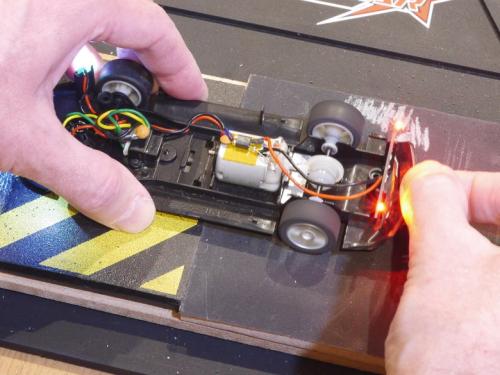
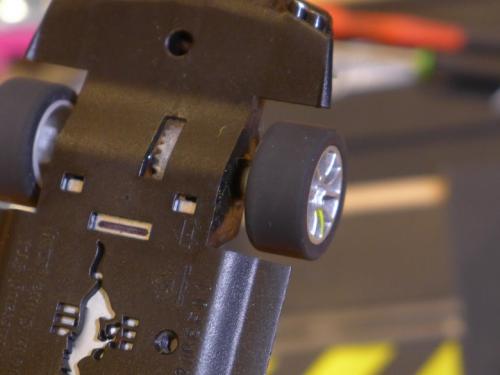
         

The aim of the truing process and repeated five-second sandings is to produce a tyre surface that is perfectly flat and a circumference that is perfectly round. In practice, I am looking at a tyre surface that is smooth and has no shiny spots left – or perhaps just a narrow ring on each edge. That still gives a rounded ‘shoulder’ on the edges, which is important. A completely square edge can increase the car’s tendency to tip over. You can create a more rounded shoulder by spinning the wheels and sanding with an emery board. The tyre truing process took me just over ten minutes for the Mustang. Tyre residue did build up on the sandpaper and I brushed it away from time to time with the soft make-up brush in my tool kit. And there was plenty of muck that came off the tyres when I cleaned them on masking tape.

Before truing I ran the Mustang on the SL6 test track and timed a two minute session using the ARC app. The car was fresh from a full service and tyre scuffing – and I managed a pretty pleasing 24 laps and a best lap of 4.63 seconds, my fastest yet in ‘standard’ spec. After truing the tyres, another two minute session gave 25 laps and my fastest lap time had plummeted to 4.28 seconds – quicker than with the magnet tweaks and the best time for the Mustang so far.


Did the car feel different? It did, especially in the tight Radius One corner, where I had loads of confidence to carry more speed. Unlike the stronger magnet tweaks, I wasn’t feeling the car tip – the rear still stepped out, but only at a much higher speed. I found myself adjusting how I drove the circuit – there were two short straights where I could now blip the throttle where I couldn’t before. That showed I was able to get on the gas sooner and brake a little later.

Although most of the improved performance will be due to extra grip of the tyres on the track, there will also be a small magnetic factor. By removing some rubber from the tyre (about half a millimetre), the traction magnet is now fractionally nearer the metal rails, increasing the magnetic downforce – enough to push up the Mustang’s reading on my magnet scales by nearly 3 grams.

Tyre Softening Treatment

A lot of slot car racers rub oil, WD40 or other more esoteric fluids (eg NSR tyre oil) into the rear tyres of their cars to soften them and give more grip. It’s something I ‘discovered’ as a teenager when tyres we’d used in rally-cross races – we added a little oil to them to make them slippy – suddenly became ultra-grippy when the oil soaked in. It turned out we weren’t the first people to do this… and the 3-in-1 oil we used was the most popular treatment – as it is today.

The theory is that the oil degrades the rubber and opens up the structure a little, making it softer. We only want to do this to the surface of the tyre that sits on the track – the surface we’ve trued – as we don’t want the tyre to swell up and distort. If that happens, the tyre may not fit tightly on the wheel and the surface will no longer be flat and true. The tyre would then need to be glued on the wheel (a palaver I don’t think is ever necessary on a standard Scalextric car) and then re-trued.


With the body removed from the Mustang, I rubbed a couple of drops of my favourite sewing machine oil onto my thumb and forefinger and then rubbed this onto one of the tyres – just coating the surface I’d trued. I topped up the oil on my thumb and forefinger with another drop and rubbed it in to the other tyre.

A thin layer of oil soaks in pretty quickly. After just ten minutes, the surface felt softer and very slightly sticky. I left the tyres overnight before returning the Mustang to the track – I managed 25 laps and a fast time of 4.38 seconds. The feel of the car wasn’t as good – the grip was there, but the sliding had been replaced by a sudden ‘letting go’ when traction was lost. The Mustang felt ‘tippy’ again and I had it on its roof a few times! Another downside was that the stickier tyres picked up more dust and debris from the track, so the initial grip started to disappear before the end of two minutes.

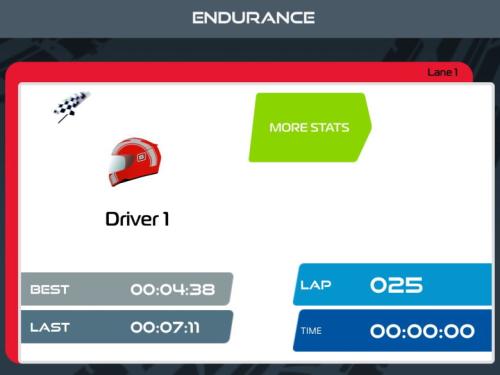
         

This reminds us that a tweak doesn’t always produce a better-handling car. And it’s not possible to revert to the harder tyres – there’s no going back to ‘standard spec’ any more. It’s time for the next piece in the jigsaw…

Adding Weight

Adding weight – or ballast – to a Scalextric car is an important tuning technique when traction magnets are removed. However, it can also be used in a standard car to help with oversteer and understeer. My aim was to do two things: help with rear grip and move the centre of gravity down towards the track a little. I hoped this might give the Mustang more stability.

There are lots of materials used to add weight – and plenty of different opinions of how much to add. When I am tuning a car, I like the flexibility of being able to add and remove very small amounts – so the big 5g and 10g wheels weights or lead sheet aren’t my choice. Instead, I use either tungsten putty (eg Slot.it putty) or good-old Blu-Tack. Unlike some racers, I don’t like my cars to pile on the pounds – an extra gram here or there is enough, an extra 10 or 20g and the car becomes a tank!
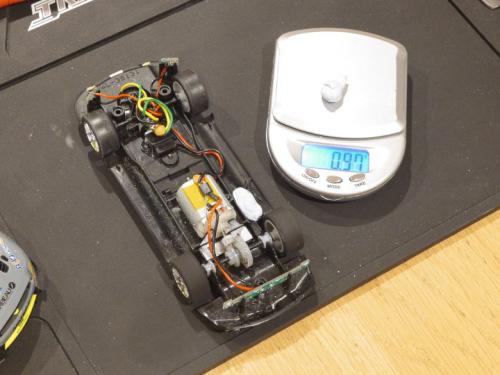
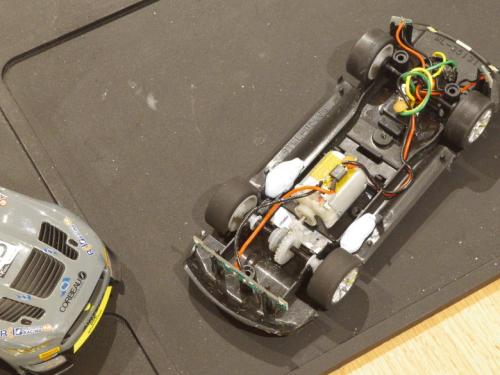
         

I measured two 1g pieces of Blu-Tack and simply pressed these into the underpan, just in front of each rear wheel, either side of the motor. I made sure the Blu-Tack didn’t impede any body-roll or interfere with the tyres, axle or gears.

On track, the Mustang’s handling was transformed – back to how I like it, but with more grip. In the initial ‘shakedown’, I managed a stunning 4.18 second lap. In a proper two-minute test run, I wasn’t able to replicate that fast time, but I managed a record 26 laps and a fast lap of 4.32 seconds. My aim in these test sessions is always to set as fast a pace as possible for two minutes without crashing, rather than an all-or-nothing search for a top time. In that respect, the 26 laps is as important a measure of handling and performance as the 4.32 second best lap.


The beauty of the Blu-Tack is that it’s easy to fine-tune – remove the body, whip out the Blu-Tack, re-weigh and replace. I tested with 0.25g, 0.5g, 0.75g and 1.30g on each side – but the original 1g (or 0.97g to be precise) remained the sweet-spot. The car felt superb, the rear was more predictable when traction was lost – sliding rather than breaking loose or tipping. In fact, the only offs were when the front of the car de-slotted in fast corners… I have created understeer!

In the next blog we will shift our attention to understeer and tweaking the front of the car – including truing the front wheels and tyres, reducing front grip, adding weight and tightening up the guide. This is the half way point of my Scalextric Tuning series and I hope you’re finding the blog posts interesting and useful.

[+] 6 members Like woodcote's post
Quote
#9

This is the perfect series for our clubs newcomers (and a fair few of our oldcomers too  Bigsmile  ) - thank you  Thumbup Thumbup Thumbup

Life is like a box of Slot cars... Cool Drinkingcheers
[+] 2 members Like Kevan's post
Quote
#10

It's a pleasure! That was exactly the motivation for me to make sure the series is available. In the past, I've just been able to share the link to the Jadlam blog with our new racers, or pop it up on Facebook. I wanted to be able to do that again.


I've also enjoyed looking back to 2020-1. Wasn't it amazing to have the time to produce something like this! I know I rarely have the time now to prepare any of my race cars this methodically, let alone photograph it all and write it up. It was a perfect moment to plan and execute this Scalextric Tuning series, so I'm glad I can share the project again.
[+] 5 members Like woodcote's post
Quote


Possibly Related Threads...
Thread / Author Replies Views Last Post
Last Post by BAracer
3rd-Jan-22, 05:02 PM
Last Post by tatter06
26th-Nov-21, 09:19 PM
Last Post by Savage GT
9th-Sep-21, 07:37 AM
Last Post by woodcote
9th-Jul-20, 07:37 AM
Last Post by BAracer
1st-Feb-20, 10:41 AM

Forum Jump:


Users browsing this thread: 1 Guest(s)