

30th-Jan-26, 06:34 AM
Scalextric Tuning 7 – Body Float

Despite a firm basis in science, body float is a very satisfying ‘dark art’ of slot car racing…
If my school teachers had used slot cars to teach us physics, I reckon I’d remember a lot more. Body float is one of those slot car tweaks that is obviously based on sound scientific principles, but all I can tell you for sure is it works – making a slot car handle significantly better in corners and reducing lap times.
In this post, I’ll do my best to try and understand the science and then go through some steps to increase the body float on our test car, the Scalextric Ford Mustang GT4. We’ll see how much different the modification make to a two-minute test run on my Jadlam SL6 test track.
Why do we need Body Float?
In Part 2 of this series “Tweaking a New Car” we looked at loosening the screws so the body is loose on the underpan. That’s basic ‘body float’.
Imagine you’re driving a full size road car and you turn a corner a little too quickly… The car will struggle to turn in and will start to tip a bit to the outside. The wheels on the inside will start to squeal, indicating they are lifting and losing grip. Inside the car, you’ll notice the driver and any passengers are tugged towards the outside of the corner – and it’s the same for any luggage or loose items.
What’s happening here is a type of inertia – a resistance to changing direction. We all know that when a slot car crashes in a corner it’s a combination of the car wanting to go straight on and it tipping over. Scalextric cars are nicely detailed scale models. However, that means their body shells are reasonably heavy and many cars have quite a high ‘centre of gravity’ – meaning more weight up high and more of a tendency to tip over going round corners. That weight is pulling the inside wheels up and off the track.
The standard traction magnets certainly help mask this effect, but there are three simple ways of overcoming that tipping…
• Adding more weight down low in the underpan to lower the centre of gravity
• Adding stronger traction magnets
• Getting the body to ‘float’
Adding a little weight to the underpan (also called 'the chassis') can be useful to overall handling, as we’ve seen. However, the sort of weight required to lower the centre of gravity would make most cars pretty heavy! That means they’d struggle to slow down and to accelerate, certainly making cornering tricky and not necessarily reducing lap times. It is a similar problem with stronger magnets, there are some big disadvantages – especially lower top speed, overheating and reduced motor life.
Which leaves us with body float. The theory is that if the body is ‘floating’ a little, its weight is not transferred immediately to the underpan as the car enters a corner – which prevents the inside wheels lifting. Put another way, this lowers the effective centre of gravity and helps the car corner better – making the car less likely to tip, lose traction or fall over.
Simple Body Float – Loosening the screws
We already looked at this in Part 2, but here’s a recap. Using a cross-head screwdriver, simply loosen each of the screws holding the body by one full turn anti-clockwise. For the Mustang, there are three screws – other cars may have four screws holding on the body. Before loosening, the body and underpan of the Mustang felt locked together. Afterwards, there’s some side-to-side movement, a rattling sound and a tiny gap opens up. This is all very good. Few Scalextric cars will give this degree of body float simply by loosening the screws, but it is worth doing in any case.
Did loosening the body screws help? Back in Part 2, I reported that there wasn’t a dramatic change to the feel of the car, but a two-minute test saw the Mustang improve by one lap and drop it’s best time of 0.39 seconds.
A couple of final thoughts on screws…
• loosening screws too much will cause them to drop out on the track. This is never good, but on a digital layout they are likely to cause a short circuit or ‘power overload’ warning if they end up in the slot. Adding a little tape over the screw holes will save any disasters should they fall out.
• Upgrading the body screws to longer versions reduces the risk of the screws falling out. Using screws with no thread immediately under the head will improve body float a little. I’ll look at upgrades in the next part of this tuning series (Part 8 – Upgrades).
Advanced Body Float – Sanding edges and cutting off lugs & braces
The aim of more advanced body float is to ‘de-couple’ the body from the chassis as much as possible. That usually means removing all tabs and braces that connect the body and the underpan, plus lightly sanding the edges (sides, front and rear) of the underpan so there is a gap of half to one millimetre between the edges and the body. These modifications should allow the body to move by about a millimetre up-and-down, side-to-side, front-to-back, as well as tilting in three dimensions.
How well we can achieve this aim on a Scalextric car depends on the layout of the body and chassis. It’s completely possible on a car that has a simple flat underpan with no interconnecting parts, but once there are raised pieces (bumpers, valances, grilles, front and rear splitters etc) connecting to body, it does become difficult.


On our Mustang GT4, the underpan is wider and longer than the body – with a front splitter, side sills and rear diffuser. That means sanding the edges of the underpan will not aid body float on this car. Loosening the screws did mean the body could float over the top of the chassis, which is good enough.


Inside the Mustang, there are braces from the interior to the rear axle and motor – and a large tab on the right side of the underpan. Four small tabs on the underpan hold the body on the side sills and two tabs on the body hold the rear light board, plus one each for the two separate headlight boards. All these tabs and braces will be removed to cut the connection between body and chassis.

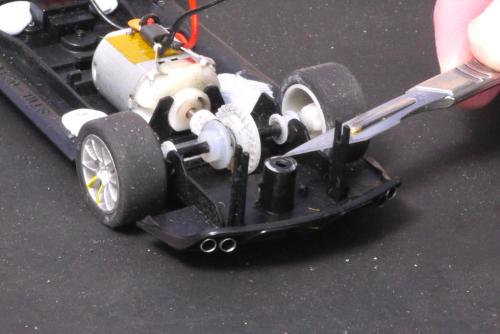
There’s one final thing to look at – the body posts. On the Mustang, the three body posts (two front, one rear) sit on top of corresponding stubs on the underpan. These stubs have a small flange to hold the body post in place and will limit any side-to-side and front-to-back float. Those flanges need to come off – either by sanding or trimming with a scalpel. If you are racing in a group or at a club that has rules, check you can do this. There may be a rule against lowering the car (ie trimming down body posts), but removing material from the chassis to aid body float may be acceptable. If in doubt, ask.


With these modifications complete, the Mustang reassembled and the screws loosened as before, I had a car with surprisingly good body float. A two minute run on the SL6 test track gave me a score of 27 laps and a best lap time of 4:19 seconds.
Another thing I noticed, is that the rear light board sits very close to the body post and the wires have clearly got caught and squashed between the body post and underpan stub. That won’t help body float. You could simply remove the rear lights to free up the rear post. I don’t want to do that – and rear lights are required for my club racing – but what I could do later is de-solder the wires and attach smaller gauge wire to the rear side of the board, taking them out of the way of the body post.

That’s pretty much as far as I’m going to go with tuning the Mustang’s standard parts. There are other things we could do – sanding out the inside of the body to reduce its weight; removing the lights; gluing the axle bushings; making the underpan more rigid, running in the motor and gears etc – a couple of which will be covered in the final part of the series.
Next I will look at fitting some upgrade parts from Slot.it and NSR to the Mustang – a couple of which I’ll carry over to Part 9, where I’ll show you a non-magnet set-up. That’s the set-up which I’ll be using at my Scalextric digital club. The final part will look at a few more preparations for racing the Mustang at the club and how to develop and maintain a race car.
Despite a firm basis in science, body float is a very satisfying ‘dark art’ of slot car racing…
If my school teachers had used slot cars to teach us physics, I reckon I’d remember a lot more. Body float is one of those slot car tweaks that is obviously based on sound scientific principles, but all I can tell you for sure is it works – making a slot car handle significantly better in corners and reducing lap times.
In this post, I’ll do my best to try and understand the science and then go through some steps to increase the body float on our test car, the Scalextric Ford Mustang GT4. We’ll see how much different the modification make to a two-minute test run on my Jadlam SL6 test track.
Why do we need Body Float?
In Part 2 of this series “Tweaking a New Car” we looked at loosening the screws so the body is loose on the underpan. That’s basic ‘body float’.
Imagine you’re driving a full size road car and you turn a corner a little too quickly… The car will struggle to turn in and will start to tip a bit to the outside. The wheels on the inside will start to squeal, indicating they are lifting and losing grip. Inside the car, you’ll notice the driver and any passengers are tugged towards the outside of the corner – and it’s the same for any luggage or loose items.
What’s happening here is a type of inertia – a resistance to changing direction. We all know that when a slot car crashes in a corner it’s a combination of the car wanting to go straight on and it tipping over. Scalextric cars are nicely detailed scale models. However, that means their body shells are reasonably heavy and many cars have quite a high ‘centre of gravity’ – meaning more weight up high and more of a tendency to tip over going round corners. That weight is pulling the inside wheels up and off the track.
The standard traction magnets certainly help mask this effect, but there are three simple ways of overcoming that tipping…
• Adding more weight down low in the underpan to lower the centre of gravity
• Adding stronger traction magnets
• Getting the body to ‘float’
Adding a little weight to the underpan (also called 'the chassis') can be useful to overall handling, as we’ve seen. However, the sort of weight required to lower the centre of gravity would make most cars pretty heavy! That means they’d struggle to slow down and to accelerate, certainly making cornering tricky and not necessarily reducing lap times. It is a similar problem with stronger magnets, there are some big disadvantages – especially lower top speed, overheating and reduced motor life.
Which leaves us with body float. The theory is that if the body is ‘floating’ a little, its weight is not transferred immediately to the underpan as the car enters a corner – which prevents the inside wheels lifting. Put another way, this lowers the effective centre of gravity and helps the car corner better – making the car less likely to tip, lose traction or fall over.
Simple Body Float – Loosening the screws
We already looked at this in Part 2, but here’s a recap. Using a cross-head screwdriver, simply loosen each of the screws holding the body by one full turn anti-clockwise. For the Mustang, there are three screws – other cars may have four screws holding on the body. Before loosening, the body and underpan of the Mustang felt locked together. Afterwards, there’s some side-to-side movement, a rattling sound and a tiny gap opens up. This is all very good. Few Scalextric cars will give this degree of body float simply by loosening the screws, but it is worth doing in any case.
Did loosening the body screws help? Back in Part 2, I reported that there wasn’t a dramatic change to the feel of the car, but a two-minute test saw the Mustang improve by one lap and drop it’s best time of 0.39 seconds.
A couple of final thoughts on screws…
• loosening screws too much will cause them to drop out on the track. This is never good, but on a digital layout they are likely to cause a short circuit or ‘power overload’ warning if they end up in the slot. Adding a little tape over the screw holes will save any disasters should they fall out.
• Upgrading the body screws to longer versions reduces the risk of the screws falling out. Using screws with no thread immediately under the head will improve body float a little. I’ll look at upgrades in the next part of this tuning series (Part 8 – Upgrades).
Advanced Body Float – Sanding edges and cutting off lugs & braces
The aim of more advanced body float is to ‘de-couple’ the body from the chassis as much as possible. That usually means removing all tabs and braces that connect the body and the underpan, plus lightly sanding the edges (sides, front and rear) of the underpan so there is a gap of half to one millimetre between the edges and the body. These modifications should allow the body to move by about a millimetre up-and-down, side-to-side, front-to-back, as well as tilting in three dimensions.
How well we can achieve this aim on a Scalextric car depends on the layout of the body and chassis. It’s completely possible on a car that has a simple flat underpan with no interconnecting parts, but once there are raised pieces (bumpers, valances, grilles, front and rear splitters etc) connecting to body, it does become difficult.
On our Mustang GT4, the underpan is wider and longer than the body – with a front splitter, side sills and rear diffuser. That means sanding the edges of the underpan will not aid body float on this car. Loosening the screws did mean the body could float over the top of the chassis, which is good enough.
Inside the Mustang, there are braces from the interior to the rear axle and motor – and a large tab on the right side of the underpan. Four small tabs on the underpan hold the body on the side sills and two tabs on the body hold the rear light board, plus one each for the two separate headlight boards. All these tabs and braces will be removed to cut the connection between body and chassis.
There’s one final thing to look at – the body posts. On the Mustang, the three body posts (two front, one rear) sit on top of corresponding stubs on the underpan. These stubs have a small flange to hold the body post in place and will limit any side-to-side and front-to-back float. Those flanges need to come off – either by sanding or trimming with a scalpel. If you are racing in a group or at a club that has rules, check you can do this. There may be a rule against lowering the car (ie trimming down body posts), but removing material from the chassis to aid body float may be acceptable. If in doubt, ask.
With these modifications complete, the Mustang reassembled and the screws loosened as before, I had a car with surprisingly good body float. A two minute run on the SL6 test track gave me a score of 27 laps and a best lap time of 4:19 seconds.
Another thing I noticed, is that the rear light board sits very close to the body post and the wires have clearly got caught and squashed between the body post and underpan stub. That won’t help body float. You could simply remove the rear lights to free up the rear post. I don’t want to do that – and rear lights are required for my club racing – but what I could do later is de-solder the wires and attach smaller gauge wire to the rear side of the board, taking them out of the way of the body post.
That’s pretty much as far as I’m going to go with tuning the Mustang’s standard parts. There are other things we could do – sanding out the inside of the body to reduce its weight; removing the lights; gluing the axle bushings; making the underpan more rigid, running in the motor and gears etc – a couple of which will be covered in the final part of the series.
Next I will look at fitting some upgrade parts from Slot.it and NSR to the Mustang – a couple of which I’ll carry over to Part 9, where I’ll show you a non-magnet set-up. That’s the set-up which I’ll be using at my Scalextric digital club. The final part will look at a few more preparations for racing the Mustang at the club and how to develop and maintain a race car.
![[+]](https://slotracer.online/community/images/bootbb/collapse_collapsed.png)