


- Forum posts: 48,459
- Forum threads: 5,012
- Members: 1,694
- Latest member: DutchKing 66
Upcoming Events
WHO Autumn Stages - 28th-Oct-26
WHO Nascar - 4th-Nov-26
NSCC Leatherhead Swapmeet - 8th-Nov-26 ( - {4})
WHO Tin Top Saturday - 14th-Nov-26
WHO Test & Fun Night - 18th-Nov-26
WHO F1 - 2nd-Dec-26
WHO Tin Top Saturday - 12th-Dec-26
Swindon Swapmeet - 10th-Jan-27

Background
A description of the factors involved in selecting and optimising braking options.
1. Simple fixed
Available since the club wired (3 wire) brsca style controllers & plugs came into common use.
(2 wire controllers do not have brakes)
The motor is directly shorted out when the throttle is released.
2. Adjustable fixed
Became available shortly after 3 wire braking was introduced.
A variable resistor was Introduced such that the short across the motor can be "softened" so that over braking can be avoided.
A car will have an optimal initial braking force.
At the optimal point, the car will come to a halt quickly.
Beyond the optimal, the tyres skid & skip, the pod hops, the car shakes, compromising corner entry.
Some cars are much better left to roll into the corner.
"Full brakes" reduces the speed too much, no matter how short the time it is applied.
3. Sweep
This function became available with digital pulse width modulation controllers like the Slot.IT SCP.
Braking force is initially hard and progressively releases as the car enters the corner.
Sweep time can be adjusted such that the progression from hard initial braking to the full release point can be optimised for the car and the track, enabling slower or faster release as required.
This braking method ensures the optimal corner entry speed even if the driver brakes a little early.
Note that sweep braking is not "anti-lock" braking but is the best approximation that can be made without the car carrying sensors and feedback mechanisms.
4.Adjustable Start Point Sweep.
Using Sweep time braking, there is no method on the Slot.IT SCP2 to initially engage the brakes at anything less than 100%
Why would you need this?
I started thinking on this problem when I was driving a car where the initial bite of the brakes was triggering such bad behaviour in the car that I had to set the throttle to a fixed adjustment. (2 above)
Just as for "adjustable braking" , the brakes engaging 100% at the start of the sweep can cause the tyres to lose traction and the car to shudder.
How to work around this limitation?
A. Some clubs have an old school rheostat adjustable brake fitted to the plug in point.
If the plug in point has a rheostat, adjust in conjunction with Sweep brake.
If the plug in point does not have a rheostat, you can buy a "choke box" that plugs into the plug point. Your controller plugs into the choke box.
This is a very expensive version of a choke box.
B. Create a linkage inside your controller's plug and insert a resistor of suitable specification to emulate a choke box.
I'm hopeful that the recently released Slot.IT SCP3 controller might enable this feature without the nasty work arounds described above.
If anyone has a Slot.IT SCP3 controller (and the associated phone App) and has experimented with this, please let me know what you found.
A disclaimer.
Everything above is my own opinion.
Feel free to disagree, I'm always open to listening to alternative view points.
There is always something new to learn in this sport
Alan W
Nonfractal


A few statements used by slot car manufacturers and their real world meanings:
RTR - ready to run. Meaning - you will need to strip the car down, fix the noisy gear mesh, replace the bent axles, remove the wonky wheels, glue them back on straight, true the square tyres and adjust the guide height before the car will actually be able to complete a lap.
Accurate scale model. Meaning - an inaccurate scale model. The driver will be on the wrong side in rally cars. Current F1 cars will be a relivery of a two year old model. Any car originally carrying tobacco or booze company sponsorship will have it replaced by something fictitious.
Anticipated delivery first quarter. Meaning - it might arrive by Christmas if you are lucky.
Limited edition. Meaning - we have made the normal quantity but the collectors will probably fall for it if we put a number on the box.
Recommended retail price (RRP). Meaning - a fictitious inflated price which nobody in their right mind would pay.
Special offer price. Meaning - the real price of the item which we will charge a month after release.
Super Resistant. Meaning - the mirrors and rear wing will break in the first crash.
Exclusive car for club members. Meaning - Car with an awful fictitious livery that the shops won't stock.
Anybody got any other examples?

I am trying something new (to me), for my table top track layout and wanted to fish for some opinions about what I am trying to do.
I have posted previously about the evolution of my table top track. I have not been happy about the latest attempt at building a new layout. Issues with the braid not staying stuck down and also that I had to use magna braid and really did not want any magnetic advantage on this layout.
So I got thinking about how I could use my laser to help me out here and do something different. I could design sections of track within the limits of my 30cm x 40cm laser bed and piece them together on the table. Very much similar to a plastic track but more variety on corners and crossovers etc if I wanted to try something different.
For the power lines I can use standard 1.2mm copper wire that is recessed into an engraved grove for it around the track.
My first test piece.
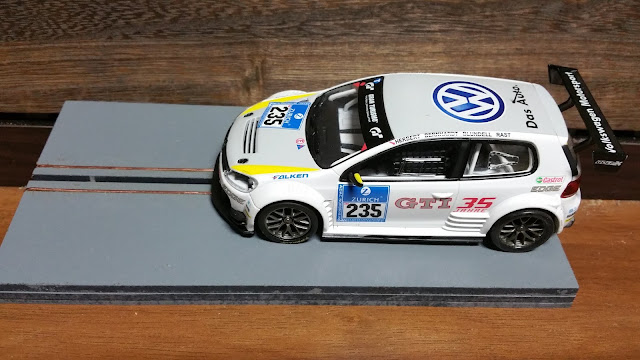
So far I am pretty happy with the results and looking forwards to making more pieces and testing. If this works out, I can try adding road textures like cobble stones with the same engraving process that does the power lines.
Any thoughts on this?
The SRC Porsche 914/6 GTs have been enjoying some great endurance racing all over the world. Next Sunday, they arrive in Watford for a six-hour race at Nascot Wood. Six teams will be taking part.
Each team has been supplied by SRC with the update of their Porsche 914/6 GT circuit racing kit...
Teams have built up the chassis and decorated the bodies in period style to look something like this...
Motors and pinions will be handed out on the morning of the race. Three of us from Worthing will be joining Nascot Wood superstar Martin Dixson - I'll let you know how we get on...

Rock County Raceway, part one - The original Tyco oval
The idea for the Rock County Raceway came from browsing obscure Californian slot car forums and learning about the great fun to be had with short 'bull ring' ovals. Real-life bull rings were the tiny ovals that appeared around the USA from the 1930s to the 60s that satisfied an appetite for racing where there was either a lack of money or a lack of space to build the more usual quarter-mile or half-mile local tracks. There's no official definition, but a track length of anything less than a quarter or fifth of a mile counts as a bull ring. The racing experience was a very short blast on a very short straight and then skilful driving round the tight corners. Here's a couple of pics of the Kearney Bowl in Fresno that inspired the Californian HO bull ring racing circle...
After much playing around and taking advice from the other side of the pond, I set about building my four-lane HO bull ring. I would use Tyco sectional track on a 4 x 2 foot lightweight board. The track and most of the materials were things I had lying around. The table was built with 3mm mdf on top of a timber frame. I squeezed some PVC angles between the frame and board to give an integral retaining wall on each side. The Tyco plastic sectional track was attached using silicone sealant with power wires soldered to the underside of the rails. I drilled holes for light sensors to hook up to a computer via a Trackmate board.
I tested the track and it was just what I'd hoped for. The straights were just under 4 feet long and the turns have an outer radius of just under a foot - a custom six inch radius turn piece inserted at each end to make the corner entry tighten. Overall, the outer lane was thirteen foot long and the inner is ten and a half feet. The average lane length is 11.82 feet or one seventh of a 1/64 scale mile or one sixth of a 1/76 scale mile. The Rock County Raceway was comfortably a 'bull ring'.
Having filled some gaps between track pieces and painted the main straight grey, I held a successful test night in late 2011 - and then that was it for nearly three years. The trials and tribulations of life in general, plus a leaking roof meant the oval stayed in storage until 2014. There was then a whirlwind of activity to get the oval ready in time for its first proper race in August.
The first task was to re-think the oval in light of things I had learned in the three intervening years. I had built two more tracks and my grasp of slot car-related electronics has come on leaps and bounds. I have also become fascinated with the original 1/76 scale cars - particularly the Aurora Thunderjets and their Auto World copies. On dusting down the oval and running some cars, I realised that it was really too small for the quicker cars I'd originally planned to use. The T-jets were perfect and Aurora Magnatraction and Auto World Xtractions quick, but not too quick.
I rewired the track, then built UK club standard 3-pin driver stations, using CAT-6 cabling to connect to the track. I fitted a relay to control track power and reed switches hooked up to Trackmate to provide lap timing and race management.
That done, I flipped the board over and finished painting the track, added an infield and painted that too. I used foamboard as end barriers and added some advertising hoardings.
I was basing the look of the raceway on a Wisconsin short track. My partner's mother grew up in Beloit and hung out at the local track with her friends - it was just something to do in the summer. In homage, the track was named Rock County Raceway and I added some local ads to the hoardings. Many of the Wisconsin short tracks have now closed, but I looked closely at one of the survivors, the quarter-mile Rockford Speedway just over the border in Illinois. I hope I captured something of its character...
One thing I definitely needed was catch fencing. Nothing I could find commercially looked like what I wanted. In the end I found some plastic netting used for keeping pet reptiles and threaded through piano wire as poles. To avoid injury, I added heat shrink tubing to the top of the wire. The bottom of the wire sits nicely into plastic tubes cut from cotton bud sticks that are glued to the back of the side walls.
For some final touches I added a wrecker truck and ambulance to the infield and then we were ready to race in my basement kitchen.
Seven club mates from Worthing HO Racing joined me for an excellent evening trying out different race formats with a set of four race-prepared Auto World T-jets. By the end of the night, the quickest drivers were turning sub 2 second laps with the T-jets and even faster with their Magnatractions and Xtractions. The track got the thumbs-up. Here's a very quick taste of the action...
We raced on the oval again the following year, adding in a very enjoyable race with Gareth's Aurora trucks...
However, despite everyone's enthusiasm for the track and the racing, there were a few issues that I wasn't happy about - and they weren't going to be solved easily with plastic sectional track. The track surface wasn't as smooth as the T-Jets really needed and there were some electrical issues too. I took the plunge and decided to commission Cheryl and Paul at MaxTrax Scale Racing in New York to build me a plastic routed oval. That moves us on to part two of the Rock County Raceway story...
Hi,
Owing to a miscommunication between myself and Patto, I've ended up with a pair of 1/24th Nascar decal sets that I can't use. They're a bit too big as you can see!
It's the complete set for each car but only one page of each is shown.
Send me a PM if you have a use for them and I will put them in the post to you.

Not for me but I've had a request for help in finding a slot car club near Rotherham. However I've not had much more success than the enquirer.
The only possibility I found was in Pontefract but they're closed pending 'new' premises.
Nothing in the club section or obvious on the interactive map either.
Any help appreciated, thanks.
We are back at the Barn on Wednesday 4 March for the first HO Formula One race of the year. And there is a minor earthquake about to hit Goring-by-Sea - the start of non-mag, brass-weighted HO racing...
We first started introducing 'sub-classes' or 'minor-championships' to WHO Racing back in 2012 as a way to widen access to end-of-season silverware. The F1 Classic Cup - for older, lower-performance chassis like the Tyco 440x2, Tomy Turbo, Micro Scalextric and Life Like 'M' - was first, followed by WHO Tuners two years later and Nascar Gen6 in 2016. For a variety of reasons, the F1 Classic Cup field has dwindled, whereas the other two sub-classes have flourished. We decided at the last AGM to re-work F1 Classic Cup to feature the brass-weighted Viper-Jet chassis and custom-converted brass Turbos, Tyco and Super-Gs. They are great fun to drive and it was the perfect place on the WHO calendar to fit them in.
We are expecting to see at least half a dozen entrants in Classic Cup this year and they will include some of the club's top racers - including all three previous WHO club champions. The brass-weighted cars will not be competitive with the fastest magnet cars, so there is a big risk of haemorrhaging a lot of club championship points. It'll be great fun for those of us racing the brass cars and create an exciting battle to crown a first-time club champion in December.


I stumbled across a post (then lost it  ) about "collecting software" and other ways that people record their collection, some use pen and paper (old school hey) others use Excel, yet I have not seen any mention of using specific collection/catalog software.
So I went on a search (after no luck finding the original forum post) and stumbled across Recollector (https://www.collectingcatalog.com/) from the limited 25 item trial I have done it appears to be what every collector would require. It can handle multiple images, no limit text boxes, fully customisable database system and at $49 to boot.
Recollector can save your data file to the cloud, you can export your collection to Excel. Recollector even has smartphone apps for Android and iOS platforms. The best thing I can say about Recollector is the ease of usage... from editing and sorting Field Names, editing pre-entered data, enteringin data, just so simple to use, yet so powerful.
So what do you use to catalog your collection? I am interested to see what others think about recollector, though not specific to Slot Cars like SCC it is a proper collection cataloguing software.
Recollector Logo
Screen shot of my testing Recollector

It's that time of year again. You know, when those of us who still like F1 start to look at the pre season testing, and try to make wild guesses at who's looking good, who's sandbagging, and who's failing miserably.
With no change in the regulations this year, I wasn't really expecting any big innovations in the design of the cars. But then... boom ... Mercedes came out with two.
First, a completely new arrangement of the rear suspension to clean up the air around the back of the car, and increase downforce.
And secondly, perhaps more controversially, a system that allows the driver to change the angle on the front wheels, from a toe out on the corners, but then straighten them up on the straights.
If those systems work out, and are proved legal, it could be a grim season for the other teams. But there is an element of risk for Mercedes.
More importantly, it could be a historic season. Hamilton could actually equal Schumacher's record of seven world titles. I never thought I'd see anyone do that, but I guess we'll have to wait and see.
Here we go. 