


Olivers Mount - Rally Stage
25th September 2021 - The history of the track, and some notes on necessary details
Nestling beneath the green and peaceful wooded slopes of Olivers Mount, lies one of the most beautiful and most challenging circuits in Europe and, it is claimed, England's only natural road racing circuit.
The track was constructed by the Scarborough Corporation in 1946 who had planned a ‘Welcome Home’ week providing a full programme of events to extend the hand of welcome and thanks to returning servicemen. In less than six weeks the entire Olivers Mount circuit was created, roads were surfaced, footbridges built and about five miles of telephone and loud speaker wiring was laid.
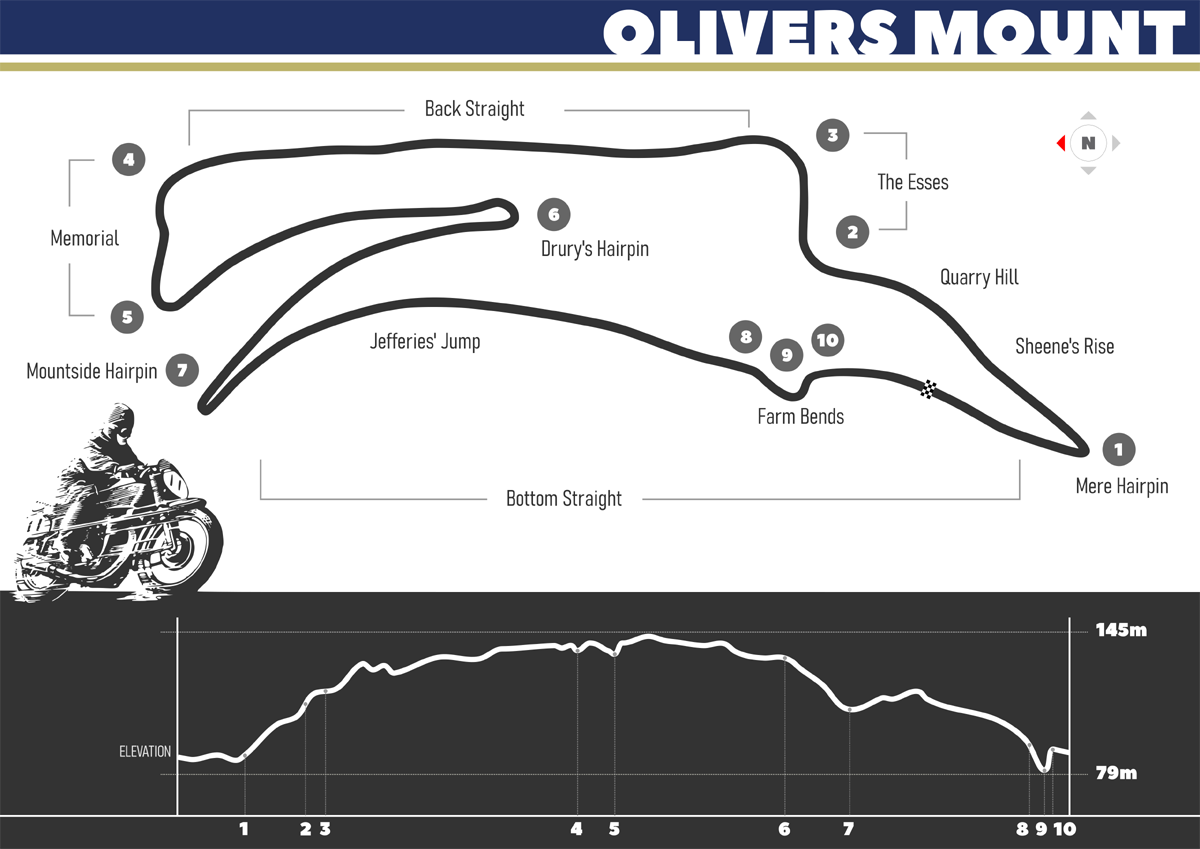
At the very first meeting in September 1946, it was reported that the circuit called for some thirty-four gear changes, with its twists and turns presenting hazard after hazard, the 1-in-9 ascent of Quarry Hill, a ‘flat-out’ 100mph straight, not to mention the ‘Hump’where both rider and machine leave the ground. All of these features of the course, instantly earned it the name of the miniature mountain course.
In truth the 2.43 mile (3.91 km) circuit has changed very little since then.
The start/finish line was moved after the first year, a new, permanent control tower was built to replace the makeshift double decker bus in 1956, and a new chicane, Farm Bends was introduced in 1991.
But apart from those minor alterations, and a few name changes for parts of the track, the circuit retains all of its original character. It still has its daunting sixty metre elevations, it still has the steep climbs and dangerous descents, it still has its impossibly tight hairpins, and it still has little in the way of what you might expect of a modern track in terms of safety features. For seventy years, the track's essential nature has endured.
However, for those of you who are unfamiliar with Olivers Mount, it's important to note that the circuit is first and foremost a motorcycle track, hosting some of some of the world’s greatest road racers with the likes of Geoff Duke, Bob McIntyre, John Surtees and Phil Read all racing there in the 1950s and 60s, Barry Sheene and Mick Grant the stars of the 1970s and 1980s, and more recently Guy Martin, John McGuinness, Ian Hutchinson and Michael Dunlop.
RAC Rally
But the track does have some history of car events, though it's narrow width has meant that these have been the exceptions, rather than the norm. It was used as a stage in the 1952 RAC Rally as a regularity trial. It also hosted F3 half litre events in July 1955 & 1956, in what are probably the circuit's only true car racing events. The track has also hosted many hillclimb events over the years, and these continue to this day.
But it was the RAC Rally's visit to the circuit in 1975 that first caught my attention. These were the days when the event was big news, with huge entry lists, a wide variety of cars, and a route map which took the event right across the length and breadth of the country. As an eleven year old, one of my first motor sports experiences was going out with my Dad to watch the rally drivers pile through the Yorkshire forests of Dalby, Langdale et al, and of course round Olivers Mount. I was instantly hooked. The RAC came back to the Mount in 1978, 1982, and 1985, as it was the ideal stage for spectators, being easy to access without the need for a long trek into the dark Yorkshire forests on a cold winter's night, and great viewpoints from all around the track, which are accessible using the footbridges.
The drivers would usually do a lap and a half in a clockwise direction, setting off at frequent intervals, meaning the action came thick and fast.
This recipe again proved successful for the Roger Albert Clark historic rally, which as it's name suggests, was a recreation of the golden years of the RAC Rally visiting many of the same stages, including Olivers Mount in 2008, 2009, and 2010 if I remember correctly.
Cars
In spite of the track being primarily a motor cycle track, the list of cars which have run at Olivers Mount is long. The classic two wheel drive rally cars which ran in the RAC, and Roger Albert Clark rallies make an impressive list, and since that's what I mainly collect, it's ideal for me.
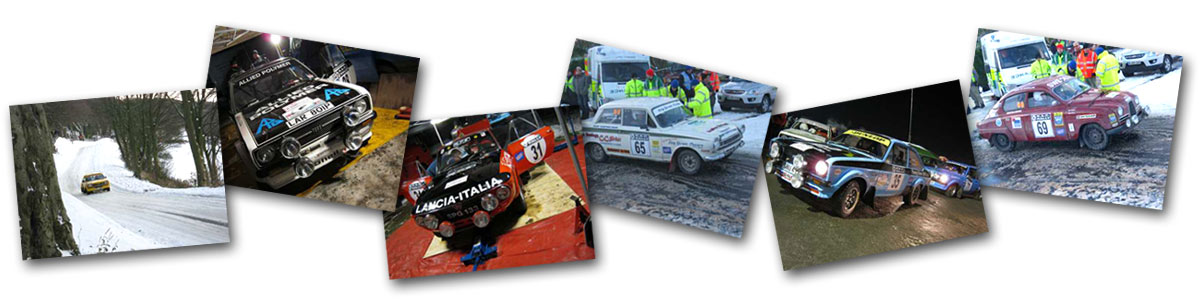
The 1975 RAC entry list alone includes the Ford Escort MkI & MkII, & Capri, Lancia Stratos, Saab 96, Opel Kadett, Toyota Celica, FIAT 131 & 124, Lancia Beta, Datsun 160, Vauxhall Magnum, Hillman Avenger & Imp, Skoda 120 & 130, Triumph Dolomite, Porsche 911, Opel Ascona, VW Golf, Alpine A110, Datsun 240z, BMW 2002, Citroen DS & GS, MGB, and of course the inevitable Mini. Add to that the older cars allowed in the historic event, and that would mean that most of my collection could have run at the track, in theory.
The 1952 RAC Rally allowed any post war production car up to 52, which may be an avenue to explore in future.
The F3 500 races are an area of interest for me, and AA bodies make both a Kieft and a Cooper which could make a historically accurate race.
The hillclimbs would obviously have included all manner of cars, though that's not an area of any great interest for me, but another avenue I might explore at some point would be motorcycle sidecar outfits.
Buildings
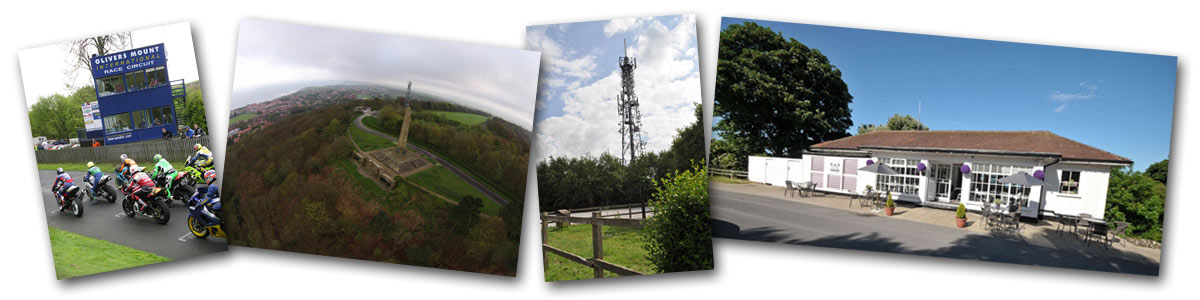
There are only a handful of buildings on Olivers Mount, and fortunately these have changed little over the years, meaning that my track would be able to reasonably accurately represent almost any period in the circuit's history.
The most distinctive and defining building is the control tower. Built in 1956, the tower is a simple, two storey, square block that is set at 45° to the track at the start finish line.
On top of the circuit are three other buildings, a war memorial, a café, and a communications tower. The war memorial is a fairly grand stone affair with a tall obelisk, which is situated at the end of the promontory with views down over Scarborough. Close by is the café which is a simple single storey building which has been on the Mount since the 1920s. The communications tower which is also nearby, is a 41m tall metal framed structure used for TV, radio, and mobile phone transmission.
There are also three pedestrian foot bridges around the track, the bridge on the esses being the most notable, the other two being placed on the two main hills.
Scenery
Aerial View
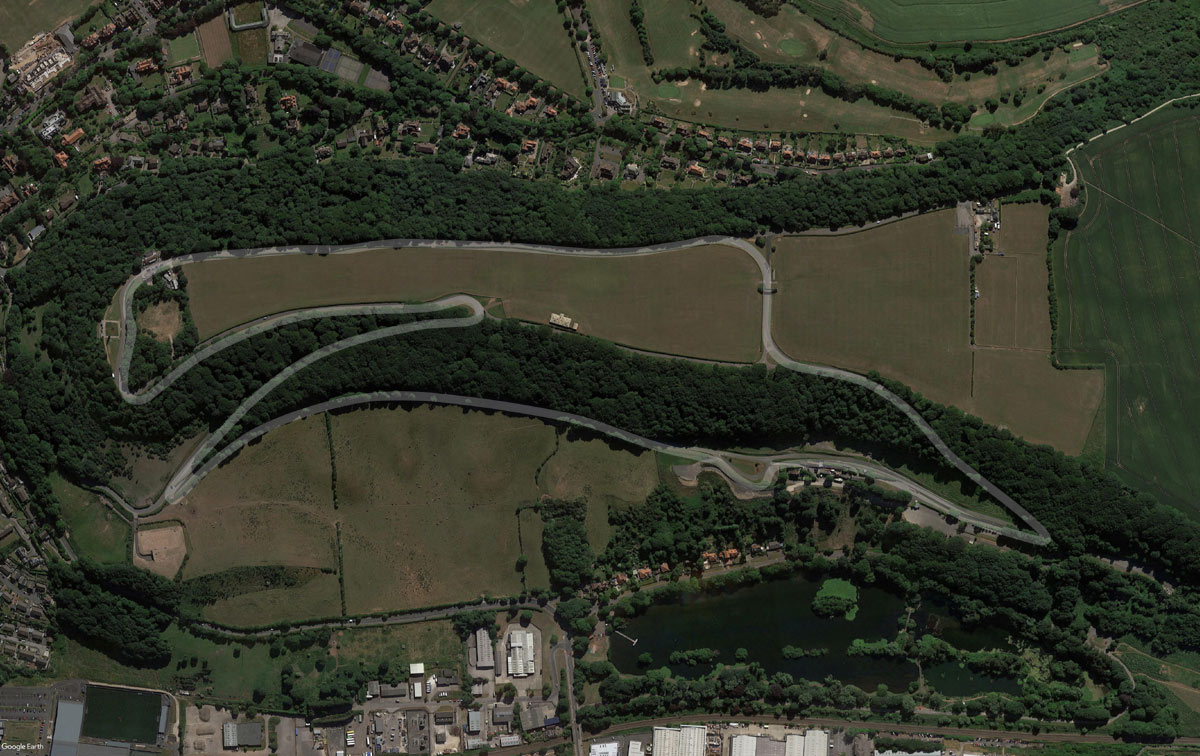
The main scenery items will be trees. As you can see from the photograph above there are hundreds and hundreds of them all around the track, and although I will have to reduce their number to keep sight lines clear, I will still need to make or buy plenty of trees.
There is no armco, and no safety barriers anywhere on the track, but it is lined all round with either hedges or with three bar wooden fencing.
So even though making fences, hedges, and trees might not be complicated, the sheer numbers will make the task a little daunting.