Thread Rating:
  • 0 Vote(s) - 0 Average
  • 1
  • 2
  • 3
  • 4
  • 5

Upgrading the Scalextric APB C7042
#1

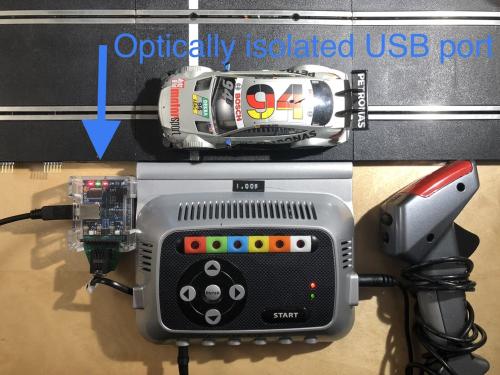
I’ve been exploring upgrade options for the APB C7042 including the addition of an optically isolated USB port (first photo) and upgraded high speed lap counter sensors (second photo).


Both have been undergoing trials with collaborators in UK and/or USA and are giving solid and reliable results. More details to follow.

c
[+] 6 members Like Dr_C2's post
Quote
#2

Referring to the above post and adding some details:

Upgrade 1/ Optically isolated USB port

The purpose of this upgrade is to add industry standard techniques which are designed to reduce risks of electrostatic damage and/or ground loop effects when using RS485 serial communications hardware. The approach replaces the ‘standard’ hard-wired USB-RS485 cable with an ‘off-the-shelf’ optical isolation module. Optical isolation means there is no physical electrical connection between the USB port and the internal workings of the APB so there is no route for electrostatic conduction or ground loops. In particular this should eliminate the APB problems associated with accidental ‘hot-plugging’ or ‘hot-unplugging’ which has been reported to damage APBs.

Upgrade 2/ High speed lap sensors.

These replacement sensors address the issue observed with the standard APB (firmware v1.009) where lap detection is unreliable for cars on ID6 when travelling at speeds in excess of 6.7m/s. Three users have reported experiencing this problem on real raceways (both routed and plastic). In each case a 4-four phototransistor upgraded sensor board has fully resolved the issue.

Although the APB has been around for many years it is interesting that new upgrade opportunities are still possible snd worth considering.

c
[+] 4 members Like Dr_C2's post
Quote
#3

The isolation on the RJ port is a nice upgrade. Despite being super-careful, we’ve fried two of Riko’s cables in ten years.

Any lap counting issues we’ve avoided by APB placement - but that’s not always an option on a permanent home track.
[+] 2 members Like woodcote's post
Quote
#4

Thanks Andy,

And just to add, the ‘riko cable’ is a well established and well liked solution. For most, a mean time to failure of 5 years sounds pretty good. The opto-isolator approach is simply another option for consideration. As mentioned the module is available online from computer stores. 

‘DSD TECH SH-U11F Isolated USB to RS485 RS422 Converter Built-in FTDI chip for Industrial Application’

If anyone is interested, it does require a three wire connection into the APB i.e. A,B and 0V. And of course, these three wires are fully electrically isolated from the incoming USB wiring - which is the whole point :)

c
[+] 4 members Like Dr_C2's post
Quote
#5

Very interesting Dr_C.
[+] 1 member Likes Drifter2's post
Quote
#6

   
This photo shows the upgraded sensor boards as fitted into APBs. The boards can be used with the APB, as here, or the ARC PRO. When used for the latter, a few additional components are added to enable IR blade detection. These were assembled a year ago and then dispatched to SSD users in the USA.


This photo shows a similar four-phototransistor design designed for single lane use or where lane pitch is non-standard. This of course corresponds to pit lanes or more generally for routed tracks. These types of sensors have been in use for a couple of years and build on a prototype design which was first tested back in 2019. All user feedback to date has been highly positive.

Used as pit sensors the boards can interface directly onto Arduino digital input pins so great for DIY-ers too.

c
[+] 4 members Like Dr_C2's post
Quote
#7

Just to add, none of this would have got off the starting blocks without an amazing group of enthusiastic collaborators. Building something on the bench is quite different from shipping it to a collaborator and friend who installs into a raceway and checks whether theory can meet useful reality. So this is a hard felt thank you to an amazing network of collaborators and friends.

c
[+] 4 members Like Dr_C2's post
Quote
#8

So, a big heartfelt thank you to my digital slotcar friends and enthusiastic collaborators which include amongst others, Clive, Dave, Frank, Gavin, Greg, John, John, Paul, Steve and Steve. Thank you for helping to make things happen.

What I plan to report in the coming months has, and continues to be, the product of collaborative thinking and collaborative ideas into action :)

And, there is always room for new collaborations too. Thanks Ed for recently reaching out to compare ideas.

Clive
[+] 5 members Like Dr_C2's post
Quote
#9

(16th-Nov-23, 11:53 AM)Dr_C Wrote:  So, a big heartfelt thank you to my digital slotcar friends and enthusiastic collaborators which include amongst others, Clive, Dave, Frank, Gavin, Greg, John, John, Paul, Steve and Steve. Thank you for helping to make things happen.

What I plan to report in the coming months has, and continues to be, the product of collaborative thinking and collaborative ideas into action :)

And, there is always room for new collaborations too. Thanks Ed for recently reaching out to compare ideas.

Clive

It always fun to try new stuff :)

Clive
[+] 4 members Like Drifter2's post
Quote
#10

When upgrading the APB, one nice option is to add pit lane sensing.

In the past this has been possible using either a modified Scalextric pit lane game (known as pit-pro) or using a bespoke design by a gentleman by the name of Kare (which is known as smart sensor).

Both options have been very popular over the years.

The modified pit lane game only has one sensor channel for both pit-in and pit-out but works quite well despite that limitation. I believe it is still available on-line.

The Kare smart sensor sadly has disappeared from the market and I was unable to establish contact with the designer. The advantage of this system is that separate sensor channels are used for entry and exit of the pit lane which avoids the potential for ‘occasional’ confusion as to whether the car is in the pits or not.

The Kare approach also includes digital signals for the control of start light gantries which is nice (when used with RCS64 race management).

As mentioned earlier, the four-phototransistor ID sensors I have been working on can be used for pit lane sensing and they can interface directly onto the GPIO pins of an Arduino Nano. So now there is another option for pit lane sensing.


The red/yellow/black wires connect to the two sensors for pit-in and pit-out respectively. The Arduino Nano carries firmware - either Kare’s or mine - which reads car IDs and outputs the data to the race management system (typically RCS64). The prototype system has been installed in a digital racetrack for approximately 12 months and has performed faultlessly. Big thanks to Dave for doing masses of kind and careful testing at track level.

Also thanks to Kare - with his firmware we were able to implement the start lights gantry too.

My software currently detects IDs but I’ve not yet go round to adding the coding for the start lights.

Anyway, a couple of sensors and an Arduino Nano make a very nice pit lane sensing system IMO.

c

[+] 4 members Like Dr_C2's post
Quote


Possibly Related Threads...
Thread / Author Replies Views Last Post
Last Post by Scott
1st-Dec-25, 11:41 PM
Last Post by woodcote
23rd-Apr-25, 08:03 AM
Last Post by Dr_C2
15th-Mar-25, 06:15 PM

Forum Jump:


Users browsing this thread: 1 Guest(s)