

15th-Jul-21, 04:59 PM
Advanced tuning tools
If you are looking for the basics, look in this link to the Slotracer.Online manual.
https://slotracer.online/manual/tools.php
However, once you've gripped the basics and you are looking for tuning tools to give you an edge, have a look at the advanced tools below.
Ultrasonic cleaner £30
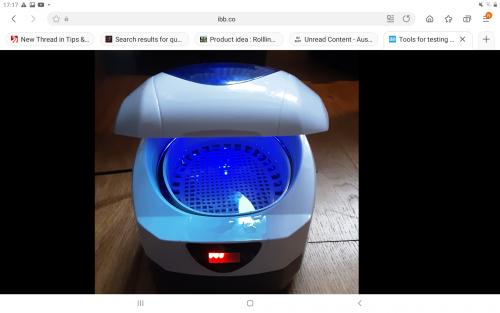
The newest addition to my tool set.
Dirty components do not look as good or work as well as clean components.
I have dropped complete motor mounts into the cleaner without any bad effects.
I have also dropped entire chassis' (without tyres) and also had good results.
The ultrasonic even cleans your braids. Use a jewellery cleaner fluid in conjunction with the ultrasonic.
I am truly shocked by the debris and dirt that comes out into the solution when dipping an older car from the first time.
Prior to the ultrasonic, I would dip a motor and run in under its own power but the ultrasonic appears to be able to shake loose the dirt and embedded carbon from motors without running them. If you have a motor that has a tendancy to smoke on startup due to bearing oil getting on to the commutator, an ultrasonic is probably the only way to tackle this without opening the motor up.
If the ultrasonic cannot shift the dirt, a commutator true up is probably your only option.
Digital scales £10
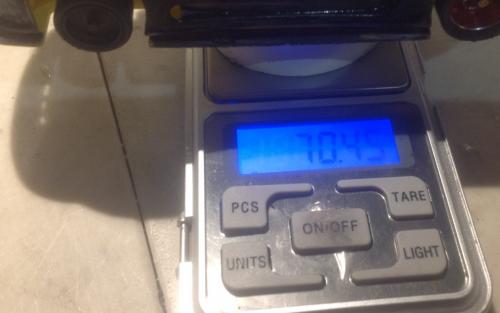
Very good for checking the weight of a car and measuring static motor torque.
Also very good for checking front to rear weight balance so that any ballasting can be added to counteract bad behaviours (power delot, roll deslot, understeer oversteer etc) that the car shows. Tracking/logging the positioning of ballast against lap times is important.
Power supply £45

It is always good to have a stable and reliable PSU.
I've owned the Fusion FS-PS201ADJT for about 3 years. It has ever let me down and provides the power for motor testing, tyre truing and an Oxigen Digital throttle and testbed setup.
Good value, twin outputs, current limiter, built-in fuse, 4 to 14v range approx.
Don't be tempted by the cheaper single output version, a false economy
Laser Tachometer £15

A laser tachometer gives you insight into how a motor is running, above or below specified RPM and also whether the motor has any built-in clockwise or anti clockwise bias that you can leverage to your advantage. Laser tachometers work best when the motor is out of the car. It is possible to measure the rpm of the wheels and with some simple maths determine the motor speed but this calculation has to be done manually for every wheel size.
Torque arm (£zero)

It is difficult to measure torque dynamically but a simple torque arm matched to a set of digital scales can give you some numbers, giving insight on whether manufacturers are sandbagging or glory running when it comes to their torque numbers. Torque matters because it has just as much a part as motor RPM in the performance of the motor and plays a big part in determining a suitable gear for the car.
Test at 4v. Never stall your motor at full voltage!
Tyre truer (£zero to £300)
I borrow a tyre truer when I need one.
I've never needed a truer more than once a year.
The majority of new tyres I buy are well formed, well sized and only need skimming on the axle in a hand held motor mount.
Tyre truers are a difficult choice because they each work in different ways.
Whether you choose :
- drum truer "hudy" type
- on-axle truer "razor" type
- rotary disc truer "nsr type"
- or.. just skim the tyres in the car
... your choice of a truer suitable for your needs depends on :
- The cars you have
- The wheels (push fit, set screw fit, air-hub?)
- The axles . Smooth or knurled ends? Axles from different manufacters are not the same size due to metric rounding (among other factors)
- The tyres. Are the new tyres well formed (slot.it f22) or rough like hell (nsr supergrip)
Tyre oil roller.

If you are using oiled tyres, a roller is useful.
Some truers have a built in roller (nsr type) but if yours doesn't and you have to oil your tyres, you can make one from an old motor, motor mount, old axle holder and 2 old axles.
Wheel and crown balancer (£5)
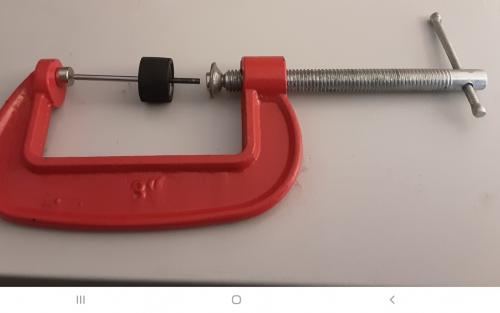
My DIY balancer made from a G-clamp, an old axle and 2 button magnets shown.
When you want you want to go the extra mile for performance, balancing will bring small incremental improvements, smoothing the ride and getting the power down.
Digital calipers

Having your car challenged, checked and shown to be too wide is embarrassing.
Set your cars up with callipers and you are sure to be within the rules.
Also, logging the effects of different settings gives you insight into the effects and allows you to prep new cars and predict the results of the settings you choose.
Gear tables (£zero)

Simple tables are OK, but a full set of tables will include tyre diameters and will allow you to change components in any part of the transmission (pinions, crowns spurs, wheels, tyres) and predict the results.
If you don't have such a table , put one together in a spreadsheet.
Setup plate and shims. (£zero)

OK so the basic setup plate IS included in the slotracer manual, but if you have the time and inclination to make your own, there are several advantages you can build in.
1. Use shims to optimise the ride height of your cars.
Create shims from old store cards or any other pieces of plastic you have lying around.
For some classifications (eg DiSCA LeMans Oxigen racing) there is a minimum ride height so shims ensure compliance.
For tracks where no ride height minimum is enforced, create shims to get your car as low as possible without scraping the chassis or motor on the track.
2.downforce simulation.
If you are racing plastic track ( with steel rails ) or wood track with magnabraid, your car will suck down your the track because of flux leakage from the motor.
If you embed rails, magnabraid or magnets into your setup plate, you are better able to simulate your car's stance on the track.
3. Rail height simulation.
Scaley sport rails are flush with the track surface, ninco are raised, wood tracks are often recessed. Using shims under the front wheels or under the guide allows you to simulate the stance the car will have on the track and adjust to suit (using guide washers and/or front axle screw adjusters)
Rolling Road (self build for about £50)

There are no rolling road units currently being commercially produced (as far as I can tell)
Some used "tamiya speed tester" units can be found and adapted.
Link below for all of the components and diagrams to build the unit shown.
https://ibb.co/album/7NR8c9
This unit gives you insights on motor selection and gearing but is not an alternative to track time.
Test your cars, Look at the numbers being pulled by your best cars and try to replicate those numbers on your underperforming cars.
Once you identify the ideal speed range for a car (for a given car-weight, motor type and track) replicating this into new builds is easier.
Combine the rolling road info with information on the weight if the car and you have some insights toward setting up new cars.
I've had more requests to build these RR-V2 units to order than I can count, however, the complexity of the build makes it non viable.
The joint venture with Dale at Slot Cartel ground to a halt.
Recent discussions with Slot.IT revealed that they are too busy with other projects to take this project on right now, however they are willing to lend some expertise to help integrate some oxigen digital functionality into a new prototype RR-V3.
I continue to explore other options with other slot car tool makers and am hopeful that I will be able to start producing units for sale.
---‐--------
If you have questions, fire away!
If you have some advanced tools, please share
Alan W
If you are looking for the basics, look in this link to the Slotracer.Online manual.
https://slotracer.online/manual/tools.php
However, once you've gripped the basics and you are looking for tuning tools to give you an edge, have a look at the advanced tools below.
Ultrasonic cleaner £30
The newest addition to my tool set.
Dirty components do not look as good or work as well as clean components.
I have dropped complete motor mounts into the cleaner without any bad effects.
I have also dropped entire chassis' (without tyres) and also had good results.
The ultrasonic even cleans your braids. Use a jewellery cleaner fluid in conjunction with the ultrasonic.
I am truly shocked by the debris and dirt that comes out into the solution when dipping an older car from the first time.
Prior to the ultrasonic, I would dip a motor and run in under its own power but the ultrasonic appears to be able to shake loose the dirt and embedded carbon from motors without running them. If you have a motor that has a tendancy to smoke on startup due to bearing oil getting on to the commutator, an ultrasonic is probably the only way to tackle this without opening the motor up.
If the ultrasonic cannot shift the dirt, a commutator true up is probably your only option.
Digital scales £10
Very good for checking the weight of a car and measuring static motor torque.
Also very good for checking front to rear weight balance so that any ballasting can be added to counteract bad behaviours (power delot, roll deslot, understeer oversteer etc) that the car shows. Tracking/logging the positioning of ballast against lap times is important.
Power supply £45
It is always good to have a stable and reliable PSU.
I've owned the Fusion FS-PS201ADJT for about 3 years. It has ever let me down and provides the power for motor testing, tyre truing and an Oxigen Digital throttle and testbed setup.
Good value, twin outputs, current limiter, built-in fuse, 4 to 14v range approx.
Don't be tempted by the cheaper single output version, a false economy
Laser Tachometer £15
A laser tachometer gives you insight into how a motor is running, above or below specified RPM and also whether the motor has any built-in clockwise or anti clockwise bias that you can leverage to your advantage. Laser tachometers work best when the motor is out of the car. It is possible to measure the rpm of the wheels and with some simple maths determine the motor speed but this calculation has to be done manually for every wheel size.
Torque arm (£zero)
It is difficult to measure torque dynamically but a simple torque arm matched to a set of digital scales can give you some numbers, giving insight on whether manufacturers are sandbagging or glory running when it comes to their torque numbers. Torque matters because it has just as much a part as motor RPM in the performance of the motor and plays a big part in determining a suitable gear for the car.
Test at 4v. Never stall your motor at full voltage!
Tyre truer (£zero to £300)
I borrow a tyre truer when I need one.
I've never needed a truer more than once a year.
The majority of new tyres I buy are well formed, well sized and only need skimming on the axle in a hand held motor mount.
Tyre truers are a difficult choice because they each work in different ways.
Whether you choose :
- drum truer "hudy" type
- on-axle truer "razor" type
- rotary disc truer "nsr type"
- or.. just skim the tyres in the car
... your choice of a truer suitable for your needs depends on :
- The cars you have
- The wheels (push fit, set screw fit, air-hub?)
- The axles . Smooth or knurled ends? Axles from different manufacters are not the same size due to metric rounding (among other factors)
- The tyres. Are the new tyres well formed (slot.it f22) or rough like hell (nsr supergrip)
Tyre oil roller.
If you are using oiled tyres, a roller is useful.
Some truers have a built in roller (nsr type) but if yours doesn't and you have to oil your tyres, you can make one from an old motor, motor mount, old axle holder and 2 old axles.
Wheel and crown balancer (£5)
My DIY balancer made from a G-clamp, an old axle and 2 button magnets shown.
When you want you want to go the extra mile for performance, balancing will bring small incremental improvements, smoothing the ride and getting the power down.
Digital calipers
Having your car challenged, checked and shown to be too wide is embarrassing.
Set your cars up with callipers and you are sure to be within the rules.
Also, logging the effects of different settings gives you insight into the effects and allows you to prep new cars and predict the results of the settings you choose.
Gear tables (£zero)
Simple tables are OK, but a full set of tables will include tyre diameters and will allow you to change components in any part of the transmission (pinions, crowns spurs, wheels, tyres) and predict the results.
If you don't have such a table , put one together in a spreadsheet.
Setup plate and shims. (£zero)
OK so the basic setup plate IS included in the slotracer manual, but if you have the time and inclination to make your own, there are several advantages you can build in.
1. Use shims to optimise the ride height of your cars.
Create shims from old store cards or any other pieces of plastic you have lying around.
For some classifications (eg DiSCA LeMans Oxigen racing) there is a minimum ride height so shims ensure compliance.
For tracks where no ride height minimum is enforced, create shims to get your car as low as possible without scraping the chassis or motor on the track.
2.downforce simulation.
If you are racing plastic track ( with steel rails ) or wood track with magnabraid, your car will suck down your the track because of flux leakage from the motor.
If you embed rails, magnabraid or magnets into your setup plate, you are better able to simulate your car's stance on the track.
3. Rail height simulation.
Scaley sport rails are flush with the track surface, ninco are raised, wood tracks are often recessed. Using shims under the front wheels or under the guide allows you to simulate the stance the car will have on the track and adjust to suit (using guide washers and/or front axle screw adjusters)
Rolling Road (self build for about £50)
There are no rolling road units currently being commercially produced (as far as I can tell)
Some used "tamiya speed tester" units can be found and adapted.
Link below for all of the components and diagrams to build the unit shown.
https://ibb.co/album/7NR8c9
This unit gives you insights on motor selection and gearing but is not an alternative to track time.
Test your cars, Look at the numbers being pulled by your best cars and try to replicate those numbers on your underperforming cars.
Once you identify the ideal speed range for a car (for a given car-weight, motor type and track) replicating this into new builds is easier.
Combine the rolling road info with information on the weight if the car and you have some insights toward setting up new cars.
I've had more requests to build these RR-V2 units to order than I can count, however, the complexity of the build makes it non viable.
The joint venture with Dale at Slot Cartel ground to a halt.
Recent discussions with Slot.IT revealed that they are too busy with other projects to take this project on right now, however they are willing to lend some expertise to help integrate some oxigen digital functionality into a new prototype RR-V3.
I continue to explore other options with other slot car tool makers and am hopeful that I will be able to start producing units for sale.
---‐--------
If you have questions, fire away!
If you have some advanced tools, please share
Alan W
![[+]](https://slotracer.online/community/images/bootbb/collapse_collapsed.png)


