Hi Rob,
Some random information and photos of things! Anything more specific please just ask.
The boards used on my layout are Polycarbonate roofing sheets. 25mm thick, and 4 ply. 25mm and above are used for roofing conservatories and similar. They are very strong, you could walk on a roof of this stuff, but also very light, so perfect for this job. Easy to work with, and to cut. The exposed edges are inclosed with C section aluminium. Think capital letter C to get the idea. This stops the sheets from getting snagged or damaged. They are riveted into place. To fix two separate sheets side by side we riveted 2 C sections together, to form an I section, capital letter I with the 2 horizontal lines. Basically 2 C sections back to back. Corner plates were then riveted into position, both on top, and below. These were heavily riveted to give sufficient strength.
My board is 3.44 metres by 2.29 metres, so pretty big! It looks like a garage door!!
I purchased the Polycarbonate sheets used from eBay. They had just come from an old chaps conservatory roof. Loads of them.
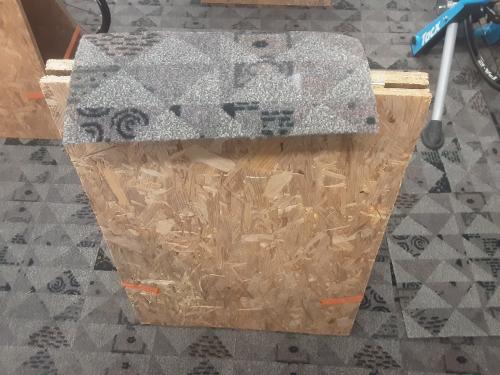
When in its lowered position the board sits on wooden A frames. They are 31 inches high and 24 inches wide. They have 2 hinges per board, so they can be folded flat for storage. Each board is also fitted with 2 thick pieces of webbing, stapled on using an industrial size stapler. This is to stop the boards from opening out to far and collapsing. Not something you want to happen! When opened out the boards are 16 inches at the bottom. I cut a couple of old carpet tiles up, and place a section on top of each A frame to protect the underside of the boards. The A frames are made from 1 inch thick OSB, an 8x4 sheet leftover from building my hobby room. Whatever you use it does need to be strong, so 1 inch thick is good. There are 5 A frame boards, in an X formation. 2 each end and 1 in the middle
For lifting the frame I have an electric winch. We were going to use a hand winch, but the board was to big and heavy. An electric winch is much safer, simpler and easier. Mine cost about £70 on eBay brand new. You dont need a massive lifting capacity, and it's not going to be used continuously. My other track, routed, folds against the back wall. This also has an electric winch, which came from the middle isle at Lidl, for £60, and is brilliant! Given how much slot cars cost, especially this year's prices , it really is worth getting an electric winch. These type of winches are sometimes referred to as hobby winches. The winch is secured directly to the concrete floor, using steel threaded rod, epoxied into the floor. It is very important that the winch is fitted safely and securely. If in doubt get a professional to fit it. Because the winch is floor mounted, not roof mounted it is in effect working in reverse.
We fitted bolts with lifting eyes into each of the 6 Corner plates. Attached to the eye is a carabiner. Attached to this is the wire, which goes up and through a pulley. The 6 wires feed into a purpose built pulley system. This acts as a reduction gear. 6 wires go into 2 sets of 3, then 2 into 1, and this attaches to the hook. It is pretty straightforward in reality, but can appear daunting.
When it's it's full up position my frame is secured using heavy duty chain, attached to bolts through the beams. This is incase any of the components should fail, and it takes the weight off the lifting equipment. If it fell it would seriously damage someone or something.
You need to be very clear what size board you need, and can accommodate, giving access around all 4 sides if possible for marshaling and drivers stations. Simply mark onto the floor and walk around until your happy. Also remember to allow sufficient height when in the raised position for scenery and track elevation. I only have one piece of scenery to remove before lifting, and I have damaged that a few times including tonight, doh.....
I designed the maximum size board I thought I could accommodate, then designed a track plan to fit. I chose plastic track due to lightness, and I already had a routed layout. Plastic track is much simpler. I went with Scalextric as I had loads, including the harder to get bits. I repainted my track with ultra smooth masonry paint, took a while but well worth it. Looks much better and gives much better grip.
Depending on your garage you might need to think about insulation. It helps so much, but really needs doing before anything else starts to take over.....
Anything else you need to know, or need more information on or more photos just ask

Good luck,
Pip
A frame boards





![[+]](https://slotracer.online/community/images/bootbb/collapse_collapsed.png)