I'm still no closer to working out whether this track will be possible, but I'm going to crack on with the plans regardless...
Since I've been learning how to use Blender 3d software, I thought I might attempt to make a 3d model of my track, and particularly its construction. In theory this should show up any fatal flaws, allow me to improve any weaknesses, and hopefully help me to get everything clear in my mind.
Before I started the modelling, I'd made several practical decisions which would affect the construction. The most important of these was that I wanted to make the track in sections. This was necessary because I want to do the bulk of the work in the workshop, leaving only the final assembly, landscaping and detailing to complete in the track room. Since the main section of the track is 8m wide by 4m deep, that left me with little choice but to use a sectional approach.
This may well be an ambitious build, it will use several techniques which I've never tried before, and it will require a daunting level of accuracy for all the sections to fit together properly. But I obviously believe it can work, so here goes with the plans...
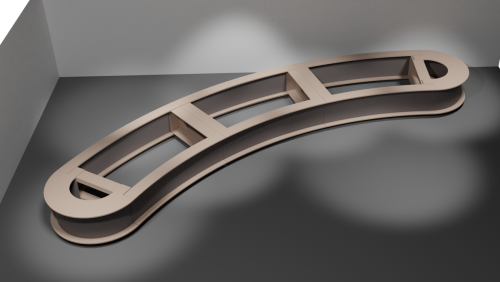
The base of the main track will be the railway, which will be formed by five curved boxes.
The front and rear of the three main boxes will be constructed from two I section curves, made by glueing sheets of flexible ply into slots cut into curved MDF. Marking out the 7m radii for the curved MDF should be fun.

Those curves will then be glued and screwed to biscuit jointed box shapes which form the end pieces, and castors will be attached underneath.

The three boxes will be bolted together. The scale is perhaps not obvious, but each of the three sections is 2.4m wide.

Two end pieces of similar construction will also bolted on, and the top of this base will form the track bed for the railway around its perimeter.
Moving on to the main slot track, this will be formed by simple skeletal frames, biscuit jointed together, holding the roadway in place.

The frames will slot down onto the railway base, with openings for the train to pass through.
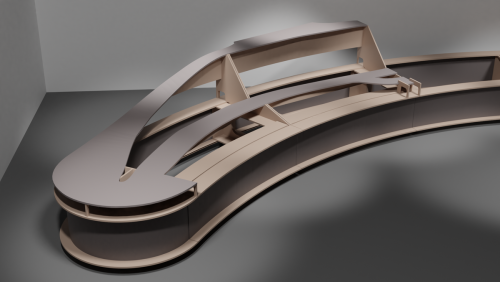
The large gaps which you can see will later be filled up with lightweight scenery materials, such as chicken wire and papier mache.
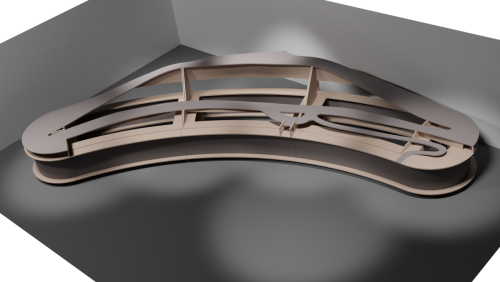
At the back there will be the top of the track which will have a separate base, probably incorporating some storage. Once the landscaping is in place the base will be more or less hidden.

At the front, the single lane rally track will be screwed on. This will be in several sections, and the elevations will be preformed, so it shouldn't require framework.
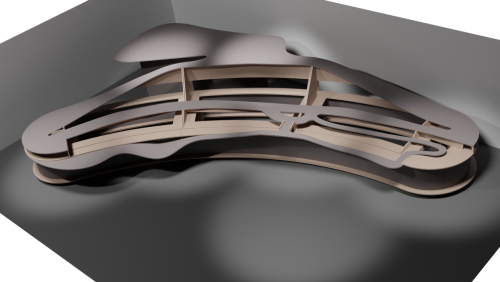
Finally, the autograss track will be a separate track, using a similar construction of curved ply, making up the two end sections, with a drawer section in the centre.
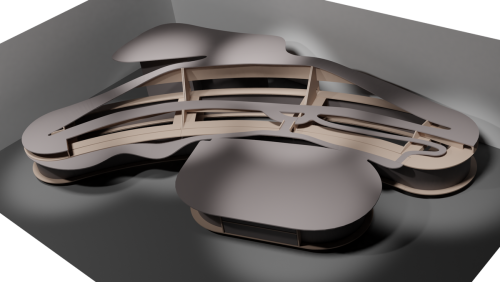
And just like that, the track is ready for painting, landscaping, braiding, wiring etc etc.





![[+]](https://slotracer.online/community/images/bootbb/collapse_collapsed.png)