Posts: 334
Threads: 25
Likes Received: 596 in 255 posts
Likes Given: 143
Joined: Oct 2023
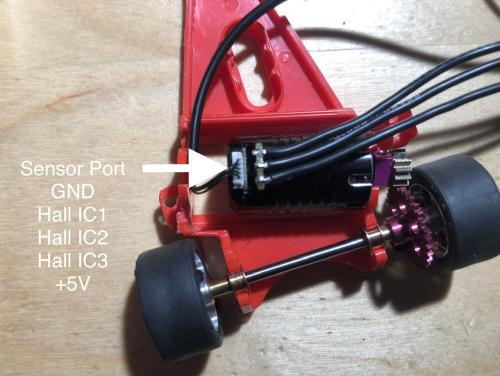
Here is the sensor port pin-out for the 1525 sized sensored brushless motors. Once again, these sensor ports require an external 10k pull-up resistor (x3) to produce the required logic high/low outputs.
The motor fitted is 5500KV, and similar motors with 3500KV and 4500KV will be explored in due course.
Understanding how to wire-up the sensor ports was an important first step in preparing for the design of the three phase driver module :)
Thanks for reading!
c
(This post was last modified: 1st-Jul-25, 02:46 PM by
Dr_C2.)
Posts: 334
Threads: 25
Likes Received: 596 in 255 posts
Likes Given: 143
Joined: Oct 2023
Edited to add this warning:
Please proceed to read this post only if you have a deep interest in brushless motors.
Three ways to drive a brushless motor (and of course there are more!):
1/ I’m familiar with Electronic Speed Controllers (ESC) as used for radio controlled aeroplanes and cars. These usually have a power lead for connection to a battery pack (typically a LiPo pack), a three wire connection to a receiver, and a three wire connection to the brushless motor. The control signal from the receiver is typically a pulse of 1-2mSec duration and a repetition rate of circa 50Hz. The pulse duration indicates throttle value (and when used also the brake value).
2/ Recent brushless motor developments and trials for analog slot cars appear to use a five terminal Electronic Commutator (Ecom). The input is two terminal and connects directly to the rails. The output is the three wire connection to the brushless motor. These typically use a simple analog track voltage as input as generated by a passive analog throttle controller or, in some cases, a PWM input that is generated within a transistorised throttle controller. And as mentioned earlier in this thread these Ecom/brushless combinations are delivering slotcar racing wins at national/international events. But so far this is only in the ‘analog’ slotcar world.
3/ What I am working on is neither. Hence I am referring to my device as a brushless motor ‘driver module’. This takes DC power from a digital decoder together with two addition digital signal lines which communicate throttle settings and brake settings. This is important for digital racing where both precise throttle control and adjustable braking are required. The output of course is the three wire connection onto the brushless motor. And, since my project uses sensored motors there is the additional requirement for interconnection of the motor’s sensor port.
I’ve already mentioned earlier my intended design point will use a two-board (or two-module) approach. These are the main decoder and the brushless motor drive module respectively. To keep the interconnection wiring harness to a minimum, the brushless motor driver module will be attached directly to the motor.
Hoping all of above is clear :)
c
(This post was last modified: 1st-Jul-25, 05:23 PM by
Dr_C2.)
Posts: 1,251
Threads: 84
Likes Received: 1,039 in 521 posts
Likes Given: 245
Joined: Apr 2019
Location France
Even DeepL had trouble translating that into English. I doubt Google would even try

![[+]](https://slotracer.online/community/images/bootbb/collapse_collapsed.png) •
•
Posts: 334
Threads: 25
Likes Received: 596 in 255 posts
Likes Given: 143
Joined: Oct 2023
(1st-Jul-25, 05:14 PM)Gordon Steadman Wrote: Even DeepL had trouble translating that into English. I doubt Google would even try
Thanks - point taken:) so I went back and added an extra line at the beginning of the post. OK?
c
Posts: 4,528
Threads: 147
Likes Received: 3,066 in 1,819 posts
Likes Given: 4,215
Joined: Apr 2019
Location Isle of Man
I understood 99% of that as a racer with no electronics knowledge but decades of RC car racing behind me, through the transition period between AM to FM to digital transmitters, brushed and brushless motors...and NiCd/NiMh and LiPo batteries, it's an interesting project

Life is like a box of Slot cars...


•
Posts: 1,251
Threads: 84
Likes Received: 1,039 in 521 posts
Likes Given: 245
Joined: Apr 2019
Location France
(1st-Jul-25, 05:25 PM)Dr_C Wrote: (1st-Jul-25, 05:14 PM)Gordon Steadman Wrote: Even DeepL had trouble translating that into English. I doubt Google would even try
Thanks - point taken:) so I went back and added an extra line at the beginning of the post. OK?
c
Very sensible

Electrickery of any sort switches what is left of my tired old brain into mush. I always like to see what's happening out there the wide world but as soon as numbers are involved, I go blind. I can manage up to the length of the average ruler and judge distances to the mil almost but that's more about vision. How I ever passed my Maths O level I still don't understand. Maybe getting my name right at the top was enough.
•
Posts: 4,528
Threads: 147
Likes Received: 3,066 in 1,819 posts
Likes Given: 4,215
Joined: Apr 2019
Location Isle of Man
Yeah but Maths O-levels were proper exams, none of this multiple guess mush.
Life is like a box of Slot cars...
(This post was last modified: 1st-Jul-25, 08:14 PM by
Kevan.)
•
Posts: 1,251
Threads: 84
Likes Received: 1,039 in 521 posts
Likes Given: 245
Joined: Apr 2019
Location France
(1st-Jul-25, 07:59 PM)Kevan Wrote: Yeah but Math's O-levels were proper exams, none of this multiple guess mush.
Makes me passing it even less understandable
Posts: 334
Threads: 25
Likes Received: 596 in 255 posts
Likes Given: 143
Joined: Oct 2023
I just connected a commercial brushless driver module to one of my 4300KV sensored brushless motors.
This module measures 32mm x 32mm so far too large as a full solution but great for quick proof of concept trials.
The commercial module drives the sensored motor beautifully. At the lowest setting the slotcar wheels rotate at about 1 revolution per second (60rpm) maybe even less. As the drive signal is increased the motor spools up very smoothly. At very high rpm the tyres start to expand due to ‘centrifugal’ force. Clearly the wheels need to have a flat surface and tyres glued.
This early effort is based on bench testing and not track level testing. That said, it has already demonstrated some useful points:
1/ it’s easy to establish correct wiring for the three Hall position sensors of a brushless motor.
2/ the motor is well controlled across a wide range of rpm as required for digital slotcars. This approach provides better low speed control than standard brushed motors and a high end which is beyond what most tracks will ever require.
3/ on the bench the motor runs very cool and with no discernible vibration.
4/ this approach also provides a tacho output without any additional design effort or additional hardware. This, too, is a ‘nice-to-have’.
I now have the rest of the summer (or longer if needed) to design a very small driver module and to optimise decoder firmware. I’ll report back in due course when both have been achieved :)
c
(apologies - one detail aboved needed correction … to 1 revolution per second).
(This post was last modified: 2nd-Jul-25, 11:22 PM by
Dr_C2.)
Posts: 334
Threads: 25
Likes Received: 596 in 255 posts
Likes Given: 143
Joined: Oct 2023



