Thread Rating:
  • 0 Vote(s) - 0 Average
  • 1
  • 2
  • 3
  • 4
  • 5

Bayview International
#11

Thank you. Thumbup
Quote
#12

Perhaps I need to add a fourth section to my layout?

Well, probably not, but I was quite taken by this old photo, which was posted on a local Facebook group. It was taken just down the road, on the beach at Filey.


It is supposed to be from 1905, though the stamp looks like it might say 1908 to me. But whatever year it was, just look at those crowds!!!

I can definitely imagine a set of George Turner's Edwardian racers on a seaside track. It's very tempting.
[+] 3 members Like JasonB's post
Quote
#13

(4th-Dec-21, 06:35 PM)JasonB Wrote:  It is supposed to be from 1905, though the stamp looks like it might say 1908 to me. But whatever year it was, just look at those crowds!!!
Hi Jason,

It's definitely pre-COVID-19, otherwise people wouldn't be so close to each other without wearing a face mask.  Bigsmile

Kidding aside; George Turner's Edwardian racers on a scenic track would be a great idea.
I know a few people in Germany who race them.

Hub Thumbup
[+] 3 members Like rallyhub's post
Quote
#14

Heheh Rofl 

If I did decide to do it, many of the seafront buildings still look much the same today, so I'd have a good reference.
[+] 2 members Like JasonB's post
Quote
#15

...and you have plenty of room for it.
It would be a nice theme and definitely a pleasure to watch your build process. Thumbup
[+] 1 member Likes rallyhub's post
Quote
#16

You'd think those narrow tyres would cut up the sand pretty quickly but clearly they don't. They've barely marked the surface.
[+] 1 member Likes Top Down's post
Quote
#17

The sand up here is made of sterner stuff than that soft southern sand. Rofl Rofl Rofl
Quote
#18

I decided to jump in and buy some train kits. 1/32 scale trains aren't that common, and most are prohibitively expensive, so I wanted to make sure that I grabbed these reasonably priced kits while they were available.

This is the little Baguley Drewery shunter which arrived just before Christmas, along with a couple of wagons. This is just taped together with sticky tape, so that I could get an idea of what it looked like.


Although it's relatively small for a loco, it's still 195mm long and 105mm tall, and with the the two wagons, I reckon the train will be about 550-600 mm long. Which means that in spite of having a fair amount of space to work with, the visible railway track run will only be about 10-15 times the length of the train. I'm glad that I decided to go for a small goods yard, as a passenger line with much bigger trains would have been unrealistic.

The kits themselves are made up of a mixture of laser cut mdf, 3d printed pieces, acrylic sheet, and various standard train components such as the motor, wheels, and gears. Assembly doesn't look too difficult, though the lack of location guides means it may be tricky to get things square and true. Most of the 3d components will need some work to make them presentable, but the other parts look ready to go.

At £95 for the loco, it's about a tenth of what you might expect to pay for many ready to run locos in this scale, so although it might not be the most intricately detailed model in the world, it seems like good value. For me it's ideal, as I reckon details can be added later, but the price made the difference between having a railway or not.

There was certainly no way I could justify paying £1,000 and upwards for a loco on what will essentially be a scenic item, so this seems like a great way for me to get started.
[+] 6 members Like JasonB's post
Quote
#19

I'm still no closer to working out whether this track will be possible, but I'm going to crack on with the plans regardless...

Since I've been learning how to use Blender 3d software, I thought I might attempt to make a 3d model of my track, and particularly its construction. In theory this should show up any fatal flaws, allow me to improve any weaknesses, and hopefully help me to get everything clear in my mind.

Before I started the modelling, I'd made several practical decisions which would affect the construction. The most important of these was that I wanted to make the track in sections. This was necessary because I want to do the bulk of the work in the workshop, leaving only the final assembly, landscaping and detailing to complete in the track room. Since the main section of the track is 8m wide by 4m deep, that left me with little choice but to use a sectional approach.

This may well be an ambitious build, it will use several techniques which I've never tried before, and it will require a daunting level of accuracy for all the sections to fit together properly. But I obviously believe it can work, so here goes with the plans...

The base of the main track will be the railway, which will be formed by five curved boxes.

The front and rear of the three main boxes will be constructed from two I section curves, made by glueing sheets of flexible ply into slots cut into curved MDF. Marking out the 7m radii for the curved MDF should be fun.


Those curves will then be glued and screwed to biscuit jointed box shapes which form the end pieces, and castors will be attached underneath.


The three boxes will be bolted together. The scale is perhaps not obvious, but each of the three sections is 2.4m wide.


Two end pieces of similar construction will also bolted on, and the top of this base will form the track bed for the railway around its perimeter.
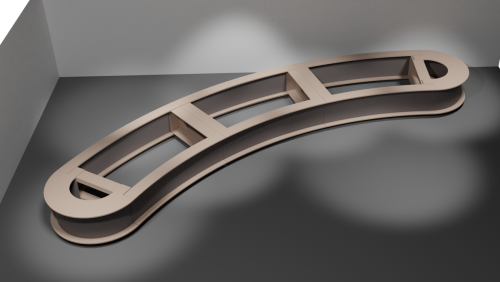


Moving on to the main slot track, this will be formed by simple skeletal frames, biscuit jointed together, holding the roadway in place.


The frames will slot down onto the railway base, with openings for the train to pass through.
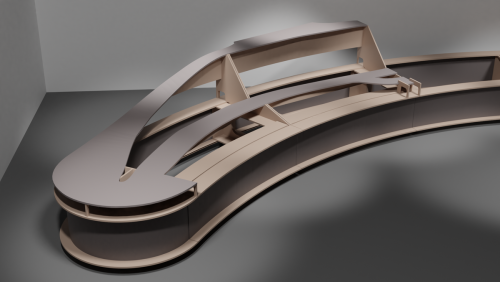
   

The large gaps which you can see will later be filled up with lightweight scenery materials, such as chicken wire and papier mache.
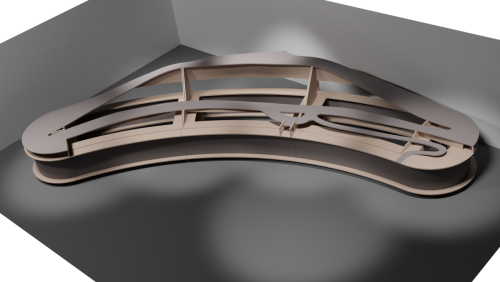
   

At the back there will be the top of the track which will have a separate base, probably incorporating some storage. Once the landscaping is in place the base will be more or less hidden.


At the front, the single lane rally track will be screwed on. This will be in several sections, and the elevations will be preformed, so it shouldn't require framework.
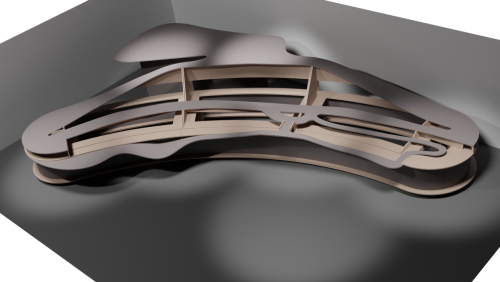
   

Finally, the autograss track will be a separate track, using a similar construction of curved ply, making up the two end sections, with a drawer section in the centre.
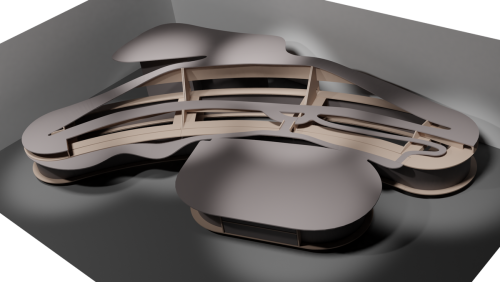


And just like that, the track is ready for painting, landscaping, braiding, wiring etc etc.

   
[+] 5 members Like JasonB's post
Quote
#20

Jason,

Looks amazing!  Rally

Looking forward to seeing how you finish it.
[+] 2 members Like KensRedZed's post
Quote


Forum Jump:


Users browsing this thread: 1 Guest(s)
