Posts: 4,528
Threads: 147
Likes Received: 3,066 in 1,819 posts
Likes Given: 4,215
Joined: Apr 2019
Location Isle of Man
Is that currently fed from the two track rails and guide?
Life is like a box of Slot cars...


![[+]](https://slotracer.online/community/images/bootbb/collapse_collapsed.png) •
•
Posts: 334
Threads: 25
Likes Received: 596 in 255 posts
Likes Given: 143
Joined: Oct 2023
Thanks Kevan - nice question. I’ll pick up via PM if that’s ok? c
Posts: 334
Threads: 25
Likes Received: 596 in 255 posts
Likes Given: 143
Joined: Oct 2023
I’ve been bench testing a 5500Kv sensored brushless motor.
Set to 7.5V DC and a suitable sensored drive module it spins at 760 revs per second. This corresponds to 45600 rpm.
The motor runs extremely smoothly and draws about 0.36A at this speed unloaded. And of course there are no sparks whatsoever!
This compares favourably with my King 46k EVO brushed motors which have significant vibration and quite a lot of sparking from the commutator at similar speeds of rotation.
The hardware circuit schematic for a matching sensored brushless driver module has now been designed and tested. The design is ready for pcb layout. This board will be small with a low component count and will piggy-back directly onto the motor.
BTW, ignoring loading effects, a motor running at 45,600 rpm via 13:31 gearbox onto 20mm diameter wheels corresponds to a theoretical speed of 20m/s. Loaded track speed to be determined in due course ;)
c
(This post was last modified: 11th-Jul-25, 08:56 AM by
Dr_C2.)
•
Posts: 4,528
Threads: 147
Likes Received: 3,066 in 1,819 posts
Likes Given: 4,215
Joined: Apr 2019
Location Isle of Man
Anything over 30k is completely wasted on our track and that's F1's and NSR Moslers.
In small sports cars or pre-1960 Grand Prix cars with narrow track and tyres, anything over 20k is completely wasted.
Life is like a box of Slot cars...
•
Posts: 4,528
Threads: 147
Likes Received: 3,066 in 1,819 posts
Likes Given: 4,215
Joined: Apr 2019
Location Isle of Man
5500Kv equates to 66k rpm @ 12v
Life is like a box of Slot cars...
•
Posts: 334
Threads: 25
Likes Received: 596 in 255 posts
Likes Given: 143
Joined: Oct 2023
Good points Kevan,
What I would say many of us, including me, have spent a good few years discussing and debating the merits of brushless motors for digital slotcar racing. So now at last we are in sight of getting some track level data.
1/ I am keen to explore smooth low speed running as required for highly technical sections of digital tracks.
2/ I am also keen to explore acceleration and braking in the range of 1-10m/s which is relevant for typical digital raceways.
3/ I am also keen to explore acceleration and braking in the range 10-20m/s. This is for potential drag-strip digital competitions and as test vehicles for new digital system testing. Regarding the latter I am keen to explore ID reading at speeds well in excess of typical digital raceways.
I now have brushless motor and driver module configurations which look promising for all three of these above objectives.
In my above post I report on the 5500Kv motor running at 7.5V. I have quite a range of motor options as below (I chose colour coding to avoid confusions):
3500Kv (blue casing)
4500Kv (grey casing)
5500Kv (black casing)
6800Kv (red casing)
In each case the applied voltage will be limited to 7.5V not 12V.
Also I note that the 5500Kv motor is under stated by about 10%, i.e. it runs 10% faster than simple calculations would suggest. It looks like the motor magnets might be a little stronger than intended.
So far only one issue has come to light… the TI driver IC has a ‘motor stalled’ electronic cut-out. However when we lightly press a throttle controller, the motor is indeed stalled until the car starts to move. I believe this detail can be addressed in due course by careful firmware/software design.
c
(This post was last modified: 11th-Jul-25, 12:19 PM by
Dr_C2.)
•
Posts: 334
Threads: 25
Likes Received: 596 in 255 posts
Likes Given: 143
Joined: Oct 2023
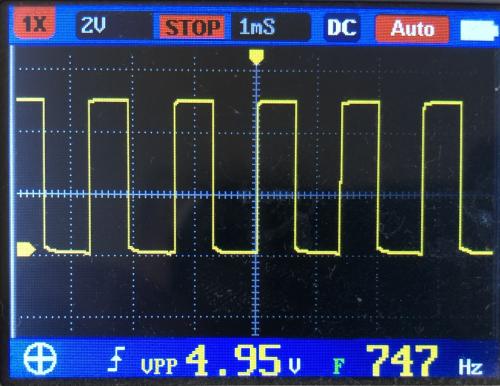
Here is a tacho pulse from one of my brushless motor driver boards. The sensored brushless motors contain three Hall sensor ICs at 120 degrees separation and each detects North and South poles as the fixed magnet rotates. The tacho pulse can be read from any of the three Hall sensor ICs.
This motor is 2-pole and in the photo is running at 747 rotations per second i.e. 44800 rpm.
As discussed elsewhere a tacho signal could be quite useful for digital slotcars.
c
(This post was last modified: 11th-Jul-25, 01:06 PM by
Dr_C2.)
•
Posts: 334
Threads: 25
Likes Received: 596 in 255 posts
Likes Given: 143
Joined: Oct 2023
Some more progress…
1/ I found a method for de-activating the ‘motor-stalled’ cut-out which is important for very low speed handling. It makes sense to set a throttle threshold (perhaps 25%) for re-engaging the motor-stalled cut-out. This can all be handled inside the decoder firmware. Decoder damage during high speed collisions could become a thing of the past.
2/ Next, the TI driver places some stringent demands on the control signals. For bespoke decoders this can be handled by the core decoder firmware itself. But what if we want to use standard SSD decoders, D132 decoders or even O2 wireless decoders to drive the brushless motors? Here I believe there is a solution too. My design will include an interface IC option which translates the PWM signals from any of the above decoder types to a signal formal as required for the TI brushless motor driver module. If this proves successful, the brushless technology should be compatible with SSD, D132 and O2 control ecosystems using their respective standard decoders.
3/ Meanwhile the tacho signal I showed in my previous post can be fed into the car windscreen display modules I also demonstrated earlier in a separate thread. With a small software tweek the display will default to showing car ID. However, when the LC button is pressed, the idea is, this would switch the display to show rpm in 1000s i.e. a display of 45 would represent 45,000 rpm.
This could be useful as a pit lane diagnostic… lift the rear wheels, throttle to max position then read off the resultant rpm - is it the expected value?
c
(This post was last modified: 14th-Jul-25, 08:37 PM by
Dr_C2.)
Posts: 334
Threads: 25
Likes Received: 596 in 255 posts
Likes Given: 143
Joined: Oct 2023
As we approach a definitive answer to what a DIGITAL slotcar brushless system should look like there are two useful in-market reference points (perhaps more?):
1/ Sensorless brushless motors have found excellent application at national/international level for ANALOG slotcar racing. While the high end variants from the likes of NSR appear full blown designs, many of the less expensive motors appear to be derivatives of ‘drone’ outrunner motors with winding ratios and mechanical fixing points re-designed to meet slotcar requirements.
2/ Meanwhile sensored brushless motors prevail in the radio controlled model racing car world with motors designed for 1/28 scale cars readily available and at affordable prices. By contrast these are inrunner motors. They have a small neat socket for interfacing with the Hall sensor ICs.
My experimental development effort uses the latter approach - the requirements for 1/24 scale digital slotcars and 1/32 scale digital slotcars conveniently straddle this 1/28 scale design point.
I have a whole range of brushless sensored motors attached in NSR motor mounts ready for trials with the new brushless driver module which I am developing. There is a clear way forward on this sensored brushless slotcar project which parallels the previous development of 1/28 radio controlled cars. So all is looking good.
But let’s add some extra fun … is it possible to add a Hall sensor PCB to a state of the art slotcar unsensored brushless motor? Here the new Slot.it brushless motor is a prime candidate.
So the question: can three Hall sensor ICs be added to a Slot.it slotcar unsensored brushless motor to transform it into a sensored motor? Let’s see…
c
(This post was last modified: 17th-Jul-25, 08:50 PM by
Dr_C2.)
Posts: 334
Threads: 25
Likes Received: 596 in 255 posts
Likes Given: 143
Joined: Oct 2023
A little bit more chat, while the brushless driver board is designed behind the scenes.
So given the range of sensored 1525-sized brushless motors available (3500-6800Kv in my case) why the interest in ‘sensorizing’ the Slot.it motors too?
The answer lies in the Kv rating of the motor and the maximum operating voltage.
The 1525-sized sensored motors are designed for battery operation in radio controlled cars where a two cell LiPo is used. Hence the maximum operating voltage is around 8V (a single LiPo cell is 3.7V). My slotcar design point is 7.5V which for a 3500Kv motor corresponds to 26,000 rpm at full throttle. To maintain compatibility with the 12V SSD track system this requires the inclusion of a tiny buck converter module onto the main decoder board. This is fine but not a perfect solution.
If the Slot.it motor can include a sensor ring pcb with three embedded SMD Hall sensor ICs, each at 120 degrees separation … that would be a more elegant solution. These motors are of course 12V compatible and have a rating of 2000Kv which corresponds to 24,000rpm at full throttle.
Both potential solutions put the motor rpm range in line with typical hi spec brushed slot car motors. Both approaches are of interest here.
BTW this thread is a simple narration between hobbyists as the ‘art-of-the-possible’ is explored regarding sensored brushless motors for digital slotcars. On this basis I hope the thread provides some entertainment/interest to fellow slotcar enthusiasts :)
c
(This post was last modified: 18th-Jul-25, 11:02 AM by
Dr_C2.)
•


