Posts: 334
Threads: 25
Likes Received: 596 in 255 posts
Likes Given: 143
Joined: Oct 2023
(16th-Jan-25, 02:45 AM)Drifter2 Wrote: I'm wondering if your sensored motors use a magnetic angle encoder or 3 hall sensors?
Very interesting either way.
Hi Drifter,
So far I am using two separate commercially available motor/ESC combinations. The benefit of this approach is that these combinations run correctly straight out of the box. The disadvantage is that they don’t come with diagrams showing how the sensors are wired inside each motor. That is a task for my oscilloscope to explain to me!
Learning so far:
The combination with the 4300KV sensored motor has a six pin sensor socket on the motor casing but only four pins appear to be electrically connected. This is likely a single Hall sensor configuration.
The combination with the 5500KV sensored motor has a five pin sensor socket on the motor casing with all pins electrically connected. This appears to be a three Hall sensors design.
As I say, all to be checked out in due course via oscilloscope waveforms - and BTW the DRV10970 manual has a nice instruction on how to identify sensor phase versus motor winding phase when building new ESC hardware.
Meanwhile I can proceed to track level trials with both motor/ESC combinations without needing to address sensor configurations until I progress to the DRV10970 based digital decoder designs (my stage 3).
c
(This post was last modified: 16th-Jan-25, 09:59 AM by
Dr_C2.)
![[+]](https://slotracer.online/community/images/bootbb/collapse_collapsed.png) •
•
Posts: 334
Threads: 25
Likes Received: 596 in 255 posts
Likes Given: 143
Joined: Oct 2023
Stage 1 progress:
The 4300KV sensored brushless motor and matching ESC are fitted onto a NSR Z4 AMG together with a Spektrum 2.4GHz DSMR receiver. The track is powered by 7.5V DC as required for this ESC. The throttle controller is a matching Spektrum DSMR transmitter.
With this setup the NSR drives nicely, including very smooth low speed control. Open the throttle and it has lots of power, torque and acceleration. The brakes are nicely effective too.
When crossing the lane changer ‘dead spots’ I observe similar effects as reported earlier by drifter2. At low speeds the ESC reset causes hesitation immediately after coasting across the ‘dead spot’. Performance at moderate and higher speeds is hesitation-free. As per drifter2’s solution I have now added the diode-capacitor ‘upgrade’ so this will be tested next :)
Also, the next trial will include the smart LED to activate lane changers and car ID detection.
These are useful first steps towards implementing a sensored brushless digital slot car. That said, the current setup is little more than fitting a commercially available sensored brushless 1/32 radio control system into a 1/32 scale slot car… so early days.
The next steps are where the fun really starts :)
c
(This post was last modified: 16th-Jan-25, 04:23 PM by
Dr_C2.)
•
Posts: 59
Threads: 6
Likes Received: 79 in 38 posts
Likes Given: 74
Joined: Nov 2023
Re track voltage,
I wonder if fitting the lane changers with a buck boost converter would allow 7.5v on the rails without needing a separate DC supply to all the LCs. I guess it depends on the size and complexity of the track layout. Just spitballing here :)
Edit... maybe easier to try a LDO regulator on the LCs. Flipper solenoids may then be under-powered though :(
•
Posts: 334
Threads: 25
Likes Received: 596 in 255 posts
Likes Given: 143
Joined: Oct 2023
(17th-Jan-25, 09:23 PM)Drifter2 Wrote: Re track voltage,
I wonder if fitting the lane changers with a buck boost converter would allow 7.5v on the rails without needing a separate DC supply to all the LCs. I guess it depends on the size and complexity of the track layout. Just spitballing here :)
Thanks Drifter2,
Your suggestions add some good options.
I did manage to find some very small buck converters which down-convert to 7.5V at 3A so will try these first - ideally I would like to keep the track at 12V SSD - but if that doesn’t work out will try your kind suggestions.
Also, will update on the application of your ‘diode-capacitor’ mod to the sensored ESCs- fingers crossed.
Many thanks,
c
(This post was last modified: 18th-Jan-25, 01:08 PM by
Dr_C2.)
•
Posts: 334
Threads: 25
Likes Received: 596 in 255 posts
Likes Given: 143
Joined: Oct 2023
I saw on a separate thread on the slotracer.online forum another discussion around brushless motors so thought it might be useful to share my understanding.
1/ Standard brushless motors and their controllers use a three-wire set-up. This setup is sensorless in so far as the motor doesn’t have any in-built position sensors. However, rotation of the motor does require that the motor controller can determine motor position. This is done my measuring the back-EMF on each of the three motor phases. This approach works extremely well except at very low speeds. This is not a concern for R/C model aeroplanes where there is never a requirement to run propellors at very low rpm.
2/ R/C cars are a different matter, and as Kevan mentioned earlier, there is a ‘cogging’ effect when trying to drive sensorless brushless motors at low speeds. Technically this is because the EMFs induced are too small to measure at these low rpm.
3/ The solution is of course to move to sensored brushless motors which typically have three Hall sensors embedded inside the motor. These motors have the normal three current carrying wires plus a separate power bus for the Hall sensors and additionally three output signals which correspond to each of the three Hall sensors.
4/ My working assumption is that we will require sensored brushless motors for digital slotcar applications.
The brushless motor in my earlier post is indeed a sensored brushless motor and the slotcar drives smoothly at low speeds, intermediate speeds and at high speed.
c
(This post was last modified: 9th-Jun-25, 05:28 PM by
Dr_C2.)
Posts: 334
Threads: 25
Likes Received: 596 in 255 posts
Likes Given: 143
Joined: Oct 2023
A while back I demonstrated a two part decoder which is SSD compatible and which has a high current drive module for brushed motors.
https://slotracer.online/community/showt...3#pid34753
This approach is now being applied to a sensored brushless motor solution.
The same core microcontroller module as used above for the brushed solution will also be used for the brushless motor solution. In this case the same four-wire interface will be connected to an electronic driver module for the sensored brushless motor. The four wires provide power and motor/brake signals.
The brushless driver module can be driven directly by the four wire interface and, as would be expected, this module has a three wire output to drive the motor. In addition it has the five wire sensor interface for the three Hall rotational position sensors.
The initial approach will use an off-the-shelf driver module which measures approx 33mm x 33mm i.e. quite large.
Once this approach is proven at track level a full custom pcb using a DRV10970 IC will be attempted.
A fun project for summer 2025.
Photos to follow as this project takes shape.
c
(This post was last modified: 19th-Jun-25, 07:32 PM by
Dr_C2.)
Posts: 334
Threads: 25
Likes Received: 596 in 255 posts
Likes Given: 143
Joined: Oct 2023
As I am now designing around the four wire interface I used for the 2023 demo of a 2-part high powered brushed motor solution, but this time for a brushless DC motor solution… this interface needs a name… so let’s call it a 4 wire motor control interface i.e. ‘4 wire MCI’.
Not to be confused with the I2C interface which also uses 4 wires and is something different.
The key benefit of using the above interface is that all necessary hardware components already exist - either from the 2023 demo or in the case of the motor driver board, as an ‘off-the-shelf’ part :)
Objective: ‘non-cogging’ brushless motors for digital slotcars.
c
(This post was last modified: 20th-Jun-25, 08:47 AM by
Dr_C2.)
Posts: 334
Threads: 25
Likes Received: 596 in 255 posts
Likes Given: 143
Joined: Oct 2023
For clarity, I’ve mentioned that my earlier brushless motor experiments with slot cars demonstrated they run smoothly at low, medium and high speeds using Hall sensored brushless motors.
However, to date these trials have used standard R/C equipment (i.e. a Spekrum transmitter and receiver) in combination with a sensored brushless ESC and motor.
It’s not too surprising this combination runs well as it’s effectively a radio controlled car that picks up power, and is guided by, the rails and slot respectively. That said, this hardware was quite bulky and barely fitted inside a 1/32 scale slot car.
The next stage is to replace the receiver with a digital decoder and to replace the ESC with a sensored brushless driver board. This should provide a far more compact solution.
With the help of a Texas Instruments motor driver development board, I hope to interrogate and characterise the 5wire/6wire Hall sensor interface of the specific brands of brushless motors I am using. Once this is completed the design of a highly compact brushless motor driver module can begin :)
Decoder->DriverModule->BrushlessMotor
c
(This post was last modified: 25th-Jun-25, 04:59 PM by
Dr_C2.)
Posts: 4,528
Threads: 147
Likes Received: 3,066 in 1,819 posts
Likes Given: 4,215
Joined: Apr 2019
Location Isle of Man
Very interesting project

Life is like a box of Slot cars...


Posts: 334
Threads: 25
Likes Received: 596 in 255 posts
Likes Given: 143
Joined: Oct 2023
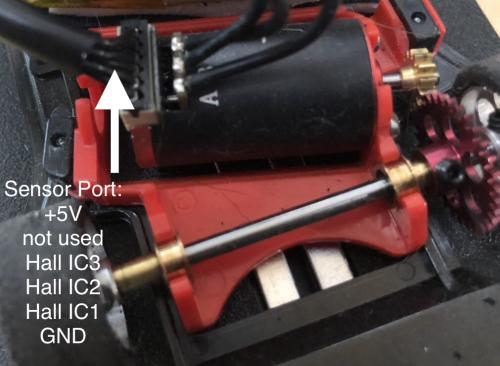
Here is a 4300KV sensored brushless motor installed into an NSR test car.
In case anyone wishes to build on this project as it progresses, I’ve added the pin-out for the 6-wire Hall sensor interface. Each of the three Hall sensors has a pull-down output transistor and therefore requires a 10k external pull-up resistor. As the motor rotates each sensor in turn switches between the two logic levels.
With this knowledge, the next step is to hook up the Texas Instruments development board. Nicely, this has SMD solder points for the three 10k pull-up resistors.
All, progressing to plan!
c
ps I’ve marked one pin as not used. This may prove to be a temperature sensor output - let’s see.
(This post was last modified: 26th-Jun-25, 06:36 PM by
Dr_C2.)
•


