
This time I'll be looking at some GT and endurance racing formats to explore some more features of the ARC app. We do a lot of team and pairs races at the club, using the RCS64 race management software for the Scalextric C7042 Six Car Advanced Powerbase (APB). Many of the simulations in RCS64 can be replicated in the ARC app, albeit in a more simple form.
1. Basic set-up
The Endurance mode is an option available from the top 'Race Mode' menu which appears when the app is launched. The race set-up is similar to the British Touring Car Championship format we looked at previously in posts #6 and #7. In fact, the basics are identical to the BTCC practice session we set up...
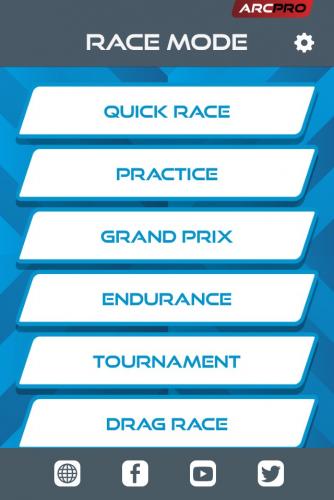
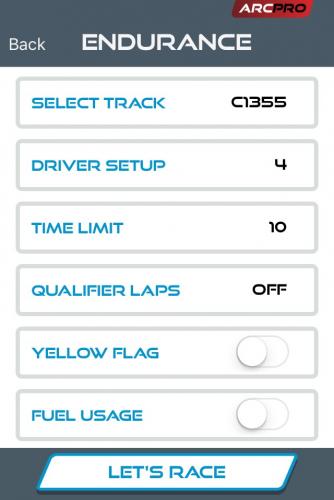
Of course, we will want to add in some simulations and tweak the format to make the racing as close to real life as possible. So, to begin with, it's good to research the real race formats.
I have always been obsessed with the Le Mans 24 hours, the highlight of my motorsport year. I also follow the other World Endurance Championship races and the American WeatherTech SportsCar Championship organised by IMSA, especially the Daytona 24 hours. Success in endurance racing is about driving fast, but also about driving consistently and looking after the car. There's also the importance of team work and strategy - it's not always the fastest car or the fastest drivers who win. I also like the added interest of the multiple classes which give fascinating battles throughout the field.
In recent years, championships for GT cars have become increasingly popular with races streamed online and via social media. The regional Blancpain GT championships bring together some fabulous GT cars for a combination of 'short' one hour races and longer three hour races, plus the iconic Spa 24 hours. In the UK, the British GT Championship is an exciting championship with rules and formats based on the Blancpain series.
Scalextric produce some lovely models of GT cars that race in all these series - Aston Martin Vantages, Bentley Continentals, Mercedes AMGs, BMW Z4s and McLaren 12Cs from Blancpain and the British GT Championship, plus Porsche 911 RSRs and Ford GTs from the World Endurance Championship and Porsches, Fords, Mercedes and BMWs from the American IMSA races. There are also the Ford Daytona Prototypes and the new Ginetta G60-LT Le Mans Prototypes for some multi-class racing.
With up to six cars racing on ARC Pro, we're looking at twelve or more drivers to make up an endurance race. If you have those numbers available, then the six car field could be split into two classes - a prototype class and a GT class. Because the prototypes are wide and low, they will have an advantage in performance - as they do in real life. You could you use the Max Power settings to increase that advantage even more or you could use Max Power and Fuel Load features to balance the performance - something that is common in GT racing.
However, for this tutorial we are going to stick with four teams, all running Scalextric GT cars. As usual, I will be using the corresponding colour helmet icons for the colour each car and controller is connected to. Instead of Driver 1, Driver 2 etc, I'll be naming the teams Team 1, Team 2 etc. I find this stands out clearly on the app display and avoids confusion in the race set-up and during the race itself...
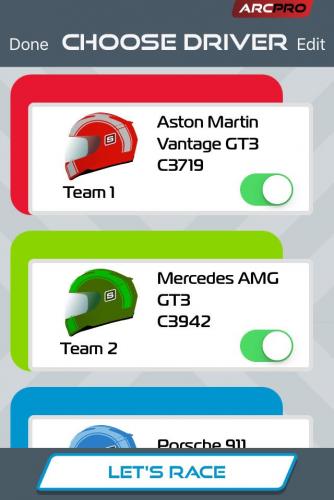
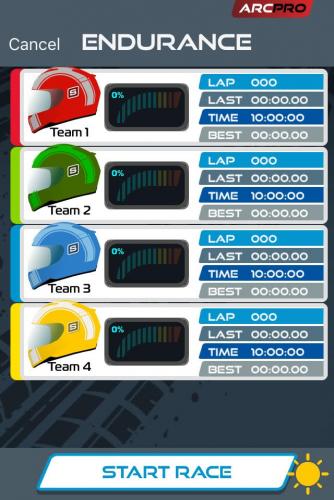 2. Balance of Performance and Driver Seeding
Balance of Performance is a big deal in modern GT racing. It encourages a wide range of manufacturers to build and homologate their GT cars to the GT3 and GTE regulations, knowing that no one manufacturer will have the dominant car. If one make of car has the advantage, it will be pegged back by adding weight and/or restricting engine power. The measurements of performance and the effect of any alterations are meticulous. It's a process that doesn't always work - annoying everyone involved - but when it does work, it provides some incredibly close and exciting racing.
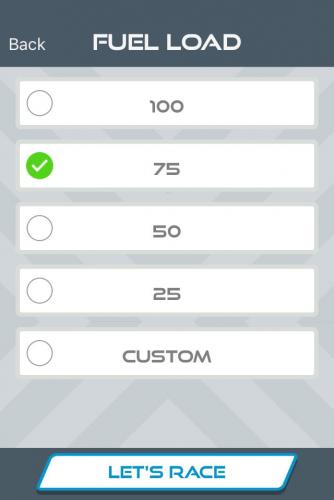
With our ARC GT simulation, we'd like to emulate a Blancpain or British GT race - or a classic like the Bathurst 12 hours, Spa 24 hours or Nürburgring 24 hours - so it'll be good to have similarly-performing cars. Although running various brands of car might give you a more varied grid, their performance can be very different. I prefer to stick with either a Scalextric-only grid or to run only Carrera GT cars. If you find a specific model is much quicker on your track, you could reduce the Max Power or Fuel Load - the former will make it slower on the straights, but not round the corners. Reducing the fuel load would mean it has to pit more frequently, which is a real disadvantage in a long endurance race. There are presets of 100, 75, 50, 25 and 'Custom' in each of the Max Power and Fuel Load menus. Just like real balancing of performance, it would need plenty of testing and tweaking to get right...

Balance of Performance is not something we use in our digital racing, although we do remove the traction magnets from our cars and allow replacement rear tyres. Running 'non-mag' does tend to even out performance a little and is important for running long endurance races - otherwise the motor can overheat and fail. I would certainly recommend that your endurance class is a non-magnet class, unless you are limiting your races to 10 or 15 minutes.
Another method of 'leveling the field' in GT racing is the
seeding of drivers. The very best drivers in the world are designated 'Platinum', with 'Gold' indicating successful professional racers and 'Silver' being other professionals. 'Bronze' drivers are the amateur drivers. Series rules might demand that all driver pairings are made up of one professional and one amateur driver - in other words a Pro/am series like the British GT Championship. Other series - such as Blancpain GT - have championships for all-Pro teams, all-Silver teams, Pro/am teams and amateur-only teams.
In our digital racing, we have no professional drivers, but we do have some drivers who are more successful than others. Keeping those more successful racers on separate teams is the basis for our seeding of drivers. As with Balance of Performance, using artificial means to produce a close race might seem wrong - but a race that sees four teams within a few laps of each other after 30 minutes of racing is so much more exciting than a team winning by 50 laps or more. If you can't select equally-matched teams, then adjusting the Max Power and Fuel Load menus can be an ideal way to make things interesting. It's also something to consider in individual races too - encouraging less-experienced drivers that, if they drive well, they can win the race.
3. How long to race?
The Endurance race mode in the ARC app will allow you to race for as long as you want - in minutes. The 'Time Limit' options are 5, 10, 15 and 20 minutes - plus a Custom menu which will happily take 1440 minutes (24 hours). If you are running standard cars with traction magnets, I wouldn't recommend exceeding 20 minutes and probably aim for 10 or 15. However, even racing for 5 minutes per team member can be a lot of fun and a test of endurance and team work. If you remove the traction magnet from the car and add some racing tyres, races of 30, 45 or 60 minutes are great. But why stop at an hour? I have raced in nine 24 hour slot car races on replicas of the Le Mans circuit - it is very tiring, but absolutely brilliant fun. Not something you'd want to do every week though.
That's it for now. Next we'll look at the fuel and tyre simulations, pit stops and the implications for track design and team work...


![[+]](https://slotracer.online/community/images/bootbb/collapse_collapsed.png)


