Posts: 1,478
Threads: 223
Likes Received: 2,275 in 824 posts
Likes Given: 1,088
Joined: Mar 2019
Location Norfolk, England
The National Scalextric Collectors Club (NSCC) is currently in its 40th year of existence, founded in January 1981 (not 1980 as their website erroneously states). It is almost certainly the oldest such enthusiasts club in the world and its monthly magazine is the longest continuously running English language publication devoted purely to slot cars anywhere.
It has never had a huge membership but has consistently punched above its weight and been responsible for initiating many of the things we take for granted these days such as swapmeets, limited edition cars and the UKSF. Several of today’s major slot car suppliers such as Pendle and MRE can trace their foundation directly back to their membership of the NSCC. As with all such clubs it has had its fair share of ups and downs but has managed to survive financial crises, committee upheavals and the rise of the internet so I thought it time to document its full story.
Part 1
Prehistory
The 1970s were an exceptionally low point in the history of Scalextric following the bursting of the slot car bubble at the end of the previous decade. The market had almost totally collapsed due to declining interest and the advent of new mechanical toys such as Hot Wheels. Several of the smaller slot manufacturers had gone bust, as had Scalextric’s parent company, Triang, in 1971. Scalextric managed to survive under new ownership but the range was drastically cut back and production of new cars was severely limited for the next few years. Quality took a nosedive with cars such as the Mini Clubman and Porsche 935 amongst the worst ever produced by the firm. Slot racing clubs had also mostly disappeared with just a few well-established ones managing to cling on.
By 1977 however, there was the glimmer of a revival in interest and some new racing clubs appeared, amongst which was the most important as far as this tale is concerned – The London Scalextric Club.
Roy Charlesworth, the club’s founder, worked as a dance instructor at the Harmony Ballroom, located above the Odeon cinema in Wood Green, North London and so he was able to use the dance hall on a Sunday to build a circuit and host races. The track sections he used in the beginning were old Plexytrack from his previous club nine years before when model slot car racing had succumbed to the might of the commercial raceway.
He advertised his race days in the Exchange and Mart and was surprised at the good response he got as people came from all over London and the South East to race every two weeks. The club grew so well that it organised a South of England Championship for several years. The 1979 event attracted a 60 strong entry and one of the drivers racing that day was a 15 year old John Herbert from Romford, Essex. Though he had never even seen the circuit before he went on to finish 3rd, beating most of the home drivers in the process. Johnny, as he later became better known, went on to greater things in real cars, winning F1 Grand Prix as well as Le Mans. A report of the race can be found HERE. The following year the club lost its premises but soon found a new home at St Marks Church Hall, just 200 yards from where it had begun, and they race there to this day every Tuesday evening.
Aside from the racing quite a few of its members had begun to collect early Scalextric cars which could be picked up for as little as a pound each at that time. Foremost amongst them was a certain Roger Gillham who was already working on the first edition of his legendary ‘Enthusiasts Guide’. Accordingly, Roy decided to start a collectors branch of the club, it was a separate entity with a subscription of £3 a year and produced newsletters in 1979/80. I have 6 of them in my possession but there may have been more. Here is #2 which also came with a couple of pages of members’ sales/swaps/wants.
Apart from Roger there were several members who would become well known to the collecting fraternity such as Martin O’Reilly, Shaun Claremont, Chris Gregory, Reg Palmer and Eddie Collins. Surprisingly, the branch had some members in the USA including Lee Stokely of California and Chuck Lawrence from New York. I have no idea how this was achieved in those pre internet days! Several auctions were held in the ballroom which were a precursor to later swapmeets, and a visit was also made by Anton Palau who ran a famous model shop in Spain which led to the first significant arrivals of Spanish Scalextric cars in the UK.
The man who started it all, Roy Charlesworth (right) with future editor of the newsletter, Malcom Parker.

(This post was last modified: 18th-Oct-20, 03:06 PM by
CMOTD.)
Posts: 1,478
Threads: 223
Likes Received: 2,275 in 824 posts
Likes Given: 1,088
Joined: Mar 2019
Location Norfolk, England
Part 2 Genesis
1981/1982
Dale Tremble of Southend was a member of the collectors branch and it occurred to him that it might be possible to expand it to a national club, so he placed a few adverts in late 1980/early 1981 to gauge the response. They were usually placed in the ‘Collectors Gazette’ and the earliest surviving one I have is from the February edition of 1981.
Interest was deemed sufficient to go ahead, most of the members of the ‘collectors branch’ signed up so that was disbanded and the National Scalextric Collectors Club was formally launched in January 1981 with the publication of the very first newsletter which also included a potted history of the brand by Roger.
Swapmeets devoted purely to slot cars, which we now take for granted, were non-existent prior to the formation of the club and the NSCC introduced them in the first few months of its life. As noted in the newsletter above the very first was held at Luigi Ciaparelli’s dental surgery in Romford on March 15th, 1981. The club has organised them ever since and they have expanded greatly over the years.
The first membership list was produced in April that year, it contained just 37 names and it is quite remarkable that five people on it, Geoff Spencer, Robert Cast, Paul Whitehead, David Wells and Chris Gregory, remain members to this day.
Unfortunately, Dale decided to step down as organiser/secretary after just six months, announcing that he had sold his collection in the June issue and was seeking someone to take over. It remains unclear why he stopped, I met Dale in early 2000 and got no definitive answer but he generously provided me with all his early club archive material which forms the basis of this early part of the history. As far as I have been able to ascertain no more newsletters were produced that year although there must have been some method of communication with members as another swapmeet was held in November.
Rebirth 1982
Rob Brittain took over the running of the club and restarted the newsletters from scratch in January 1982. As he began at #1 again it means that all subsequent publications are incorrectly numbered to this day.
The newsletter gradually expanded to 6 sheets of A4, mostly consisting of members wants and swaps which were a mainstay of the club’s appeal for many years until the arrival of eBay. A secondhand price guide was also introduced for people’s guidance.
The only swapmeet of that year was held in Petersfield, Hampshire:
The June issue brought both good and bad news:
Good – Hornby Hobbies officially recognised the club and were willing to help promote it.
Bad – the club was in danger of running out of money, probably due to subscriptions being set too low to cover the printing and postage costs of the newsletter.
An urgent appeal was launched for members to donate £2 each to see the club out till December. This had the desired response; the financial crisis was averted and membership cost was increased to a more sensible level (£4.50 per annum!) for the following year.
A monthly prize draw was introduced in September, two entries for a pound with a top prize of a C96 white Auto Union. As the total membership was 70 people at the time the odds of a substantial win were rather good!
By the end of 1982 10 newsletters had been produced (July/August and October/November were combined issues), membership had increased to 85 and the club was properly up and running. One notable new member was Dave Yerbury of Accrington who you may know as the maker of AA Bodies.
(This post was last modified: 28th-Oct-20, 01:29 PM by
CMOTD.)
Posts: 1,478
Threads: 223
Likes Received: 2,275 in 824 posts
Likes Given: 1,088
Joined: Mar 2019
Location Norfolk, England
Part 3 onwards and upwards
1983/1990
The club made consistent progress throughout the rest of the decade, the finances stabilised with a modest surplus each year, membership steadily increased and reached the 500 mark by December 1990.
During this period the club organised several factory visits and race meetings while the swapmeet calendar expanded to three a year, with events in Birmingham and Farnham together with the first appearance of the Milton Keynes event in July 1987 which has been running ever since.
Newsletter
This gradually expanded, became a bit more professional and was regularly running to 20 pages by the end of 1990. The original photocopied A4 version was superseded in early 1984 by a commercially printed A5 issue and has remained at that size to date. The familiar laurel wreath logo also made its first appearance on the front cover at this time.
Members adverts still formed a significant part of the content but the number of informative articles about the hobby greatly increased as time went on.
The original secretary/editor, Rob Brittain handed over to Mike Pack in May 1983 who ran things and produced the newsletter until June 1985. Incidentally, the handover was slightly delayed which resulted in the April issue being missed. This was the only month the magazine failed to appear until 2019!
In July 1985, the two jobs were split and Norman Wheatley took over as editor until December 1990 with Mike Pack continuing in the secretary/treasurer role.
Bearing in mind that this was long before proper home computers became widely available it is a credit to the various editors that so many issues were compiled with nothing more than an electric typewriter, cut out pictures and a large jar of flour paste!
Club Cars
Nowadays the world and his mother seems to churn out ‘limited edition’ slot cars – mostly limited to the number that they think the mugs will buy at a suitably inflated price! Back in the 80s these hardly existed when the club initiated the production of unique models available only to its members at sensible prices.
Prior to the formation of the club Scalextric had never really bothered with such things but, during a factory visit in 1982 it was discovered that the moulds for the original Bugatti from the 60s still existed. After some persuasion Hornby agreed to produce a limited run of Bugatti bodies and chassis only in yellow, green and red for NSCC committee member, Steve de Havilland. They were marketed by Steve’s business, ‘Traffic’ and initially only sold to club members in 1983 with surplus ones being offered to the public later.
Following on from this the first pair of complete club cars was produced in 1984, a reissued 60s Alfa Romeo 2.3 Litre in a unique dark red colour and a Ford Escort XR3i in sky blue with separately applied NSCC decals.
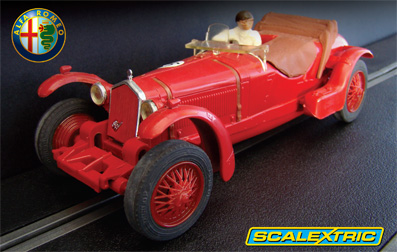 126 Alfas and 80 Escorts were produced and they are highly sought after by collectors to this day.
They were followed by a grey Datsun 260Z in 1986/7
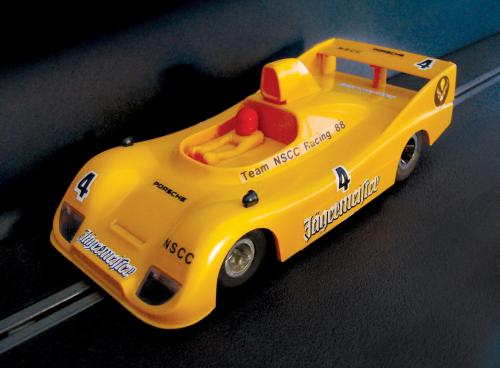
Unfortunately, a change of Scalextric management occurred around this time and they lost interest in producing any more club cars for many years so two further ones were commissioned from MRRC instead, an orange Porsche 936 in 1988 and a brown Mini in 1989:
126 Alfas and 80 Escorts were produced and they are highly sought after by collectors to this day.
They were followed by a grey Datsun 260Z in 1986/7
Unfortunately, a change of Scalextric management occurred around this time and they lost interest in producing any more club cars for many years so two further ones were commissioned from MRRC instead, an orange Porsche 936 in 1988 and a brown Mini in 1989:
 Notable members
Julian (Jules) Birley joined in 1985, just a collector at the time and long before his Pioneer slot car business was set up.
Gary Cannell joined in 1986, more about him in the next part of the history.
Bruce Patterson from Australia joined in 1989, the proprietor of Pattos Place which produces a myriad of slot car decals and parts.
By now the club was firmly established and had expanded worldwide with members in every continent.
Notable members
Julian (Jules) Birley joined in 1985, just a collector at the time and long before his Pioneer slot car business was set up.
Gary Cannell joined in 1986, more about him in the next part of the history.
Bruce Patterson from Australia joined in 1989, the proprietor of Pattos Place which produces a myriad of slot car decals and parts.
By now the club was firmly established and had expanded worldwide with members in every continent.
(This post was last modified: 3rd-Nov-20, 01:14 PM by
CMOTD.)
Posts: 1,478
Threads: 223
Likes Received: 2,275 in 824 posts
Likes Given: 1,088
Joined: Mar 2019
Location Norfolk, England
Part 4 - reaching peak membership
1991/ 1999
This was the most successful decade in terms of growing membership, reaching a peak of around 1100 by 1999, but it did not start off very professionally when the first newsletter of 1991 managed to spell Scalextric incorrectly on the front cover!
The newsletter continued to thrive and often contained 40 plus pages by 1999. The production quality improved as the club acquired some new-fangled things called computers!
Tony Frewin edited it from January 1991 to December 1992 on an Amstrad word processor then Malcolm Parker took over from January 1993 till December 1994 and caused a major row when he purchased a Gateway 486 PC, scanner, Microsoft Publisher and a laser printer without getting permission from the rest of the committee! Such things were not cheap in those days and the club finances, although reasonably healthy, were not unlimited. Malcolm was responsible for the oldest surviving part of the current magazine; in his first issue he introduced this little drawing of a slot car and It remains part of the masthead to this day.
Malcolm also wrote the definitive history of VIP slot cars which can be found HERE.
Alan Slade took over in January 1995 and edited the magazine till September 1999.
Rise of the traders
As interest in collecting and the club increased, slot car dealers, both part and full time began to appear. Many have disappeared over time but some did very well and two of the biggest ones today owe their very existence to membership of the NSCC.
Gary Cannell was an early member, joining in 1986. He served on the committee for many years and eventually, in 1998, decided to go into the slot business under the name of MRE. Here is his first advert to appear in the newsletter:
Sean Fothersgill was just an ordinary collector with a full time job when he joined in April 1991. He advertised in the newsletter and began to attend swapmeets to sell off his surplus cars. He found it so successful that he decided to set up Pendle Slot Racing and the very first advert for the firm appeared in the June issue of 1995.
Other names you may recognise also got their start through the club with small adverts in the newsletter and attendance at swapmeets:
Mark Scale of Scale Models joined in January 1991.
Limited Editions, financial grumblings and the 200th edition of the newsletter
In 1994 a new manufacturer, Ninco, appeared on the scene and offered to make a special car for the club. With Hornby still showing no interest in them the club decided to accept and the first club car for many years was produced in 1995, a Renault Clio in plain yellow with separate NSCC decals.
In 1996 Hornby finally agreed to produce a club car again, two in fact, a pair of Rover SD1s, tampo printed with the club logo, which were delivered to members in mid-1996.
Many years of penny pinching by the club’s treasurer and the profits from these cars led to a healthy surplus of £30,000 in the club’s accounts and people complained at the next year’s AGM that it was too high and such cars should be sold at below cost to the members.
The committee had a cunning plan in place for some of the surplus funds though. In November 1998, the 200th edition of the Newsletter arrived on the doormat. This was a bumper sixty page issue which contained the very first colour supplement and the news that every paid up member, 1018 of them, would be receiving a special Scalextric Jaguar XJ220C anniversary edition totally free of charge.
Some interesting new members
In September 1991, a previously unknown American citizen, with a small collection of 130 cars, joined the club and the following letter and advert appeared:
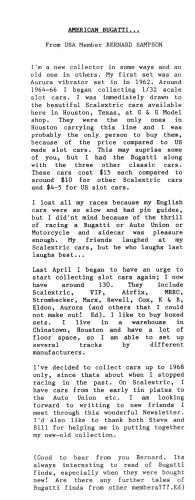
 If you have never heard of Bernard Sampson then try looking at the website of Bernard’s Slot Car Museum in Houston, Texas which now contains over 7000 cars. His collection has grown a bit since he joined the NSCC!
In June 1992, a change of front cover was designed by new member Marc Abbot. If you haven’t heard of him either then have a look at Slot Car Magazine which he edits, his design talents have come a long way.
Stunt car driver Russ Swift joined in 1992. He had quite an extensive collection at the time and wrote some articles for the newsletter.
Other well known enthusiasts who were members and wrote articles for the magazine during this period were David Lawson of Southend and Don Siegel, an American living in Paris. Both are current moderators on SFI.
Doug Passell joined in 1995 and wrote several articles about HO cars. You will find him as 'Top Down' on this forum.
Someone called Adrian Norman also joined in 1995 but more about him and the rest of the decade in the next instalment.
(This post was last modified: 3rd-Nov-20, 12:13 PM by
CMOTD.)
Posts: 1,478
Threads: 223
Likes Received: 2,275 in 824 posts
Likes Given: 1,088
Joined: Mar 2019
Location Norfolk, England
Part 5
The 90s continued
Model Engineer Exhibition
This was a long running major exhibition at Olympia over nine days each year which catered for many disciplines. In 1992 Gary Cannell joined the committee as promotions officer and, at his prompting, the club decided to take a stand at the 1993 event and run a slot car track for the public with prizes generously provided by Scalextric. With the help of a well-known collector of the time, Phil Etgart and other volunteers from the club it was a huge success. Over 2000 people paid to have a go on the track and many new members were recruited.
The exercise was repeated in the following years and gave a very welcome boost to the club finances from the race fees. In 1996 Gary and the club received an award for the “Stand of the Show.” The certificate still resides on the wall of his downstairs loo!
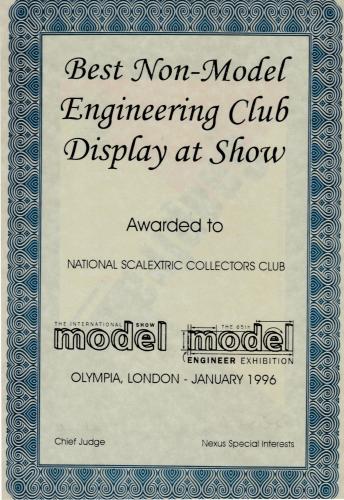 At this time Gary was still just a slot car enthusiast and collector but the number of people who asked him where to buy Scalextric at the exhibition set his mind working and he eventually decided to take the plunge, left his job and started MRE in 1998 as a high street shop before moving online the following year.
Goodwood Revival
The club also had a stand at the second Revival in 1999 and built a replica of the Goodwood circuit for public use. Unfortunately the set up expenses were allowed to get out of hand, the club lost money on the exercise, few new members were signed up and it was never repeated.
Relationships with Hornby
The club has had somewhat variable relations with the firm over the years and there were times in the late 80s/early 90s when communications deteriorated quite badly. For most of this period Scalextric did not really have a separate brand manager as Simon Kohler was marketing manager of both the model railway and slot car divisions. He is a well known and liked figure in the industry, has Hornby written through him like a stick of rock and has been the public face of the company since God was a lad. Unfortunately his extreme brand loyalty makes him over sensitive to the slightest criticism of the product and this led to many run ins with the club. He is essentially a model railway man with little interest in slot cars which he often seemed to regard as something of a nuisance. One particular past member of the committee also had a unique talent for upsetting him which led to temporary withdrawals of support, a refusal to produce any special cars for the club and veiled threats to withdraw permission to use the brand name in the club’s title.
Malcolm Parker put in a great deal of effort to restore a somewhat shattered relationship in the early 90s and eventually got to the stage where they were once again happy to give news, prizes and another limited edition car.
Things improved further in 1997 when Adrian Norman became NSCC/Scalextric liaison officer and wrote the ‘Factory Lines’ monthly report. He went to the factory every month and got on well with Simon Kohler. In 1998 he arranged the 200th Edition Jaguar and designed the livery himself.
Ramsgate Weekend
One of Adrian’s major achievements was convincing Simon and the Scalextric development team that it would be a good idea to get first-hand feedback from the members at a jointly organised social weekend in a Ramsgate hotel. The first one was held in 1998, has been repeated virtually every year since and continues to be a highlight of the NSCC calendar. The weekend consists of some racing, Q&A sessions with Scalextric product managers and designers, evaluation of new products, charity auctions of rare pre-production items, an evening meal with a quiz and much socialising of members over a pint or six.
At this time Gary was still just a slot car enthusiast and collector but the number of people who asked him where to buy Scalextric at the exhibition set his mind working and he eventually decided to take the plunge, left his job and started MRE in 1998 as a high street shop before moving online the following year.
Goodwood Revival
The club also had a stand at the second Revival in 1999 and built a replica of the Goodwood circuit for public use. Unfortunately the set up expenses were allowed to get out of hand, the club lost money on the exercise, few new members were signed up and it was never repeated.
Relationships with Hornby
The club has had somewhat variable relations with the firm over the years and there were times in the late 80s/early 90s when communications deteriorated quite badly. For most of this period Scalextric did not really have a separate brand manager as Simon Kohler was marketing manager of both the model railway and slot car divisions. He is a well known and liked figure in the industry, has Hornby written through him like a stick of rock and has been the public face of the company since God was a lad. Unfortunately his extreme brand loyalty makes him over sensitive to the slightest criticism of the product and this led to many run ins with the club. He is essentially a model railway man with little interest in slot cars which he often seemed to regard as something of a nuisance. One particular past member of the committee also had a unique talent for upsetting him which led to temporary withdrawals of support, a refusal to produce any special cars for the club and veiled threats to withdraw permission to use the brand name in the club’s title.
Malcolm Parker put in a great deal of effort to restore a somewhat shattered relationship in the early 90s and eventually got to the stage where they were once again happy to give news, prizes and another limited edition car.
Things improved further in 1997 when Adrian Norman became NSCC/Scalextric liaison officer and wrote the ‘Factory Lines’ monthly report. He went to the factory every month and got on well with Simon Kohler. In 1998 he arranged the 200th Edition Jaguar and designed the livery himself.
Ramsgate Weekend
One of Adrian’s major achievements was convincing Simon and the Scalextric development team that it would be a good idea to get first-hand feedback from the members at a jointly organised social weekend in a Ramsgate hotel. The first one was held in 1998, has been repeated virtually every year since and continues to be a highlight of the NSCC calendar. The weekend consists of some racing, Q&A sessions with Scalextric product managers and designers, evaluation of new products, charity auctions of rare pre-production items, an evening meal with a quiz and much socialising of members over a pint or six.
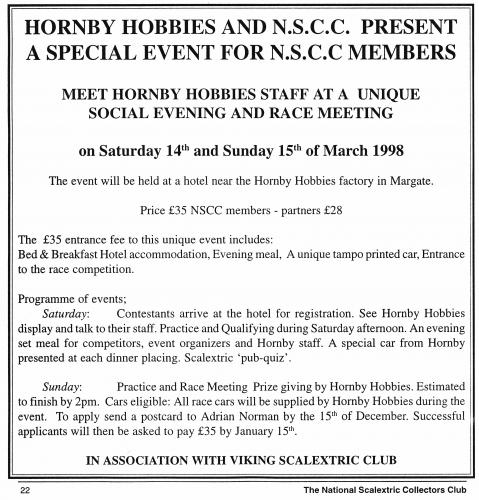
Each year all attendees receive a special event car and these have become the most sought after of all the club’s limited editions. At this time production was still based in Margate so Hornby would take a small number of whatever car was being made at the time and do it in a special colour free of charge. When production was later moved to China this facility was not available so the club had to pay for special NSCC liveries to be produced.
The 1998 car was a blue Renault Megane, 50 were made, 48 for attendees, one for the club archives and the last one was a prize car for overseas members, who made up a quarter of the membership at this time.
Change of name
The club had always been mostly known by its initials but in 1999 it dropped the Scalextric reference entirely from the name and became just the NSCC. There were a couple of reasons for this:
The arrival of Ninco in 1994 and Fly cars in 1996 had really shaken up the slot car market and the newsletter naturally reflected members’ interest in them with articles on a much wider variety of makes.
In 1998 Hornby had launched its own Scalextric club with a magazine called ‘Racer’. This was really just a promotional tool for its products rather than a genuine club but it started to refer to the NSCC as ‘The National Slot Car Collectors Club’ indicating that they were not happy with the continued use of their brand name by a ‘rival’ club.
Permission to use the brand name was never formally withdrawn but the committee took the hint, removed it unilaterally and changed the club logo and masthead accordingly. A few different designs were tried out before settling on these, designed by Gareth Jex:
(This post was last modified: 11th-Nov-20, 02:30 PM by
CMOTD.)
Posts: 1,478
Threads: 223
Likes Received: 2,275 in 824 posts
Likes Given: 1,088
Joined: Mar 2019
Location Norfolk, England
Part 6
2000/2008 all appears well but………..
As the new millennium dawned the club seemed to be in excellent shape with a stable membership around the 1000 mark, healthy finances and a continually improving monthly magazine. However, several things were conspiring to make the club less relevant, particularly the rise of the internet.
In 1999 eBay reached the UK and this soon wiped out one of the mainstays of the magazine, members adverts, which virtually disappeared within a few years as vast amounts of slot car items could now be bought and sold online without joining the club. The appearance of slot car forums in 2003/4 meant that people could receive all their information virtually instantaneously without waiting for a print magazine at the end of the month. Facebook did not become a major force till about 2010 but the rise of social media would change many things in the years to come. Like other organisations the NSCC initially failed to notice which way the wind was blowing and struggled to cope with the new internet connected world, it had a fairly lacklustre website and didn’t really engage with the new forums. Although membership levels were stable the club ceased to grow and, if you are just standing still, then you are really going backwards.
Newsletter/Journal
In October 1999 I took over the job of newsletter editor myself when Alan Slade retired. I had actually joined the club in 1983 but made no real contribution to things apart from placing a few adverts and helping out at the occasional swapmeet. Quite why I decided to take on the role of editor remains a mystery to this day as my only previous experience of computers was playing games on a Sinclair Spectrum ZX. Somehow it just seemed like a good idea at the time!
I inherited some aging computer equipment running Windows 98 and outdated desktop publishing software and it took a little while to get the hang of it with the blue screen of death a common occurrence. The committee were reluctant to spend money updating things, cash reserves were still good but the annual membership fees were rarely increased so higher printing and postage costs were gradually eating into them. Eventually I did the same thing as Malcolm Parker many years previously, bought a brand new system running Windows XP and an updated version of the Adobe publishing software then sent in the bill without asking permission first.
The quality of the magazine continued to improve during my tenure but this was due to advancing technology rather than any great effort on my part. When I started out, the internet, which was still dial up and terribly slow was really in its infancy so most articles received were handwritten and had to be typed in manually. Any photos provided were old fashioned prints which had to be scanned in with somewhat haphazard results. The arrival of broadband and widespread email use radically changed things for the better and it became far easier to put the thing together. A large membership also ensured that I had a good number of regular and knowledgeable contributors to draw from so the number of pages continued to increase with at least 52 pages every month.
In 2000 the committee decided that ‘Newsletter’ was an outdated term so the magazine was renamed the ‘NSCC Journal’ although it remained the same black and white production it had always been. Colour printing was still very expensive at this time and would have required a doubling of the annual membership fee so it was not until printing costs became more affordable in 2005 that colour was introduced on a regular basis. Initially a four page colour section was included and this continually expanded until a full colour magazine became the norm in 2010.
One of the earliest colour supplements featured an article about a home rally track by new member Hub Habets. You may know him as master track builder Rallyhub on the forum and the NSCC journal was the first magazine in the UK to feature three of his tracks.
Incidentally, you can read issues of the magazine from 1999 - 2018 on the club’s website in a cut down (minus adverts) pdf version. Each year's publications are usually put up about 12 months after the print version appears.
Adrian Norman’s dream job
In 2002, NSCC/Scalextric liaison officer Adrian was made redundant from his IT position at Pfizer when it shut down its research and development facility in Kent and he was recruited by Hornby for the post of Scalextric promotions manager. At long last enthusiasts had one of their own in the company! He resigned from the committee to avoid a conflict of interest and naturally tended to toe the company line but was an invaluable friend of the NSCC for many years to come and the club’s relationship with Hornby flourished while he was there.
25th Anniversary Year 2005
This was a very significant year for the club as it celebrated its 25th year of existence and continuous publication of the magazine.
To celebrate this the first club cars since 1998 were produced, a matching pair of Scalextric Minis, probably the prettiest of all to date. 500 of each were produced and sold out in record time.
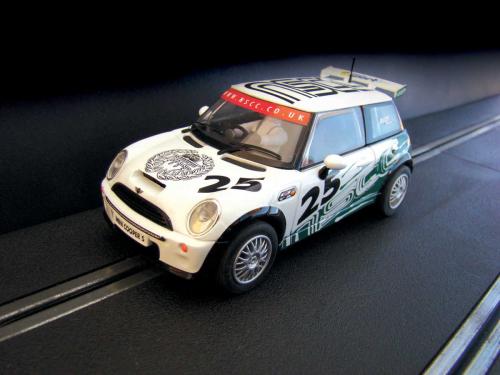 The club also organised a two day 25th Anniversary show at the Toyota Headquarters in Surrey which was the very first major event solely dedicated to slot cars in the UK and would eventually result in the birth of the annual UKSF show at Gaydon. The full story of this event and a second one in 2006 can be read HERE. It also built a giant Hillclimb for the Toyota stand at the Goodwood Festival of Speed in 2006 which you can read about HERE.
The decline of club swapmeets
These had always been run as members only events (although this was not always strictly enforced) and had settled into a pattern of six a year. Milton Keynes was always the largest and most commercial with the others, at various venues around the country, being smaller more social events. As time went on the committee came under pressure from the traders within the club to open them up to the public and greatly expand the calendar.
Rightly or wrongly this was resisted so the traders went their own way, started to organise open events themselves and the number of swapmeets multiplied dramatically in the following years. Some were successful and still continue while others fell by the wayside.
NSCC ones, which had always been run by individual members on a non-profit basis as a service for the club then rapidly declined. The commercial events were often run in close proximity (date or place) to the club events so tables became difficult to sell and it was no longer worth the effort of running them. The sole survivor was Milton Keynes, which is still run by the club, albeit no longer restricted to members only but they do get free admission.
A bad choice of car
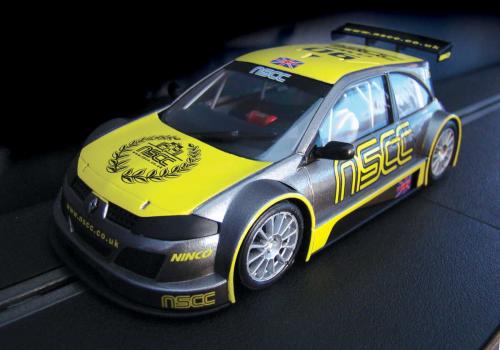
Two more limited edition cars were produced in 2006 and 2008. The Ninco Mégane was a great choice and an instant sell out but the SCX Skoda Fabia was a bit of a disaster and probably the most unloved club car of all. SCX had originally agreed to produce a unique Mk11 Escort in full Rothmans ciggy livery but reneged on the deal at the last moment and offered a muddied version of the standard Fabia instead with just a small NSCC tampo on the windscreen. It should have been rejected out of hand but for some reason the committee allowed it to go ahead and sales were terrible. It took many years to offload them, with some still unsold as late as 2017 and causing a considerable hole in the finances for a fair while.
The club also organised a two day 25th Anniversary show at the Toyota Headquarters in Surrey which was the very first major event solely dedicated to slot cars in the UK and would eventually result in the birth of the annual UKSF show at Gaydon. The full story of this event and a second one in 2006 can be read HERE. It also built a giant Hillclimb for the Toyota stand at the Goodwood Festival of Speed in 2006 which you can read about HERE.
The decline of club swapmeets
These had always been run as members only events (although this was not always strictly enforced) and had settled into a pattern of six a year. Milton Keynes was always the largest and most commercial with the others, at various venues around the country, being smaller more social events. As time went on the committee came under pressure from the traders within the club to open them up to the public and greatly expand the calendar.
Rightly or wrongly this was resisted so the traders went their own way, started to organise open events themselves and the number of swapmeets multiplied dramatically in the following years. Some were successful and still continue while others fell by the wayside.
NSCC ones, which had always been run by individual members on a non-profit basis as a service for the club then rapidly declined. The commercial events were often run in close proximity (date or place) to the club events so tables became difficult to sell and it was no longer worth the effort of running them. The sole survivor was Milton Keynes, which is still run by the club, albeit no longer restricted to members only but they do get free admission.
A bad choice of car
Two more limited edition cars were produced in 2006 and 2008. The Ninco Mégane was a great choice and an instant sell out but the SCX Skoda Fabia was a bit of a disaster and probably the most unloved club car of all. SCX had originally agreed to produce a unique Mk11 Escort in full Rothmans ciggy livery but reneged on the deal at the last moment and offered a muddied version of the standard Fabia instead with just a small NSCC tampo on the windscreen. It should have been rejected out of hand but for some reason the committee allowed it to go ahead and sales were terrible. It took many years to offload them, with some still unsold as late as 2017 and causing a considerable hole in the finances for a fair while.
 An interesting front cover and the 300th issue of the magazine
In 2005 the venerable magazine ‘Motor Sport’ had a disastrous makeover and ditched its distinctive green cover for a garish red one which went down like the proverbial lead balloon with its readership and was soon abandoned. Mark Sanderson designed a tribute front cover for the 2006 NSCC Journal which is quite possibly the best one to date.
Another milestone was reached in March 2007 with the publication of the 300th edition of the magazine, the first full colour issue ever. Among other things it contained the definitive history of the collector’s holy grail, the Scalextric Bugatti.
An interesting front cover and the 300th issue of the magazine
In 2005 the venerable magazine ‘Motor Sport’ had a disastrous makeover and ditched its distinctive green cover for a garish red one which went down like the proverbial lead balloon with its readership and was soon abandoned. Mark Sanderson designed a tribute front cover for the 2006 NSCC Journal which is quite possibly the best one to date.
Another milestone was reached in March 2007 with the publication of the 300th edition of the magazine, the first full colour issue ever. Among other things it contained the definitive history of the collector’s holy grail, the Scalextric Bugatti.
(This post was last modified: 24th-Nov-20, 01:28 PM by
CMOTD.)
Posts: 1,478
Threads: 223
Likes Received: 2,275 in 824 posts
Likes Given: 1,088
Joined: Mar 2019
Location Norfolk, England
Part 7
2009/2020
40 years on and still here
When I retired from editing the magazine in December 2008 having ‘done my bit for the club’ there was a bit of a hiccup when the new editor was not up to the job and threw in the towel after a single issue but fortunately Jeremy Naylor stepped into the breach and has remained in post ever since. He has done a sterling job and maintained the quality of the magazine throughout his tenure.
Jeremy has the twin distinctions of being the longest serving editor (having chalked up nearly 11 years in the post so far) and being the first one to miss an issue since 1983! The Windows XP device which he inherited from me finally died in April 2019. Ever since 1995 the magazine had been compiled with the aid of Adobe PageMaker desktop publishing software which had been obsolete and unsupported since 2004 and would not work with later versions of Windows. Apart from installing a new computer Jeremy had to set up the whole magazine from scratch again with different software. This was not a five minute job so the May issue of 2019 never appeared.
Committee upheavals
Unsurprisingly, throughout its long history the club had a few disagreements and departures from the committee as all organisations do, with a couple in the 80s and 90s. The period from 2009 through 2014 was particularly fraught as the club lost three successive chairmen, a long serving secretary and several other committee members over various internal disputes. Some of the arguments spilled over into the public domain, did the club’s reputation no favours and some longstanding members were lost as a result. Everything eventually settled down though and it currently has a stable, hard working committee who are committed to the club’s well being.
30th anniversary year and an incorrect date
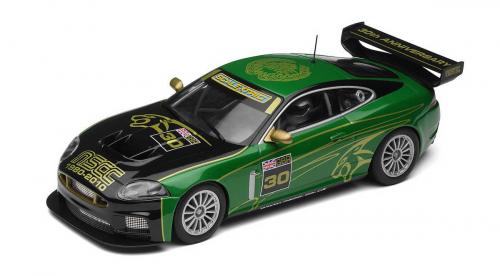
This was celebrated in 2010 and the club produced a very nice commemorative Jaguar in a special box with a booklet detailing previous club cars. I believe this was the point when the error over the club’s formation date happened. As I said at the beginning of this history the club was actually formed in January 1981 so although 2010 was the 30th year of its existence the actual birthday would not occur till January 2011. When the car was commissioned someone confused these two things and the wrong date was put on its nose. Prior to the release of this car a formation date of 1980 had never been mentioned in any club literature and the 25th anniversary Minis of 2005 had no reference to it either. The error has been perpetuated ever since.
 Membership decline and financial implications
By 2010 the influence of Facebook was really starting to be felt and a long term slow decline in membership took hold. This was not uncommon amongst enthusiasts clubs of all kinds and slot forums also began to suffer a reversal of fortunes as people departed for this brave new world. New members were still being recruited but not enough to balance those who left for the dubious short term delights of social media. By the end of the decade membership levels were less than half of those achieved at its peak although the associated NSCC Facebook group currently has over 3000 members.
‘Likes’ and ‘shares’ don’t pay the bills though and printing/postal charges for the magazine began to seriously outweigh the receipts from annual membership fees. Costs incurred in supporting the UKSF were also a drain on the funds. By 2012 the once healthy bank balance was seriously depleted and the club became unable to finance the purchase of club cars upfront and, for the first time in many years, advance payment from members became necessary.
In order to control costs the number of pages in the journal were restricted to keep the weight down so that it would normally qualify for ‘small letter’ rate and it was sent out second class instead of first. It remains excellent value though at less than £3.00 (including postage) per issue.
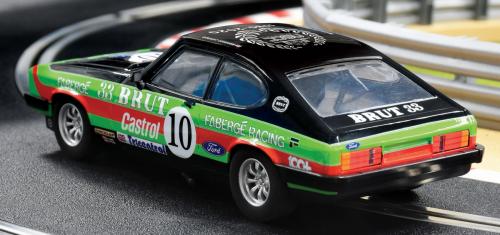
The production of limited edition club cars was also stepped up considerably. Previously they had only appeared at irregular intervals but were now an annual occurrence and each swapmeet also had its own one which was only available to members who actually attended the event. Special event cars were also produced for the UKSF each year. To some extent this has devalued the rarity value of the club cars but it helped to balance the finances and it has remained a significant source of the club’s income ever since.
This is the latest one:
Membership decline and financial implications
By 2010 the influence of Facebook was really starting to be felt and a long term slow decline in membership took hold. This was not uncommon amongst enthusiasts clubs of all kinds and slot forums also began to suffer a reversal of fortunes as people departed for this brave new world. New members were still being recruited but not enough to balance those who left for the dubious short term delights of social media. By the end of the decade membership levels were less than half of those achieved at its peak although the associated NSCC Facebook group currently has over 3000 members.
‘Likes’ and ‘shares’ don’t pay the bills though and printing/postal charges for the magazine began to seriously outweigh the receipts from annual membership fees. Costs incurred in supporting the UKSF were also a drain on the funds. By 2012 the once healthy bank balance was seriously depleted and the club became unable to finance the purchase of club cars upfront and, for the first time in many years, advance payment from members became necessary.
In order to control costs the number of pages in the journal were restricted to keep the weight down so that it would normally qualify for ‘small letter’ rate and it was sent out second class instead of first. It remains excellent value though at less than £3.00 (including postage) per issue.
The production of limited edition club cars was also stepped up considerably. Previously they had only appeared at irregular intervals but were now an annual occurrence and each swapmeet also had its own one which was only available to members who actually attended the event. Special event cars were also produced for the UKSF each year. To some extent this has devalued the rarity value of the club cars but it helped to balance the finances and it has remained a significant source of the club’s income ever since.
This is the latest one:
 New swapmeet
During this period there were occasional abortive attempts to revive some of the older swapmeets, such as Eastleigh which ran for a few years. In 2011 the Northern Swapmeet was reintroduced, initially held in Ossett, near Wakefield. It proved successful and is now a firm fixture on the calendar with subsequent events taking place in Leeds. Both this and the Milton Keynes swapmeet are run entirely by the NSCC committee and any profits provide a boost to the club funds.
Current position
As the decade draws to a close the club is still here and providing benefits for its members just as it has always done. For just £35 per year they get an excellent monthly magazine, free access to two swapmeets, an opportunity to attend the social weekend at Ramsgate and a regular supply of exclusive cars. The club still has unrivalled access to Scalextric management with the most comprehensive reports on the brand in the magazine that you will find anywhere. A major unsung benefit of club membership is the opportunity to meet and make friends with fellow enthusiasts at the various functions which it organises and the shallow, ephemeral world of social media can never replace that. Former committee member, Rob Smith summed it up when he told me: “The best thing about the NSCC is the sheer number of people I have met over the years, some of whom I even like!”
The future? 2021…………
Will the NSCC still be around in ten years’ time and celebrating its 50th anniversary? I sincerely hope so as it has given its members an immense amount of pleasure over the years and has been a prime source of innovation in the slot car world as I hope this history has shown. Without its influence we may not have had the rich variety of events and suppliers we enjoy now.
Much depends on the willingness of an upcoming generation to take over its running when the present committee reaches its sell by date. Throughout its history it has always been a struggle to find fresh committee members and especially a new magazine editor when one retires. Jeremy will step down at some point and that will be crunch time because the club would struggle to survive without a magazine and Facebook will have taken over the world!
And Finally……..
Whatever the future may bring the NSCC can be justifiably proud of its achievements. Its past membership list reads like a who’s who of the slot car world and it has been responsible for the birth of swapmeets, exclusive club cars, two of the biggest UK slot car suppliers and the Slot Festival. Not at all bad for a small club that stems from one man and his Scalextric track in that Wood Green ballroom some 44 years ago!
Photos used in this history ©NSCC. My thanks to Jeremy Naylor and the club for their help in its compilation.
Comments, criticisms and corrections of any errors all welcome.
New swapmeet
During this period there were occasional abortive attempts to revive some of the older swapmeets, such as Eastleigh which ran for a few years. In 2011 the Northern Swapmeet was reintroduced, initially held in Ossett, near Wakefield. It proved successful and is now a firm fixture on the calendar with subsequent events taking place in Leeds. Both this and the Milton Keynes swapmeet are run entirely by the NSCC committee and any profits provide a boost to the club funds.
Current position
As the decade draws to a close the club is still here and providing benefits for its members just as it has always done. For just £35 per year they get an excellent monthly magazine, free access to two swapmeets, an opportunity to attend the social weekend at Ramsgate and a regular supply of exclusive cars. The club still has unrivalled access to Scalextric management with the most comprehensive reports on the brand in the magazine that you will find anywhere. A major unsung benefit of club membership is the opportunity to meet and make friends with fellow enthusiasts at the various functions which it organises and the shallow, ephemeral world of social media can never replace that. Former committee member, Rob Smith summed it up when he told me: “The best thing about the NSCC is the sheer number of people I have met over the years, some of whom I even like!”
The future? 2021…………
Will the NSCC still be around in ten years’ time and celebrating its 50th anniversary? I sincerely hope so as it has given its members an immense amount of pleasure over the years and has been a prime source of innovation in the slot car world as I hope this history has shown. Without its influence we may not have had the rich variety of events and suppliers we enjoy now.
Much depends on the willingness of an upcoming generation to take over its running when the present committee reaches its sell by date. Throughout its history it has always been a struggle to find fresh committee members and especially a new magazine editor when one retires. Jeremy will step down at some point and that will be crunch time because the club would struggle to survive without a magazine and Facebook will have taken over the world!
And Finally……..
Whatever the future may bring the NSCC can be justifiably proud of its achievements. Its past membership list reads like a who’s who of the slot car world and it has been responsible for the birth of swapmeets, exclusive club cars, two of the biggest UK slot car suppliers and the Slot Festival. Not at all bad for a small club that stems from one man and his Scalextric track in that Wood Green ballroom some 44 years ago!
Photos used in this history ©NSCC. My thanks to Jeremy Naylor and the club for their help in its compilation.
Comments, criticisms and corrections of any errors all welcome.
Posts: 2,355
Threads: 106
Likes Received: 2,443 in 1,147 posts
Likes Given: 7,771
Joined: Mar 2019
Location Farlington, North Yorkshire, UK
Posts: 2,054
Threads: 131
Likes Received: 3,410 in 1,389 posts
Likes Given: 3,125
Joined: Sep 2020
Location A small igloo in Canada
Brian. Thank you very kindly. Cool read for newbies.


![[+]](https://slotracer.online/community/images/bootbb/collapse_collapsed.png)


